Rafah Border Crossing Closure and Gaza Humanitarian Crisis
Source:Indian Express ↗
Why It Matters
Understanding the strategic control of border crossings like Rafah and Kerem Shalom is vital for analyzing the Israel-Palestine conflict. It illustrates how humanitarian aid and geographic choke points are weaponized in international conflicts, aligning with UPSC's focus on West Asia geopolitics and international organizations' (like the WFP) operational challenges.
Summary
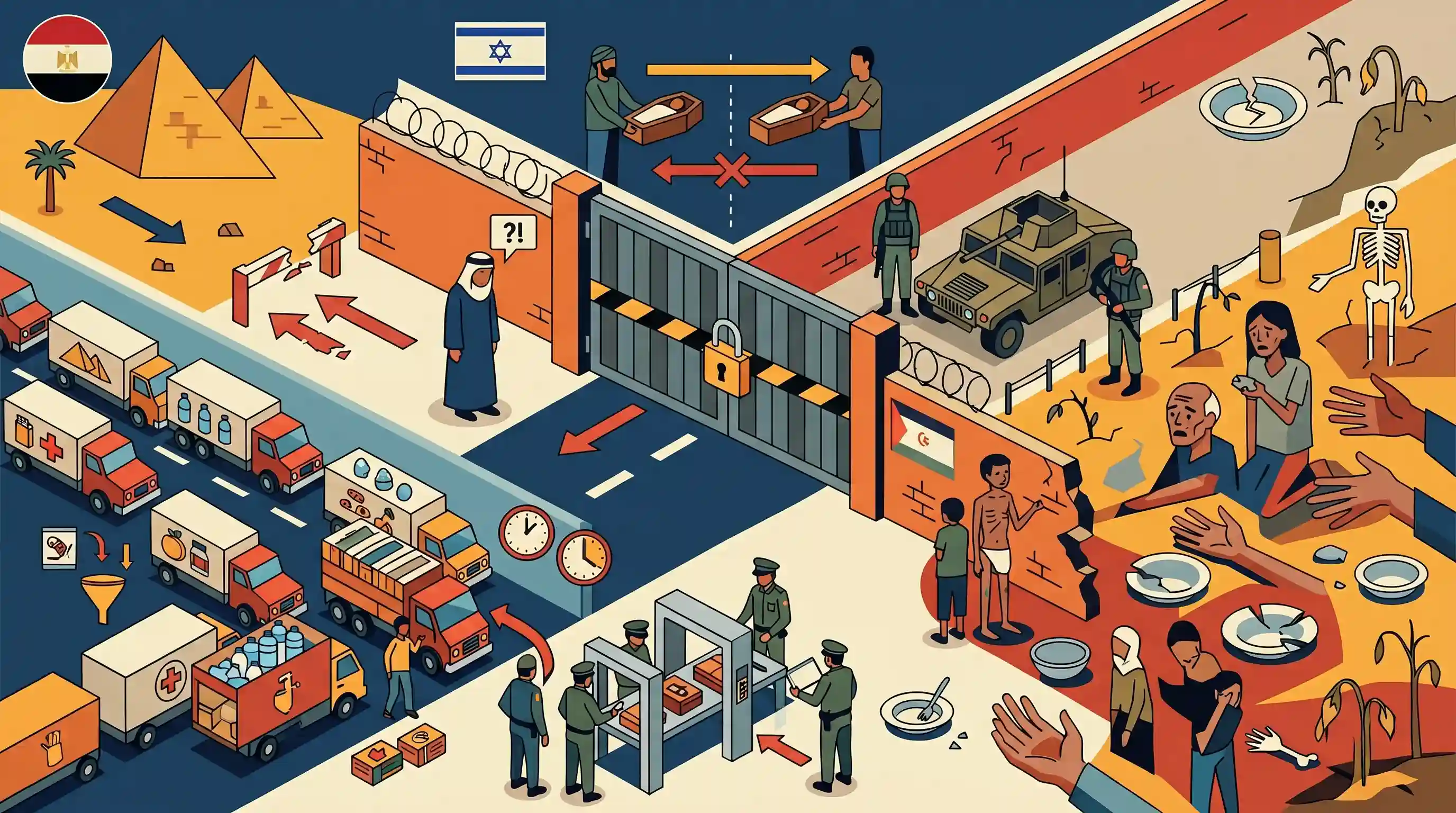
Israel has confirmed that the Rafah border crossing into Egypt will remain closed, contradicting a prior announcement by the Palestinian embassy in Cairo that it would reopen for aid and stranded individuals. Israel maintains that the crossing will only open once Hamas fulfills its obligations under the recent ceasefire agreement, specifically the return of deceased Israeli hostages. Since Israel seized the Gaza side of the Rafah crossing in May 2024, the primary route for international aid has shifted to the Kerem Shalom crossing. However, rigorous Israeli security inspections there have severely bottlenecked the flow of supplies, exacerbating acute famine conditions and worsening the humanitarian crisis in the Gaza Strip.
Key Points
- Israel contradicted the Palestinian embassy's announcement that the Rafah crossing to Egypt would reopen, stating it will remain closed.
- Israel demands that Hamas fulfill its commitments under the recent hostage deal, specifically returning deceased Israeli hostages, before opening the crossing.
- The Rafah crossing has been under Israeli control and largely closed since May 2024, cutting off a major artery for people and goods.
- Humanitarian aid is currently diverted to the Kerem Shalom crossing, where stringent Israeli inspections severely bottleneck the volume of relief reaching Gaza, worsening famine conditions.
Important Terms
Rafah Crossing

The southernmost border crossing connecting the Gaza Strip to Egypt's Sinai Peninsula; it is the only land passage from Gaza not leading into Israel.
UPSC context
GS Paper 1 (Geography) and GS Paper 2 (IR); frequently tested under 'Places in News' for its strategic humanitarian role.
Kerem Shalom Crossing
A commercial junction located at the intersection of Israel, Gaza, and Egypt borders; currently the primary, though bottlenecked, route for humanitarian aid into Gaza.
UPSC context
GS Paper 2 (International Relations); significant for understanding the logistical challenges and security protocols in conflict-driven humanitarian crises.
Hamas
A Palestinian Islamist political and militant organization that has governed the Gaza Strip since 2007; designated as a terrorist group by several Western nations.
UPSC context
GS Paper 2 (International Relations); tests knowledge of non-state actors and their role in West Asian geopolitics.
World Food Programme (WFP)
The United Nations' food-assistance branch and the world's largest humanitarian organization focused on hunger, nutrition, and food security in conflict zones.
UPSC context
GS Paper 2 (International Organizations); relevant for questions on global food security, humanitarian aid, and UN agency functions.
Gaza Strip
A narrow Palestinian coastal enclave on the Mediterranean Sea, bordered by Israel and Egypt, central to the ongoing Israel-Palestine territorial and political conflict.
UPSC context
GS Paper 1 (World Geography) and GS Paper 2 (IR); critical for map-based questions and regional stability analysis.
Prelims Trap
Rafah crossing is the primary border gateway connecting the Gaza Strip directly to Israel.
Rafah exclusively connects the Gaza Strip to Egypt's Sinai Peninsula. It is the only terrestrial exit from Gaza that does NOT directly lead into Israel.
Static Concepts Connected
What are the key border crossings and buffer zones of the Gaza Strip?
- Rafah Crossing: The sole exit connecting Gaza to Egypt (Sinai Peninsula); the only exit not leading into Israel.
- Kerem Shalom: A commercial crossing located precisely at the tri-junction of the Gaza Strip, Israel, and Egypt.
- Erez Crossing: The northern gateway primarily used for pedestrian and diplomatic movement between Gaza and Israel.
- Philadelphi Corridor: A strategic 14km demilitarized buffer strip running along the entire Gaza-Egypt border, originally established to prevent smuggling.
How does International Humanitarian Law (IHL) regulate aid access during conflicts?
- Fourth Geneva Convention: Obligates an occupying power to ensure the food and medical supplies of the civilian population to the fullest extent of the means available to it.
- Customary IHL: Requires parties to the conflict to allow and facilitate rapid and unimpeded passage of impartial humanitarian relief for civilians.
- Rome Statute (ICC): Classifies the intentional starvation of civilians, including willfully impeding relief supplies, as a prosecutable war crime.
Cross-Topic Patterns
ICJ rulings and humanitarian access
The deliberate restriction of aid via Rafah forms the crux of the ongoing legal proceedings initiated by South Africa at the International Court of Justice (ICJ) regarding obligations under the Genocide Convention.
Weaponization of geographic choke points
Similar to the Black Sea grain blockade or Red Sea maritime attacks, blocking terrestrial aid routes demonstrates the modern warfare trend of weaponizing geographic choke points for geopolitical leverage.

Match-the-following pairs featuring Gaza's crossings (Rafah, Kerem Shalom, Erez) and their adjoining borders are highly likely in Prelims.
Linked PYQs · 5
Linked PYQs · 5
- 2023PrelimsGS1
Consider the following statements: Statement-I: Israel has established diplomatic relations with some Arab States. Statement-II: The 'Arab Peace Initiative' mediated by Saudi Arabia was signed by Israel and Arab League. Which one of the following is correct in respect of the above statements?
- 2022PrelimsGS1
The term "Levant" often heard in the news roughly corresponds to which of the following regions?
- 2015PrelimsGS1
The area known as 'Golan Heights' sometimes appears in the news in the context of the events related to
- 2018MainsGS2
“India’s relations with Israel have, of late, acquired a depth and diversity, which cannot be rolled back.” Discuss.
- 2011MainsGS2
Write a short note on the World Food Programme (WFP) of the United Nations (UN).
