US-Israel Coordination on Iran Nuclear Negotiations
Source:The Hindu ↗
Why It Matters
The geopolitical stability of West Asia is intimately tied to India's energy security, trade routes, and the safety of its large diaspora. The evolving dynamics between the US, Israel, and Iran over nuclear proliferation and proxy warfare directly influence regional peace and global energy markets.
Summary
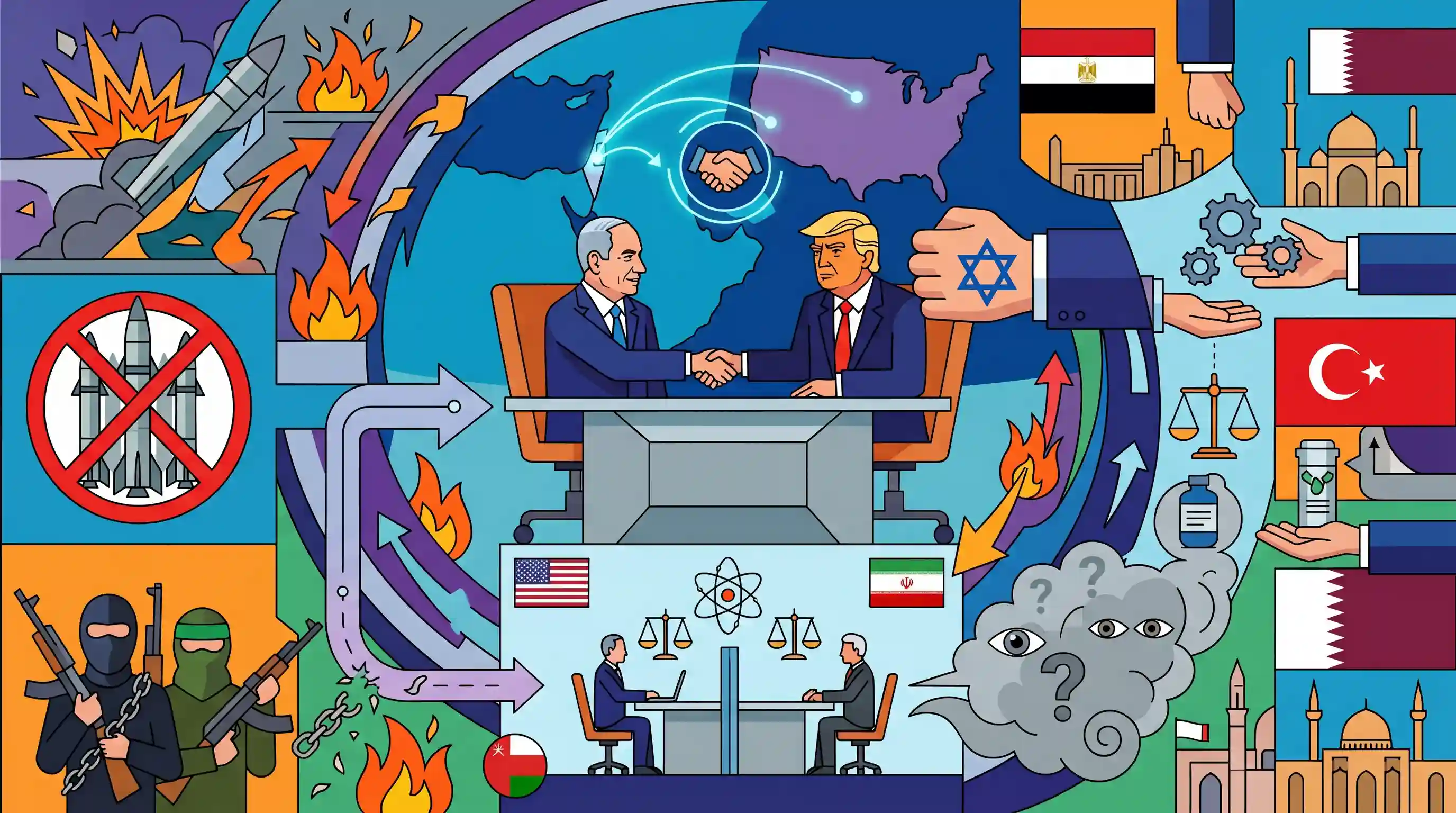
Israeli Prime Minister Benjamin Netanyahu will meet with US President Donald Trump to coordinate stances on the recent indirect nuclear talks between the US and Iran in Oman. Israel is pressuring the US to ensure any deal restricts Iran's ballistic missile capabilities and cuts off support for proxy militant groups like Hamas and Hezbollah. The negotiations are unfolding in a highly volatile geopolitical environment, marked by recent military conflicts, deep Iranian distrust of US intentions, and proposed compromises from regional actors like Egypt, Turkey, and Qatar regarding Iran's uranium enrichment.
Key Points
- Israeli PM Benjamin Netanyahu is scheduled to meet US President Donald Trump to discuss the ongoing indirect US-Iran nuclear negotiations taking place in Oman.
- Israel insists that any potential agreement must restrict Iran's ballistic missile program and end its backing of the 'Iranian axis', which includes militant groups like Hezbollah and Hamas.
- Following previous US strikes on Iranian nuclear sites during a recent 12-day Israel-Iran conflict, Iran expressed deep distrust and warned of retaliatory strikes on US regional bases if attacked again.
- A regional compromise proposed by Egypt, Turkey, and Qatar suggests Iran halt uranium enrichment for three years, export its highly enriched uranium, and commit to not initiating the use of ballistic missiles.
- The US diplomatic presence, featuring envoys Steve Witkoff and Jared Kushner alongside US Central Command head Brad Cooper, underscores a blend of diplomatic negotiation and military readiness.
Important Terms
Hezbollah

A Lebanese Shia Islamist political party and militant group backed by Iran; it functions as a "state within a state" and opposes Israeli influence.
UPSC context
GS-II (International Relations); critical for understanding West Asia power dynamics, proxy warfare, and regional stability impacting Indian energy security.
Hamas
A Palestinian Sunni Islamist organization that has governed the Gaza Strip since 2007; it is a primary actor in the Israel-Palestine conflict.
UPSC context
GS-II (International Relations); central to Middle East geopolitics and India's strategic balancing in the Israel-Palestine issue.
JCPOA (Joint Comprehensive Plan of Action)
The 2015 landmark agreement between Iran and world powers (P5+1) to restrict Iran’s nuclear program in exchange for lifting international economic sanctions.
UPSC context
GS-II (Bilateral and Global Agreements); essential for India’s oil security and strategic connectivity via the Chabahar Port.
Uranium Enrichment
The process of increasing the percentage of the fissile isotope Uranium-235 to create nuclear fuel or, at high levels (90%+), weapons-grade material.
UPSC context
GS-III (Science & Technology/Security); core to nuclear non-proliferation, IAEA safeguards, and global security standards.
US Central Command (CENTCOM)
A unified combatant command of the U.S. Department of Defense responsible for military operations and security in the Middle East and Central Asia.
UPSC context
GS-II (International Relations/Security); key for understanding US strategic footprint and defense cooperation in India’s extended neighborhood.
Prelims Trap
Highly Enriched Uranium (HEU) is synonymous with weapons-grade uranium.
HEU refers to any uranium enriched to 20% or more U-235. Weapons-grade uranium is a specific subset requiring 90%+ enrichment. Thus, not all HEU is weapons-grade.
Static Concepts Connected
What are the different grades of Uranium enrichment?
- Natural Uranium: Mined uranium contains approximately 0.7% of the fissile U-235 isotope, requiring processing for most reactors.
- LEU: Low-Enriched Uranium (3-5% U-235) is the standard fuel used in commercial light water nuclear power reactors.
- HEU: Highly-Enriched Uranium (20% or more U-235) is primarily utilized in research reactors and naval propulsion systems.
- Weapons-Grade: A highly concentrated subset of HEU, enriched to 90% or higher U-235, which is necessary to construct nuclear warheads.
Why is Oman geographically and diplomatically critical for India?
- Strategic Neutrality: Follows an Ibadhi-driven non-interventionist foreign policy, earning the moniker 'Switzerland of West Asia' for its reliable conflict mediation.
- Maritime Chokepoint: Shares territorial control of the strategic Strait of Hormuz with Iran, a critical chokepoint for India's crude oil imports.
- Naval Access: As India's oldest strategic partner in the Gulf, Oman provides critical logistical and berthing facilities to the Indian Navy at the Port of Duqm.
Cross-Topic Patterns
Chabahar Port + US Sanctions
Renewed US-Iran hostility and potential sanctions directly threaten India's strategic investments in Iran's Chabahar Port and the broader International North-South Transport Corridor (INSTC) connectivity to Central Asia.
Intra-regional Middle Power Diplomacy
The joint proposal by Egypt, Turkey, and Qatar highlights a multipolar shift in West Asia, where middle powers are actively shaping intra-regional security architectures rather than relying exclusively on US mediation.

Expect a Prelims question pairing uranium enrichment thresholds (LEU vs HEU) with Oman’s geographical control over the Strait of Hormuz.
Linked PYQs · 3
Linked PYQs · 3
- 2018MainsGS2
In what ways would the ongoing US-Iran Nuclear Pact Controversy affect the national interest of India? How should India respond to this situation?
- 2018MainsGS2
“India’s relations with Israel have, of late, acquired a depth and diversity, which cannot be rolled back.” Discuss.
- 2025MainsGS2
"Energy security constitutes the dominant kingpin of India's foreign policy, and is linked with India's overarching influence in Middle Eastern countries.” How would you integrate energy security with India's foreign policy trajectories in the coming years?
