Netanyahu to meet Trump to coordinate stance on Iran nuclear talks
Source:The Hindu ↗
Why It Matters
The evolving US-Iran nuclear negotiations and Israel's security demands directly impact the stability of West Asia (Middle East), a region critical to India's energy security, diaspora, and trade. For UPSC aspirants, this highlights the complexities of non-proliferation, proxy warfare, and great power diplomacy in a volatile geography.
Summary
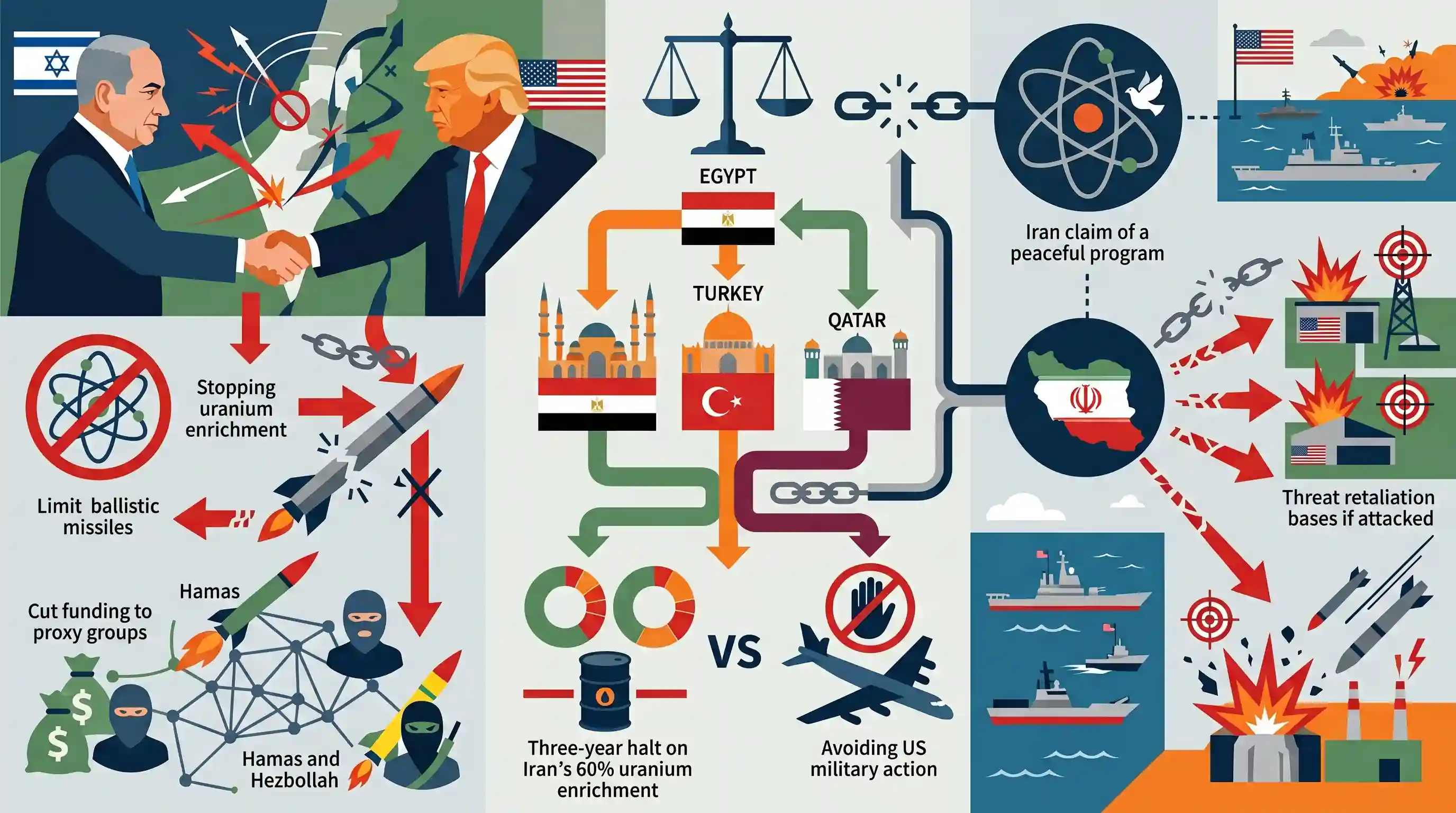
Israeli Prime Minister Benjamin Netanyahu plans to meet US President Donald Trump to coordinate stances on indirect US-Iran nuclear negotiations taking place in Oman. A proposal mediated by Egypt, Turkey, and Qatar suggests a three-year halt on Iran's 60% uranium enrichment in exchange for averting US military action. While the US and regional mediators aim for a limited nuclear freeze, Israel insists that any agreement must also curtail Iran's ballistic missile program and its funding for proxy groups like Hamas and Hezbollah. Meanwhile, Iran has warned of striking US bases in the region if attacked, maintaining that its nuclear program is peaceful and blaming Israel for regional instability. The talks follow recent military escalations, including US strikes on Iranian nuclear sites and the deployment of American naval assets to the Middle East.
Key Points
- Israeli PM Benjamin Netanyahu is scheduled to meet US President Donald Trump to discuss ongoing indirect US-Iran negotiations hosted in Oman regarding Iran's nuclear program.
- Regional diplomats from Egypt, Turkey, and Qatar have proposed a short-term deal where Iran halts 60% uranium enrichment for three years, exports highly enriched stockpiles, and pledges not to initiate ballistic missile attacks.
- Netanyahu demands that any US-Iran agreement must also encompass limitations on Iran's ballistic missile capabilities and terminate its support for the 'Axis of Resistance', including Hezbollah and Hamas.
- Iranian Foreign Minister Abbas Araghchi threatened retaliation against US military bases in the region if attacked, blaming Israeli actions against Palestinians and regional neighbors for the broader instability.
- The geopolitical tension follows a brief June conflict between Israel and Iran, which included US military involvement (CENTCOM) and strikes on Iranian nuclear sites.
Important Terms
Joint Comprehensive Plan of Action (JCPOA)

A 2015 multilateral agreement between Iran and the P5+1 (permanent UN Security Council members plus Germany) to limit Iran's nuclear activities in exchange for the lifting of economic sanctions.
UPSC context
GS Paper II: Bilateral and regional agreements. Essential for understanding West Asian geopolitics and nuclear non-proliferation frameworks.
Uranium Enrichment (60% Threshold)
The process of increasing the concentration of fissile U-235. While 3-5% enrichment suffices for nuclear power, 60% is a critical technical threshold approaching the 90% required for weapons-grade material.
UPSC context
GS Paper III: Science & Technology and Security. Tests knowledge of nuclear technology and the "breakout time" concept in international security.
Hamas
A Palestinian Islamist militant and political group that has governed the Gaza Strip since 2007. It is part of the Iran-backed "Axis of Resistance" and refuses to recognize Israel.
UPSC context
GS Paper II: International Relations. Focuses on regional conflicts, non-state actors, and their impact on West Asian stability.
Hezbollah
A powerful Shia militant organization and political party in Lebanon, established with Iranian support. It acts as a primary regional proxy against Israel and Western influence.
UPSC context
GS Paper II: International Relations. Relevant for studying proxy warfare, regional security architecture, and Lebanon's political stability.
CENTCOM (US Central Command)
A U.S. Department of Defense combatant command responsible for military operations in the Middle East, Central Asia, and parts of South Asia. It coordinates defense cooperation with regional partners.
UPSC context
GS Paper II: Global Groupings affecting India's interests. Tests awareness of major foreign military frameworks in India's extended neighborhood.
Oman (as Mediator)
A neutral Arab sultanate that frequently serves as a diplomatic back-channel and mediator for indirect negotiations between the United States and Iran regarding nuclear and regional security issues.
UPSC context
GS Paper II: International Relations. Illustrates the role of regional balancers and diplomacy in resolving long-standing international disputes.
Prelims Trap
Uranium enriched to 60% by Iran is considered weapons-grade and ready for immediate deployment in nuclear warheads.
Weapons-grade uranium requires roughly 90% enrichment of the U-235 isotope. 60% is highly enriched and a technical stepping stone, but it is not weapons-grade.
Static Concepts Connected
What are the distinct grades of Uranium enrichment?
- Natural Uranium: Contains roughly 0.7% of the fissile U-235 isotope, with the remainder being mostly U-238.
- Low Enriched (LEU): Enriched to about 3-5% U-235; primarily utilized as fuel in standard civilian nuclear power reactors.
- Weapons-Grade: Highly Enriched Uranium (HEU) that reaches approximately 90% U-235, which is necessary for constructing nuclear warheads.
What constitutes the 'Levant' and the 'Axis of Resistance' in West Asia?
- The Levant: A historical geographic term referring to the eastern Mediterranean region, encompassing modern-day Israel, Lebanon, Syria, Jordan, and Palestine.
- Axis of Resistance: An informal political-military coalition of state (Iran) and non-state actors (Hezbollah, Hamas, Houthis) opposing US and Israeli regional influence.
Cross-Topic Patterns
Chabahar Port + US Sanctions
A breakdown in US-Iran talks often triggers tighter US sanctions, directly complicating India's operational timeline for the Chabahar port and the broader International North-South Transport Corridor (INSTC).
Nuclear Diplomacy + Strait of Hormuz
Oman's neutral mediation underscores its strategic leverage over the Strait of Hormuz, a critical maritime chokepoint that directly determines India's crude oil supply stability and diaspora safety.

Expect a 2026 Prelims question mixing West Asia geography (Oman, Levant) with nuclear tech (Uranium-235 enrichment thresholds).
Linked PYQs · 5
Linked PYQs · 5
- 2018MainsGS2
In what ways would the ongoing US-Iran Nuclear Pact Controversy affect the national interest of India? How should India respond to this situation?
- 2012MainsGS2
How have the US sanctions against Iran affected India's bilateral relations with Iran?
- 2018MainsGS2
“India’s relations with Israel have, of late, acquired a depth and diversity, which cannot be rolled back.” Discuss.
- 2015PrelimsGS1
The area known as 'Golan Heights' sometimes appears in the news in the context of the events related to
- 2022PrelimsGS1
The term "Levant" often heard in the news roughly corresponds to which of the following regions?
