Gaza Disarmament and Middle East Peace Proposals
Source:The Hindu ↗
Why It Matters
The Israel-Palestine conflict and broader Middle East stability remain critical areas in international relations, significantly impacting global energy security and geopolitical alignments. Understanding the positions of various state and non-state actors is essential for answering questions on regional conflicts, peace processes, and India's diplomatic balancing act in West Asia.
Summary
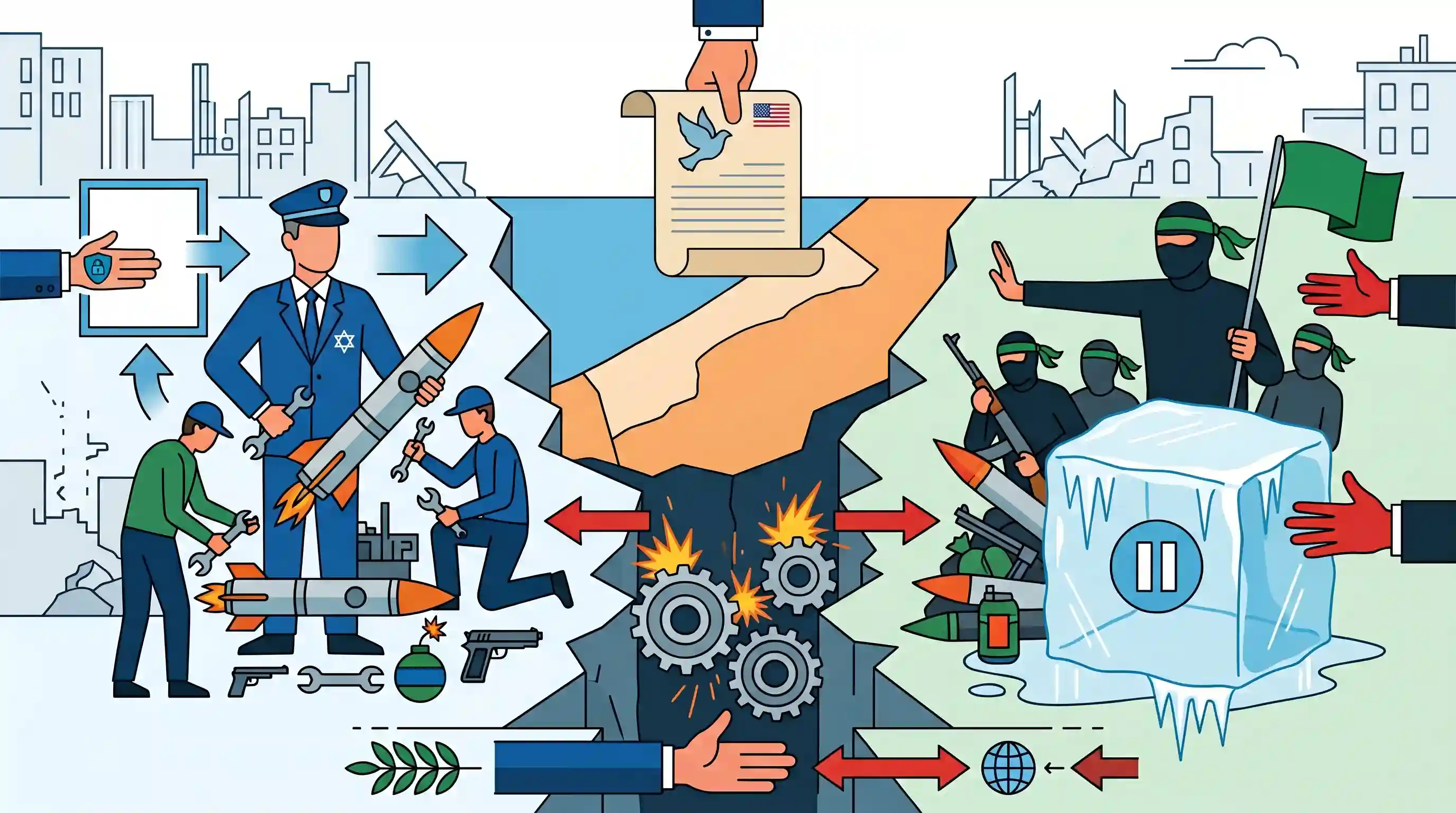
Tensions over the implementation of a U.S.-sponsored peace plan for Gaza persist as Israel demands the full disarmament of Hamas. While Hamas, through leader Khaled Meshaal, has offered a weapons "freeze," it firmly rejects total demilitarisation. Israeli officials remain resolute that under the 20-point plan, Gaza must be demilitarised and Hamas's armed wing dismantled, underscoring the deep fundamental differences stalling a permanent peace settlement in the region.
Key Points
- Israel has declared that Hamas will be fully disarmed as part of a U.S.-sponsored 20-point peace plan for Gaza.
- The plan, backed by U.S. President Donald Trump, stipulates the demilitarisation of Gaza and envisions no future role for Hamas as an armed entity.
- Hamas leader Khaled Meshaal has proposed a weapons 'freeze' rather than full disarmament, leading to a deadlock over the terms of the peace settlement.
Important Terms
20-point U.S.-sponsored peace plan

A multilateral framework (2025) proposed by Donald Trump to end the Gaza war, involving a staged ceasefire, hostage release, demilitarization, and a technocratic transition to Palestinian governance.
UPSC context
Relevant for GS Paper II: International Relations. Tests understanding of West Asian geopolitics, peace diplomacy, and the impact of U.S. foreign policy on regional stability.
Hamas
A Palestinian Sunni-Islamic fundamentalist, militant, and political organization that governed Gaza since 2007. It is currently negotiating terms for its political survival and disarmament under international pressure.
UPSC context
Significant for GS II: Non-state actors in international relations. Tests knowledge of Middle Eastern conflict dynamics and their implications for global security and Indian interests.
National Committee for the Administration of Gaza (NCAG)
A proposed 15-person governing body of Palestinian technocrats tasked with managing Gaza's day-to-day administration and security during the transitional phase of the peace plan.
UPSC context
Relevant for GS II: Global governance structures. Analyzes the role of transitional authorities in post-conflict reconstruction and state-building.
International Stabilization Force (ISF)
A multinational security body proposed to train Palestinian police and secure Gaza's borders, intended to replace Israeli military presence as demilitarization milestones are achieved.
UPSC context
Important for GS II: International agreements. Examines multilateral security cooperation and the challenges of peacekeeping in volatile conflict zones.
Phase II (Gaza Peace Plan)
The transitional stage of the Gaza peace plan focusing on the demilitarization of militant groups, Israeli withdrawal, and the establishment of technocratic governance and reconstruction.
UPSC context
Tests GS II analytical skills: Deconstructing complex international peace processes and evaluating the hurdles to regional demilitarization.
Weapons Freeze
A Hamas counter-proposal to store or "freeze" its weapons under mediator oversight for a set period (5-10 years) instead of permanent disarmament and dismantling.
UPSC context
Relevant for GS II: Security studies. Evaluates the strategies of non-state actors in negotiation processes and the concept of "resistance" versus demilitarization.
Prelims Trap
The 20-point peace plan mandating Gaza's demilitarisation is a legally binding United Nations Security Council resolution.
The 20-point plan is a U.S.-sponsored proposal, not a UN-mandated resolution. UPSC often swaps the sponsor/originator of international peace plans to confuse aspirants.
Static Concepts Connected
What is India's 'De-hyphenation' policy regarding Israel and Palestine?
- Independent Tracks: Managing bilateral relations with Israel and Palestine separately, ensuring ties with one do not mutually constrain ties with the other.
- Two-State Solution: Despite deepening defence and technological ties with Israel, India maintains steadfast diplomatic support for a sovereign, independent State of Palestine.
What were the 1993 Oslo Accords?
- Mutual Recognition: A landmark agreement where the PLO recognized Israel's right to exist, and Israel recognized the PLO as the representative of the Palestinian people.
- Palestinian Authority: Established a framework for limited Palestinian self-governance in parts of the West Bank and Gaza Strip via the Palestinian Authority.
- Hamas Rejection: Hamas vehemently opposed the Accords due to its foundational ideology, which completely rejects the existence of the Israeli state.
Cross-Topic Patterns
Middle East Instability vs IMEC
Prolonged Gaza conflicts and stalled peace plans threaten the operationalization of the India-Middle East-Europe Economic Corridor (IMEC), showing how regional geopolitics stall geo-economics.
Red Sea Chokepoint Risks
Regional spillover from the Gaza peace deadlock heightens asymmetric warfare risks near Bab el-Mandeb (e.g., Houthi attacks), directly affecting global shipping and India's energy security.

Expect a 2026 mains question linking the failure of Middle East peace plans to the stalling of geo-economic corridors like IMEC.
Linked PYQs · 2
Linked PYQs · 2
- 2018MainsGS2
“India’s relations with Israel have, of late, acquired a depth and diversity, which cannot be rolled back.” Discuss.
- 2025MainsGS2
"Energy security constitutes the dominant kingpin of India's foreign policy, and is linked with India's overarching influence in Middle Eastern countries.” How would you integrate energy security with India's foreign policy trajectories in the coming years?
