Israel Stance on Hamas Disarmament and Gaza Truce Proposals
Source:The Hindu ↗
Why It Matters
The Israel-Palestine conflict and broader Middle Eastern geopolitics are frequent areas of focus in the UPSC exam (both Prelims map-based questions and Mains IR analysis). The role of non-state actors (like Hamas), international mediation efforts (like those by the U.S.), and the challenges of conflict resolution (disarmament vs. weapons freeze) form critical case studies for GS2 (IR) and GS3 (Security).
Summary
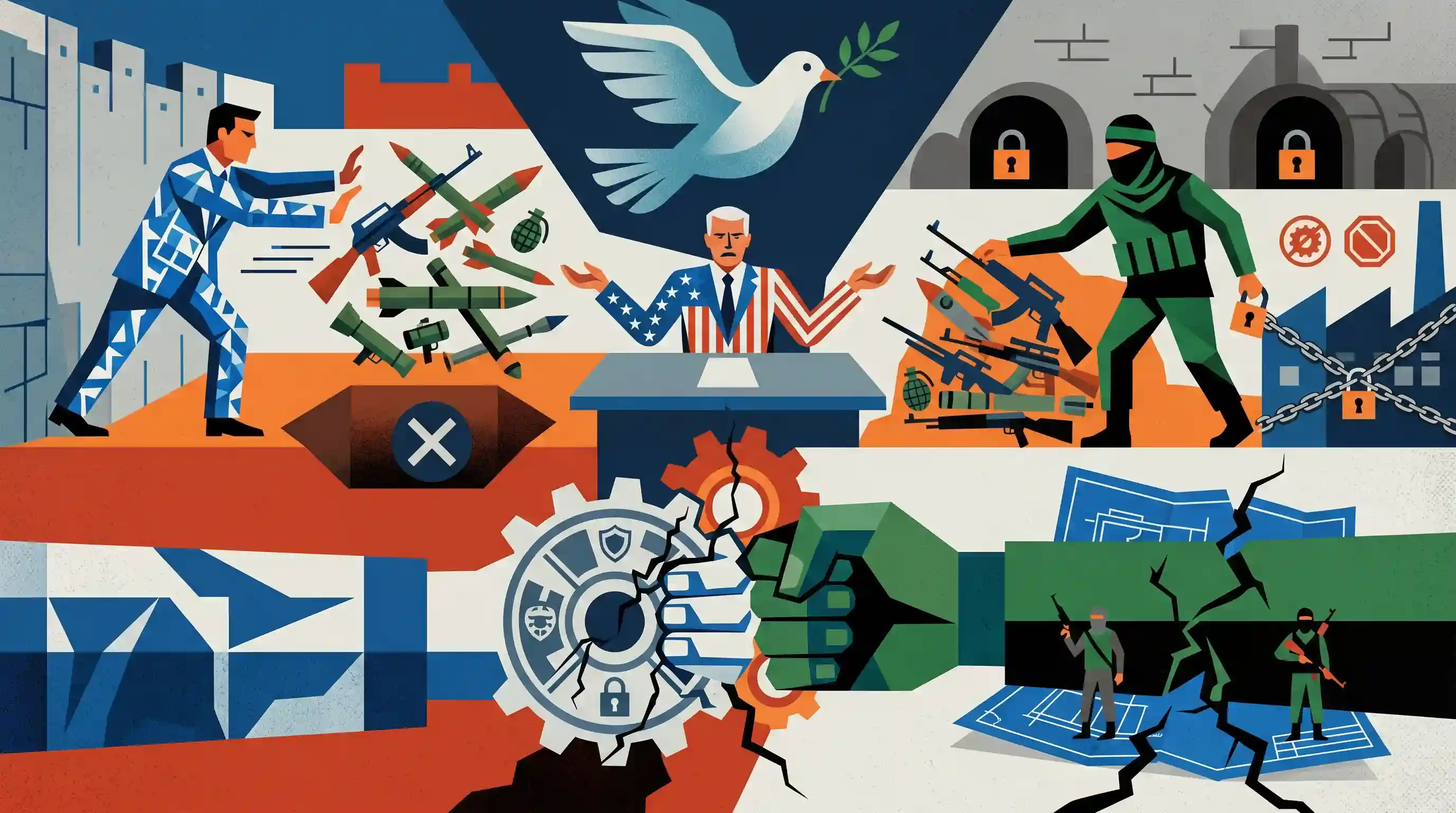
Amid ongoing Middle East peace negotiations under a U.S.-sponsored plan, Israel has maintained that Hamas must be completely disarmed in Gaza. This hardline stance comes after Hamas leader Khaled Meshaal proposed a "weapons freeze" while outright rejecting full demilitarization. The disagreement highlights a fundamental deadlock regarding the security frameworks and the existence of armed non-state actors in post-conflict Gaza.
Key Points
- Israel has insisted on the complete disarmament of Hamas as part of a U.S.-sponsored peace plan for Gaza.
- Hamas leader Khaled Meshaal proposed a "weapons freeze" but categorically rejected the condition of total disarmament.
- The standoff over the military capabilities of non-state actors remains a primary roadblock in finalizing ceasefire and peace agreements in the Israel-Palestine conflict.
Important Terms
Hamas

A Palestinian Sunni-Islamic fundamentalist organization that has governed the Gaza Strip since 2007. It is designated as a terrorist group by several nations and remains a primary party in the conflict with Israel.
UPSC context
GS Paper II: International Relations. Understanding West Asian geopolitics and the role of militant organizations in regional instability.
Demilitarization
The process of removing military forces, weaponry, or fortifications from a region, often as part of a peace treaty or security agreement to ensure stability and prevent renewed aggression.
UPSC context
GS Paper II: International Relations. Knowledge of conflict resolution mechanisms and security frameworks in post-war reconstruction.
Gaza Strip
A densely populated Palestinian enclave on the Mediterranean coast. Its political and security status is a core issue in Middle Eastern stability and international peace negotiations.
UPSC context
GS Paper II: International Relations. Crucial geographical area impacting global energy security and India's regional interests.
Non-State Actor
An individual or organization that has significant political influence but is not allied to any particular sovereign state, often used to describe militant groups, NGOs, or multinational corporations.
UPSC context
GS Paper III: Internal Security. Challenges posed by entities operating outside state control to national and global stability.
Two-State Solution
A proposed diplomatic framework to resolve the Israeli-Palestinian conflict by establishing an independent State of Palestine alongside Israel, aiming for peace based on secure and recognized borders.
UPSC context
GS Paper II: International Relations. Knowledge of India’s long-standing foreign policy stance on the West Asia peace process.
Prelims Trap
Hamas is the internationally recognized representative body that signed the Oslo Accords with Israel.
The Palestine Liberation Organization (PLO), not Hamas, signed the Oslo Accords and forms the Palestinian Authority. Hamas is a separate militant non-state actor governing Gaza.
Static Concepts Connected
What are the geographical boundaries and border crossings of the Gaza Strip?
- Southwest border: Shares a border with Egypt's Sinai Peninsula, featuring the critical Rafah border crossing.
- East and North: Borders Israel, heavily fortified with strictly controlled checkpoints like the Erez and Kerem Shalom crossings.
- Western coast: Bounded by the Mediterranean Sea, though its maritime space and fishing zones operate under strict Israeli blockade.
What defines India's de-hyphenation policy in West Asia?
- Standalone relations: India treats its bilateral ties with Israel and Palestine as mutually independent, not viewing one through the lens of the other.
- Strategic balance: Allows India to maintain robust defense and technological partnerships with Israel while continuing humanitarian and diplomatic support for Palestine.
- Diplomatic milestone: Clearly demonstrated when PM Modi conducted separate, independent state visits to Israel in 2017 and Palestine in 2018.
Cross-Topic Patterns
Role of Armed Non-State Actors
Hamas's standoff mirrors broader GS-3 internal security and IR themes where non-state actors (like Houthis or Hezbollah) utilize asymmetric warfare to derail state-led regional peace processes.
IMEEC and Regional Normalization
Prolonged deadlock over Gaza's security framework threatens broader geo-economic strategies like the India-Middle East-Europe Economic Corridor (IMEEC) and stalls the Abraham Accords normalization.

Expect a Prelims map question on the Levant or Gaza's borders, or a GS2 Mains question on India's de-hyphenation policy amidst crises.
Linked PYQs · 5
Linked PYQs · 5
- 2018MainsGS2
“India’s relations with Israel have, of late, acquired a depth and diversity, which cannot be rolled back.” Discuss.
- 2021MainsGS3
Analyse the multidimensional challenges posed by external state and non-state actors, to the internal security of India. Also discuss measures required to be taken to combat these threats.
- 2015PrelimsGS1
The area known as 'Golan Heights' sometimes appears in the news in the context of the events related to
- 2022PrelimsGS1
The term "Levant" often heard in the news roughly corresponds to which of the following regions?
- 2023PrelimsGS1
Consider the following pairs: Regions often mentioned in news Reason for being in news 1. North Kivu and Ituri : War between Armenia and Azerbaijan 2. Nagorno-Karabakh : Insurgency in Mozambique 3. Kherson and Zaporizhzhia : Dispute between Israel and Lebanon How many of the above pairs are correctly matched?
