Israel drafts ceasefire proposal ahead of US presidential talks
Source:The Hindu ↗
Why It Matters
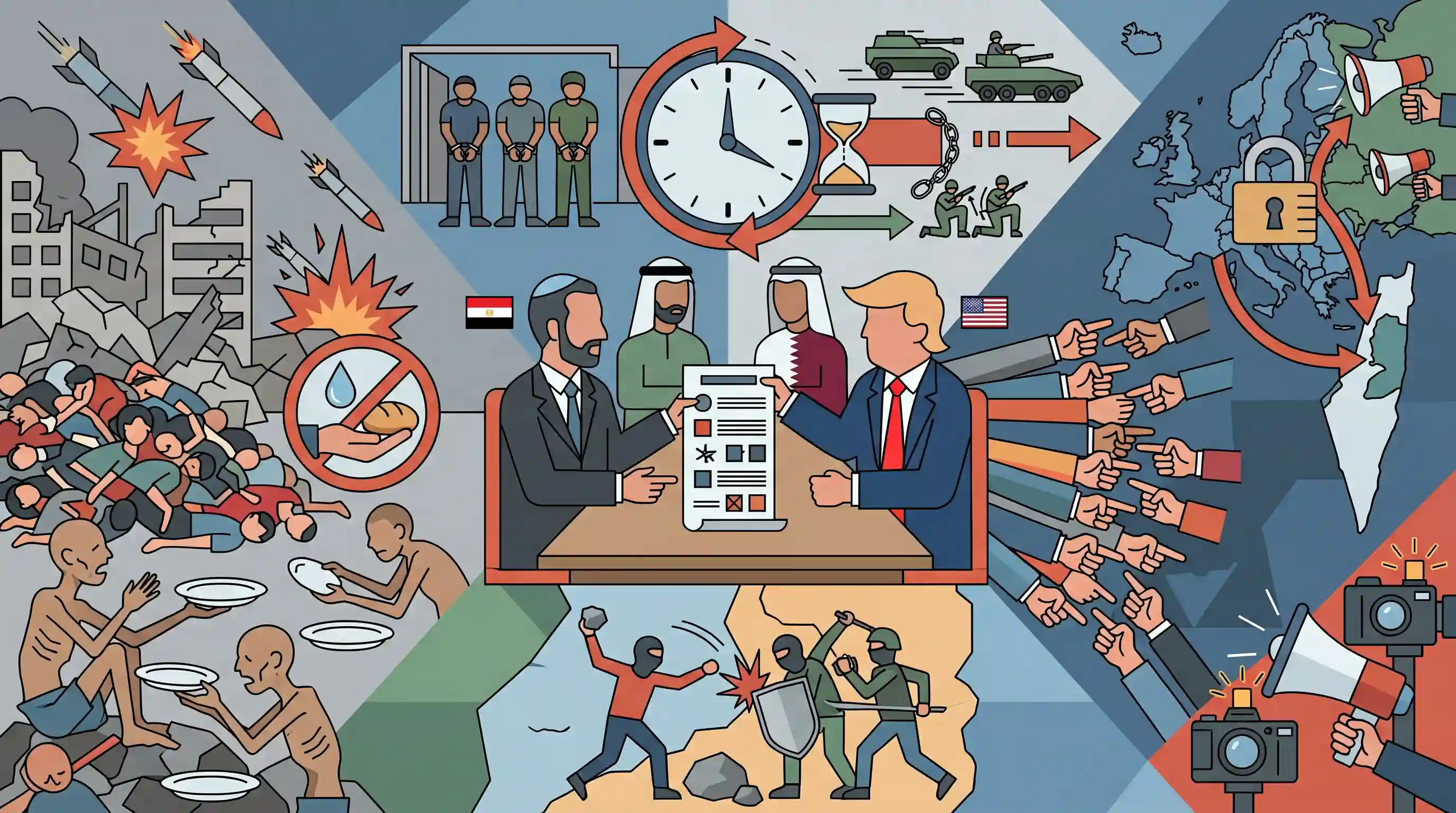
Demonstrates the complex dynamics of international diplomacy and conflict resolution in the Middle East, highlighting the critical role of US leadership and regional mediators (Qatar, Egypt). It is essential for understanding the geopolitical ramifications of the Israel-Hamas war, the humanitarian consequences of prolonged conflict, and the shifting stance of the international community (e.g., potential EU sanctions) toward Israeli policies.
Summary
Israeli Prime Minister Benjamin Netanyahu announced ongoing talks with U.S. President Donald Trump regarding a 21-point ceasefire proposal to end the devastating Israel-Hamas war. The proposed agreement, contingent upon negotiations with Egyptian and Qatari mediators, outlines an immediate ceasefire, the release of all remaining hostages within 48 hours, and a gradual withdrawal of Israeli forces from the Gaza Strip. This diplomatic initiative unfolds as Israel faces mounting international backlash, potential European Union sanctions, and a severe humanitarian crisis in Gaza characterized by widespread famine and over 66,000 casualties. Simultaneously, the region is witnessing escalating violence in the West Bank.
Key Points
- Israeli PM Benjamin Netanyahu and U.S. President Donald Trump are negotiating a 21-point ceasefire proposal to halt the Israel-Hamas conflict.
- The draft plan demands an immediate ceasefire, the release of all hostages within 48 hours, and a phased withdrawal of Israeli forces from the Gaza Strip.
- The conflict has led to severe international pressure on Israel, including potential EU sanctions and boycott movements, as the Palestinian death toll surpasses 66,000.
- Regional mediators, primarily Egypt and Qatar, are involved in diplomatic efforts to finalize the agreement amidst a catastrophic humanitarian crisis and famine in Gaza.
Important Terms
Trump’s 21-point ceasefire proposal

A 2025-26 U.S.-led diplomatic framework proposing an immediate Gaza ceasefire, release of all hostages within 48 hours, phased Israeli withdrawal, and the establishment of a post-Hamas transitional administration.
UPSC context
GS Paper-2: International Relations; critical for understanding peace initiatives and U.S. mediation roles in West Asian stability.
Hamas
A Palestinian militant and political organization governing the Gaza Strip since 2007. It is a central belligerent in the current conflict, facing international demands for disarmament.
UPSC context
GS Paper-2 & 3: International Relations/Internal Security; relevant for non-state actors' impact on regional geopolitics and global security.
United Nations General Assembly (UNGA)
The main deliberative and policymaking organ of the UN. In 2025-26, it adopted the New York Declaration, pushing for a time-bound two-state solution and Palestinian statehood.
UPSC context
GS Paper-2: Important International Institutions; tests knowledge of UN mandates and its influence on global humanitarian/sovereignty issues.
European Union (EU)
A 27-member European bloc and Israel's top trading partner. It is currently debating sanctions on extremist settlers and the partial suspension of its Association Agreement with Israel.
UPSC context
GS Paper-2: Bilateral/Regional Groupings; focuses on the role of trade leverage and human rights in international diplomacy.
Two-State Solution
A proposed diplomatic outcome establishing an independent State of Palestine alongside the State of Israel, based on pre-1967 borders, to resolve the decades-long conflict.
UPSC context
GS Paper-2: India’s Foreign Policy; essential for analyzing India’s principled stand and "de-hyphenation" strategy in West Asia.
Palestinian Authority (PA)
The interim governing body established under the Oslo Accords to exercise limited self-rule in parts of the West Bank and Gaza Strip.
UPSC context
GS Paper-2: International Relations; relevant for discussions on post-war governance and administrative reforms in Palestine.
India-Middle East-Europe Economic Corridor (IMEC)
A strategic transport route connecting India to Europe via the UAE, Saudi Arabia, Jordan, and Israel. Its viability depends heavily on Middle Eastern stability.
UPSC context
GS Paper-2 & 3: Global Groupings/Infrastructure; tests the strategic and economic impact of regional conflicts on India’s connectivity projects.
Prelims Trap
The Gaza Strip shares a land border with Jordan and Israel.
Gaza is bordered by the Mediterranean Sea, Egypt, and Israel. It is the West Bank that shares a border with Jordan.
Static Concepts Connected
Which countries comprise the geographic region of the 'Levant'?
- Definition: A historical geographical term referring to a large area in the Eastern Mediterranean region.
- Key Nations: Typically encompasses Israel, Jordan, Lebanon, Syria, Palestine, and sometimes Cyprus and parts of southern Turkey.
- UPSC Context: Frequently tested in Prelims mapping questions due to ongoing geopolitical conflicts and border disputes.
What is India's 'De-hyphenation' policy regarding Israel and Palestine?
- Core Principle: Treating bilateral relations with Israel and Palestine as mutually independent, standalone ties rather than a zero-sum game.
- Strategic Balancing: Allows India to deepen defense and agriculture ties with Israel while officially maintaining support for a Two-State Solution.
Cross-Topic Patterns
Gaza conflict + IMEC viability
Prolonged instability and shifting U.S.-Israel dynamics directly threaten the geopolitical feasibility of the proposed India-Middle East-Europe Economic Corridor (IMEC).
Sanctions + Trade weaponization
The threat of unilateral EU sanctions reflects a broader trend of leveraging economic embargoes in armed conflicts, posing challenges to global trade strategic autonomy.

Middle East map locations (Gaza/West Bank borders, Levant) linked to India's de-hyphenation policy are highly probable for Prelims 2026.
Linked PYQs · 3
Linked PYQs · 3
- 2018MainsGS2
“India’s relations with Israel have, of late, acquired a depth and diversity, which cannot be rolled back.” Discuss.
- 2022PrelimsGS1
The term "Levant" often heard in the news roughly corresponds to which of the following regions?
- 2023PrelimsGS1
Consider the following statements: Statement-I: Israel has established diplomatic relations with some Arab States. Statement-II: The 'Arab Peace Initiative' mediated by Saudi Arabia was signed by Israel and Arab League. Which one of the following is correct in respect of the above statements?
