UN Declaration on Two State Solution for Israel and Palestine
Source:Indian Express ↗
Why It Matters
The Israel-Palestine issue is a core topic in International Relations (GS2) and directly relates to India's diplomatic balancing act in West Asia. Understanding the positions of global powers and the role of UN bodies helps aspirants grasp the complexities of international conflict resolution, which is frequently tested in both Prelims and Mains.
Summary
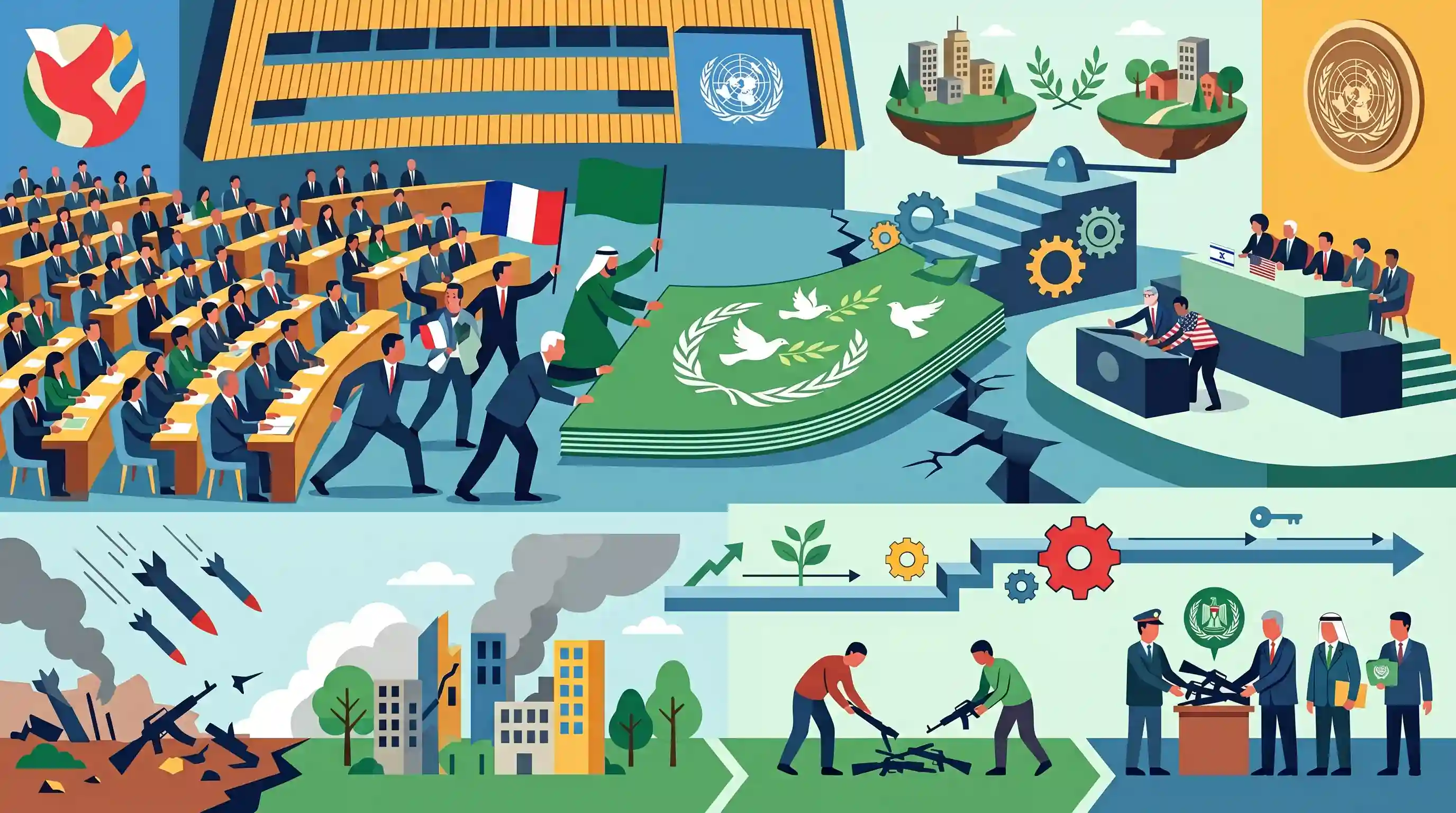
The United Nations General Assembly has overwhelmingly approved a declaration calling for "tangible, timebound, and irreversible steps" toward a two-state solution to resolve the Israel-Palestine conflict. Spearheaded by Saudi Arabia and France, the non-binding resolution demands an end to the Gaza war and insists that Hamas surrender its weapons to the Palestinian Authority. While supported by 157 countries, the measure faced strong opposition from Israel, the United States, and eight others, underscoring the deep geopolitical divides that complicate peace efforts in the Middle East.
Key Points
- The UN General Assembly overwhelmingly passed a non-binding resolution supporting a two-state solution for Israel and Palestine with 157 votes in favour.
- The declaration calls for tangible and irreversible steps towards establishing a Palestinian state and an end to the ongoing war in Gaza.
- It requires Hamas to relinquish its control over Gaza and hand over weapons to the Palestinian Authority.
- The resolution was pushed by a global coalition spearheaded by Saudi Arabia and France.
- Israel, the United States, and eight other nations opposed the resolution, highlighting significant geopolitical rifts regarding the conflict's resolution.
Important Terms
Two-State Solution

An internationally-backed peace formula proposing an independent State of Palestine alongside Israel, typically based on pre-1967 borders with East Jerusalem as the Palestinian capital.
UPSC context
GS Paper-II (IR). Crucial for understanding Middle East geopolitics and India's long-standing 'balanced' diplomatic stance on the conflict.
United Nations General Assembly (UNGA)
The UN's main deliberative, policymaking, and representative organ where all 193 member states have equal representation; its resolutions carry moral weight but are generally non-binding.
UPSC context
GS Paper-II (International Organizations). Tests knowledge of multilateral diplomacy and the functions/limitations of global governance bodies.
New York Declaration (2025)
A 2025 UNGA-endorsed roadmap for peace, spearheaded by Saudi Arabia and France, demanding a Gaza ceasefire, Hamas disarmament, and irreversible steps toward Palestinian statehood.
UPSC context
GS Paper-II (Current Affairs). Highlights the role of middle powers (Saudi-France) in spearheading new peace initiatives outside traditional US mediation.
Hamas
A Palestinian Sunni-Islamic militant and political organization that has controlled Gaza since 2007; the recent UN declaration demands its disarmament and exclusion from governance.
UPSC context
GS Paper-II/III (IR & Security). Relevant for analyzing regional instability, non-state actors, and challenges to unified Palestinian governance.
Palestinian Authority (PA)
The interim governing body established by the 1994 Oslo Accords, recognized internationally as the legitimate representative of Palestinians to govern parts of the West Bank and Gaza.
UPSC context
GS Paper-II (IR). Central to discussions on post-war Gaza administration and the viability of a future sovereign Palestinian state.
Prelims Trap
"The UN General Assembly passed a binding resolution to enforce the two-state solution."
Unlike UN Security Council (UNSC) decisions, UN General Assembly (UNGA) resolutions are purely recommendatory and non-binding on member states.
Static Concepts Connected
What is the difference between UNGA and UNSC resolutions on peace?
- UNGA nature: Passes recommendatory, non-binding resolutions based on sovereign equality (one member, one vote).
- UNSC nature: Can pass legally binding resolutions under Chapter VII of the UN Charter to restore or maintain international peace.
- Deadlock bypass: UNGA can invoke the "Uniting for Peace" resolution if the UNSC is paralyzed by a P5 veto.
What are the historical frameworks proposing a Two-State Solution?
- Oslo Accords (1990s): Created the Palestinian Authority (PA) with limited self-rule in parts of the West Bank and Gaza Strip.
- Arab Peace Initiative (2002): A Saudi-led proposal offering Israel normalized relations with Arab states in exchange for full withdrawal and an independent Palestinian state.
Cross-Topic Patterns
Middle powers bypassing UNSC vetoes
Deadlocks in the UNSC increasingly push middle powers like Saudi Arabia and France to build massive coalitions in the UNGA, highlighting a shift in diplomatic leverage.
India's De-hyphenation Policy
The UN push for a Two-State Solution tests India's 'de-hyphenation' policy, which carefully balances strategic defense ties with Israel against historical support for an independent Palestine.

UNGA vs UNSC voting powers, and the historical terms of the Arab Peace Initiative vs Abraham Accords, are highly likely for Prelims 2026.
Linked PYQs · 3
Linked PYQs · 3
- 2018PrelimsGS1
The term "two-state solution" is sometimes mentioned in the news in the context of the affairs of
- 2023PrelimsGS1
Consider the following statements: Statement-I: Israel has established diplomatic relations with some Arab States. Statement-II: The 'Arab Peace Initiative' mediated by Saudi Arabia was signed by Israel and Arab League. Which one of the following is correct in respect of the above statements?
- 2025MainsGS2
"The reform process in the United Nations remains unresolved, because of the delicate imbalance of East and West and entanglement of the USA vs. Russo-Chinese alliance.” Examine and critically evaluate the East-West policy confrontations in this regard.
