US Brokered Trilateral Framework for Israel Lebanon Border Security
Source:Indian Express ↗
Why It Matters
The agreement is a critical development in Middle Eastern geopolitics involving high-stakes US diplomacy. Understanding the nuances of the Israel-Lebanon border conflict, the role of non-state actors like Hezbollah, and efforts at regional peace is essential for grasping the broader security dynamics in West Asia—a region vital to India's energy, trade, and diaspora interests.
Summary
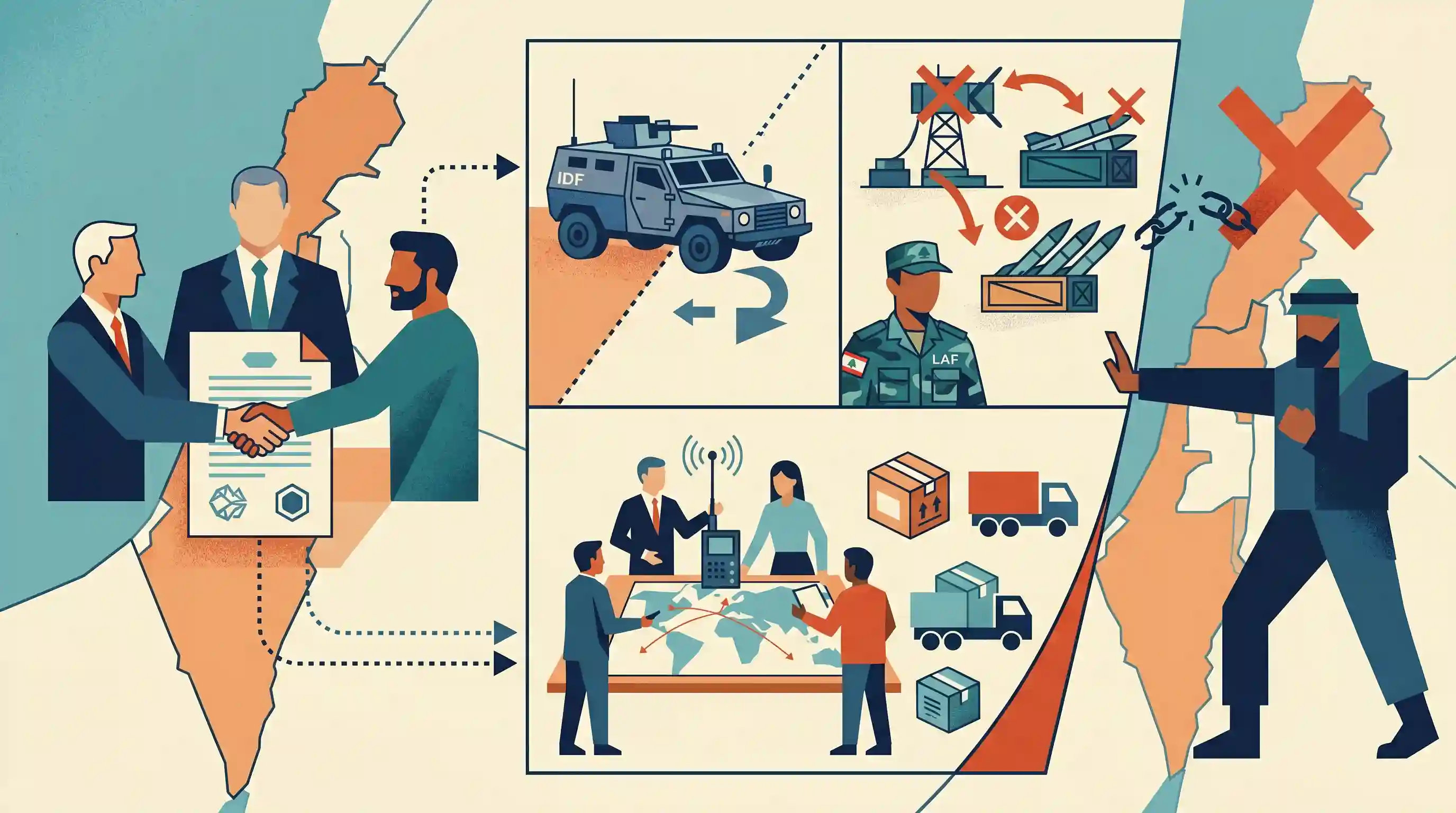
The United States has brokered a Trilateral Framework with Israel and Lebanon to end months of intense border conflict. The agreement outlines a reciprocal process where the Israel Defense Forces (IDF) will gradually withdraw from Lebanese territory in exchange for the verified disarmament of Hezbollah and the dismantling of its militant infrastructure. The Lebanese Armed Forces are tasked with securing the evacuated "pilot zones," supported by a US-led military coordination mechanism and $100 million in humanitarian assistance. However, Hezbollah has rejected the framework, condemning the disarmament clause, which casts significant doubt on the viability of the peace deal.
Key Points
- The US-brokered Trilateral Framework aims to halt the Israel-Hezbollah conflict by establishing a phased IDF withdrawal from Lebanon.
- The Israeli withdrawal is strictly conditional upon the "verified disarmament" of non-state armed groups, primarily targeting Hezbollah, and the dismantling of their infrastructure.
- The Lebanese Armed Forces (LAF) are mandated to take control of the territory starting with "pilot zones", supported by a US-led military coordination group and $100 million in US humanitarian aid.
- Hezbollah, which was not a party to the agreement, rejected it completely, describing the disarmament conditions linked to Israeli withdrawal as a "humiliation."
Important Terms
Trilateral Framework

A 2026 US-brokered agreement between Israel and Lebanon for border de-escalation, involving phased Israeli military withdrawal and the verified disarmament of militant groups.
UPSC context
GS-II: International Relations; effect of developed countries' policies on regional stability and India's interests.
Hezbollah
A Lebanon-based Shia militant group and political party supported by Iran, designated as a non-state actor with significant influence in West Asian geopolitics.
UPSC context
GS-II: West Asia geopolitics; GS-III: Role of non-state actors in security challenges.
Lebanese Armed Forces (LAF)
The official national military of Lebanon, tasked with maintaining sovereignty and securing border zones previously controlled by non-state militant groups.
UPSC context
GS-II: Regional security frameworks and state capacity in international relations.
Israel Defense Forces (IDF)
The unified national military of Israel, comprising land, air, and sea forces, central to the state's defense and regional strategic operations.
UPSC context
GS-II: Bilateral relations and strategic partnerships in the Middle East.
Blue Line
A 120km UN-recognized demarcation line established in 2000 to verify Israeli withdrawal from Lebanon, serving as a critical buffer zone.
UPSC context
GS-I: Geography (Levant region maps); GS-II: Role of International Organizations in peacekeeping.
Prelims Trap
"The Trilateral Framework is a UN-brokered agreement signed by Israel, Lebanon, and Hezbollah."
Aspirants often assume Hezbollah was a signatory or that it was brokered by the UN. The US brokered it, and Hezbollah actively rejected the disarmament clauses.
Static Concepts Connected
What are the key geographical features of the Israel-Lebanon border region?
- The Levant: The historical Eastern Mediterranean region encompassing Israel, Lebanon, Syria, Jordan, and Palestine.
- Litani River: The longest river entirely within Lebanon; historically marks a critical security buffer zone in conflicts.
- Blue Line: The UN-recognized boundary demarcation separating Lebanon and Israel, established in 2000.
How do non-state armed groups impact state sovereignty and regional security?
- Parallel Militaries: Groups like Hezbollah operate alongside state armies (LAF), undermining the national government's monopoly on violence.
- Peace Spoilers: They possess defacto veto power over diplomatic treaties by leveraging military capabilities outside state control.
- Proxy Warfare: Often funded by external powers, they turn domestic territory into a theater for broader regional geopolitical conflicts.
Cross-Topic Patterns
UNIFIL limits & Non-State Spoilers
The shift from UNIFIL's historical mandate to a new US-led mechanism highlights the failure of traditional UN peacekeeping when dealing with heavily armed non-state actors like Hezbollah.
Incremental sovereignty in conflict zones
Using "pilot zones" to transition control to the Lebanese Armed Forces parallels phased security transitions seen in other post-conflict states, heavily testing local state capacity against entrenched militias.

2026 Prelims will likely feature a map question on the Levant (Litani River, Blue Line) or a statement on Hezbollah's non-state status.
Linked PYQs · 5
Linked PYQs · 5
- 2017PrelimsGS1
Mediterranean Sea is a border of which of the following countries? 1. Jordan 2. Iraq 3. Lebanon 4. Syria Select the correct answer using the code given below:
- 2015PrelimsGS1
Which one of the following countries of South-West Asia does not open out to the Mediterranean Sea?
- 2003PrelimsGS1
Israel has common borders with
- 2022PrelimsGS1
The term "Levant" often heard in the news roughly corresponds to which of the following regions?
- 2018MainsGS2
“India’s relations with Israel have, of late, acquired a depth and diversity, which cannot be rolled back.” Discuss.
