Israel Lebanon Border Incursion and Unmanned Aerial Vehicle Threats
Source:The Hindu ↗
Why It Matters
The Israel-Lebanon conflict directly affects the geopolitical stability of West Asia, a region vital to India's energy security and diaspora interests. Additionally, Hezbollah's use of hard-to-detect fibre-optic drones is highly relevant to UPSC GS3 topics on internal security and the evolving threats posed by unmanned aerial vehicles (UAVs) in asymmetric warfare.
Summary
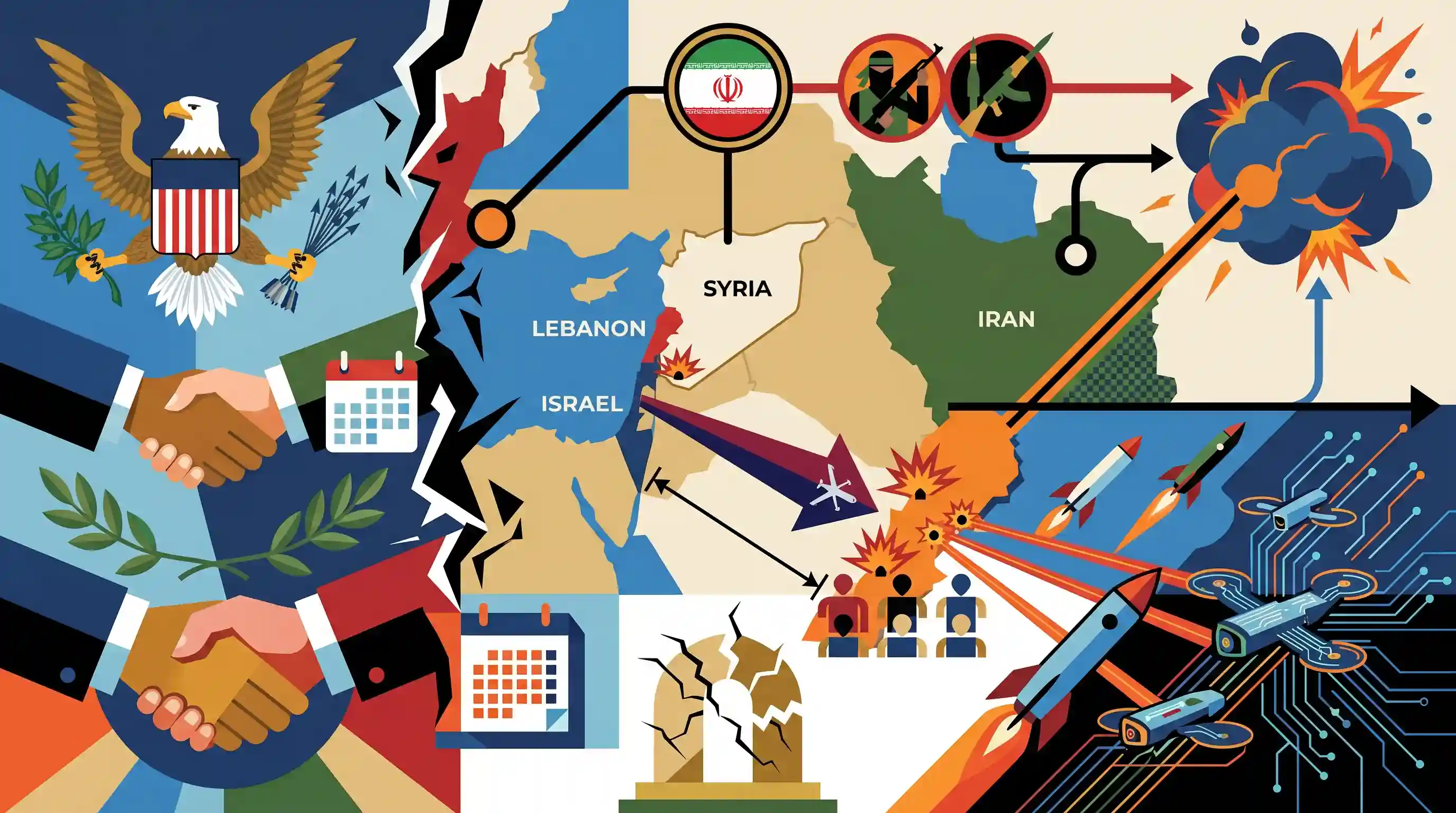
Israeli drone strikes killed eight people in southern Lebanon in its deepest incursion in 26 years, occurring just after U.S. President Donald Trump claimed Israel and Hezbollah agreed to de-escalate. The continued hostilities, which saw Hezbollah retaliating with rockets and advanced fibre-optic drones, underscore the fragility of diplomatic ceasefires and the persistent volatility in West Asia driven by underlying Iran-Israel tensions.
Key Points
- Israeli forces killed eight people in southern Lebanon via drone strikes, marking their deepest incursion into the country in 26 years.
- The military action occurred just a day after U.S. President Donald Trump announced that Israel and Hezbollah had agreed to de-escalate fighting.
- Hezbollah retaliated with rocket fire into northern Israel, utilizing advanced hard-to-detect fibre-optic drones that pose significant asymmetric warfare challenges.
- Despite a U.S.-brokered ceasefire earlier in the year and ongoing talks in Washington, hostilities continue to be fueled by broader Iran-Israel tensions.
Important Terms
Hezbollah

An Iran-backed Shia militant group and political party in Lebanon, founded in 1982. It is a major non-state military force in West Asia and a key participant in Lebanese politics.
UPSC context
GS II: International Relations. Essential for understanding West Asian stability, non-state actors, and India's diplomatic balancing in the region.
UN Resolution 1701
A 2006 UNSC resolution that ended the Lebanon War, calling for a permanent ceasefire and a buffer zone south of the Litani River free of unauthorized armed personnel.
UPSC context
GS II: International Relations/Peacekeeping. It represents the legal and diplomatic framework for peace between Israel and Lebanon and UNIFIL's mandate.
West Asia Geopolitics
The complex political and security interactions between nations in the Middle East, involving regional powers like Israel, Iran, and Saudi Arabia, alongside global influences like the U.S.
UPSC context
GS II: International Relations. Crucial for India's energy security, trade routes (Strait of Hormuz), and the welfare of its 9-million-strong diaspora.
Fibre-optic Drone
A modern attack drone tethered to its operator by a physical optical cable (10-30km), making it immune to electronic jamming, radio frequency interception, and GPS spoofing.
UPSC context
GS III: Science & Technology/Internal Security. Represents a significant shift in asymmetric warfare and challenges to conventional air defense and electronic warfare systems.
Blue Line
A 120-km boundary line established by the UN in 2000 to verify the withdrawal of Israeli forces from Lebanon. It serves as the de facto border but is not formally recognized.
UPSC context
GS I: World Geography; GS II: IR. Important for monitoring border violations and understanding the geographic flashpoints in the Israel-Lebanon conflict.
Litani River
A major river in southern Lebanon. UN Resolution 1701 designates the area between this river and the Blue Line as a buffer zone for peace.
UPSC context
GS I: World Geography. A key geographic landmark used to define demilitarized zones and security boundaries in West Asian regional conflicts.
Prelims Trap
The Blue Line serves as the formal, internationally recognized border between Israel and Lebanon.
It is a temporary UN-demarcated line of withdrawal established in 2000 to confirm Israeli troop departure, not a permanent or recognized international boundary.
Static Concepts Connected
What are the bordering nations of Israel and the 'Levant' region?
- Israel's Borders: Israel shares land boundaries with Lebanon to the north, Syria to the northeast, Jordan to the east, and Egypt to the southwest.
- The Levant: A historical geographical term referring to the eastern Mediterranean region, encompassing modern-day Israel, Lebanon, Syria, Jordan, and Palestine.
- Maritime Access: Both Israel and Lebanon feature western coastlines that open directly out into the Mediterranean Sea.
How do fibre-optic drones evade conventional electronic warfare?
- Physical Connection: They utilize a physical spool of trailing cable for real-time telemetry and video instead of wireless radio frequencies (RF).
- Jamming Immunity: Because they do not rely on RF signals for command, they cannot be neutralized by standard electronic signal jamming or GPS spoofing.
Cross-Topic Patterns
Asymmetric Warfare & Emerging Tech
Non-state actors like Hezbollah using fibre-optic drones illustrates the democratization of advanced military tech, linking West Asian conflicts directly to Defense S&T and asymmetric warfare themes.
India's UN Peacekeeping Role
Hostilities in southern Lebanon directly impact UNIFIL operations. As India is a major troop-contributing nation, this links regional West Asian geopolitics to India's multilateral peacekeeping commitments.

Expect a 2026 Prelims question matching West Asian conflict zones (Blue Line, Levant) alongside emerging S&T like fibre-optic EW evasion.
Linked PYQs · 5
Linked PYQs · 5
- 2022PrelimsGS1
The term "Levant" often heard in the news roughly corresponds to which of the following regions?
- 2017PrelimsGS1
Mediterranean Sea is a border of which of the following countries? 1. Jordan 2. Iraq 3. Lebanon 4. Syria Select the correct answer using the code given below:
- 2003PrelimsGS1
Israel has common borders with
- 2015PrelimsGS1
Which one of the following countries of South-West Asia does not open out to the Mediterranean Sea?
- 2023MainsGS3
The use of unmanned aerial vehicles (UAVs) by our adversaries across the borders to ferry arms/ammunitions, drugs, etc., is a serious threat to the internal security. Comment on the measures being taken to tackle this threat.
