Israel Gaza City Evacuation Warning and Netzarim Corridor Seizure
Source:The Hindu ↗
Why It Matters
The Israel-Hamas war heavily impacts global security, Middle East geopolitics, and international diplomacy. Understanding US-mediated peace efforts, the geography of strategic corridors like Netzarim, and the challenges faced by humanitarian organizations is crucial for analyzing modern international relations and conflict resolution.
Summary
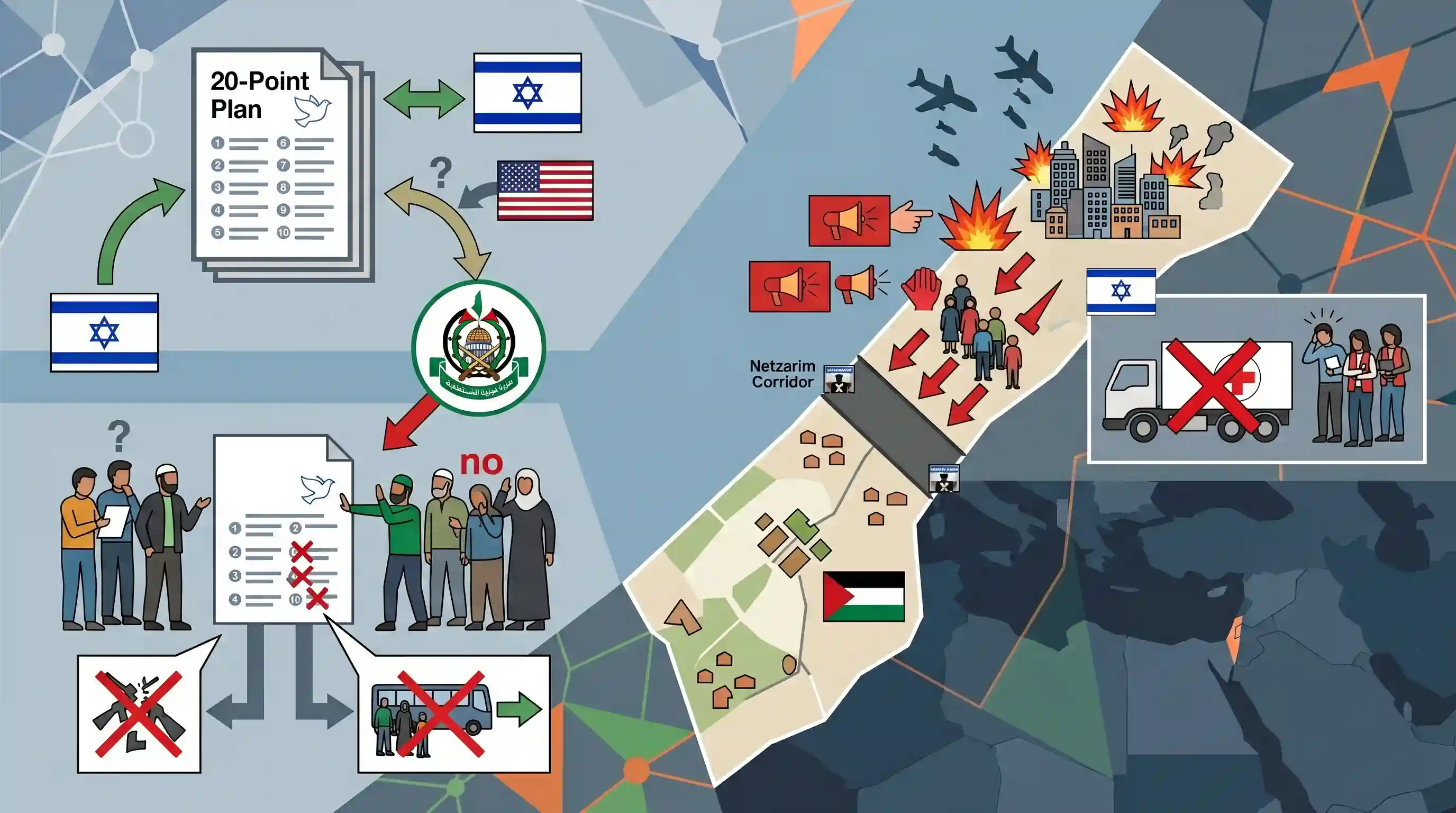
Israel has issued a "last warning" for civilians to evacuate Gaza City as its military seizes the strategic Netzarim corridor, effectively dividing the northern and southern parts of the Gaza Strip. The intensified assault has led key humanitarian agencies like the ICRC to halt local operations. Simultaneously, Hamas is evaluating US President Donald Trump's 20-point peace plan—backed by Israel—which mandates a ceasefire, hostage release, the group's disarmament, and a phased Israeli withdrawal. However, the proposal faces resistance within Hamas over clauses demanding disarmament and potential expulsion of Palestinians.
Key Points
- Israel's military has warned civilians to leave Gaza City for the south, capturing the strategic Netzarim corridor to cut off northern Gaza from the south.
- International humanitarian organizations, including the ICRC and Doctors Without Borders, have suspended operations in Gaza City due to the intensified military siege.
- Hamas is currently evaluating US President Donald Trump's 20-point peace plan, which calls for a ceasefire, the release of hostages, the group's disarmament, and a gradual Israeli withdrawal.
- Hamas faces internal division over the peace plan, with factions expressing reservations over disarmament and demanding international guarantees against Israeli violations.
Important Terms
Trump's 20-point Gaza plan

A 2025 US-led framework for Gaza featuring a ceasefire, hostage release, and the disarmament/removal of Hamas in exchange for Israeli withdrawal and international reconstruction aid.
UPSC context
GS II: International Relations. Tests understanding of global peace initiatives and US influence in Middle East geopolitics.
Board of Peace
An international administrative body proposed to oversee Gaza's transition to technocratic rule, coordinate stabilization forces, and manage multi-billion dollar reconstruction funds outside UN channels.
UPSC context
GS II: Bilateral & Global Groupings. Relevant for analyzing new multilateral governance models in conflict zones.
Netzarim Corridor
A 4km-wide Israeli military buffer zone splitting Gaza north-to-south. It controls movement between Gaza City and the south, serving as a critical strategic leverage point in negotiations.
UPSC context
GS I: Geography & GS III: Internal Security. Significant for mapping conflict zones and understanding tactical military 'fragmentation' strategies.
International Committee of the Red Cross (ICRC)
An independent, neutral organization mandated by the Geneva Conventions to protect victims of armed conflict. It facilitates hostage releases and provides emergency medical relief.
UPSC context
GS II: International Institutions. Tests knowledge of the role of neutral intermediaries in humanitarian crises.
Doctors Without Borders
An international medical NGO (MSF) that provides emergency healthcare. In 2026, it faced operational halts in Gaza due to Israeli deregistration and staff-vetting disputes.
UPSC context
GS II: Important Aspects of Governance (NGOs). Relevant for discussing challenges faced by international civil society in war zones.
Hamas
A Palestinian militant group and political entity. The 2026 peace proposal hinges on its total disarmament and transition of power to a technocratic Palestinian authority.
UPSC context
GS II: IR/Regional Security. Essential for understanding non-state actors and the political dynamics of the Israel-Palestine conflict.
Prelims Trap
The Netzarim Corridor runs along the southern border connecting the Gaza Strip to Egypt.
The Netzarim Corridor bisects Gaza horizontally from Israel to the Mediterranean. The Philadelphi Corridor is the one running along the Gaza-Egypt border.
Static Concepts Connected
What are the key strategic corridors controlling movement in the Gaza Strip?
- Netzarim Corridor: An east-west passage cutting across Gaza from the Israeli border to the Mediterranean Sea, splitting the territory into distinct northern and southern zones.
- Philadelphi Corridor: A narrow 14-km strip of land running entirely along the southern border between the Gaza Strip and Egypt.
What governs the protection of civilians and agencies like the ICRC in war zones?
- Fourth Geneva Convention: Adopted in 1949, it establishes the international legal standards for the humanitarian protection of civilians in a war zone, specifically including occupied territories.
- ICRC's Status: It is an independent, neutral organization based in Geneva—not a UN agency—mandated to protect and assist victims of international and internal armed conflicts.
Cross-Topic Patterns
Abraham Accords vs. Gaza Demilitarization
The Abraham Accords focused on Arab-Israeli diplomatic normalization, bypassing Palestine, whereas current US peace proposals mandate direct intervention in Gaza's governance and militant demilitarization.
Ethics of Humanitarian blockades
The forced withdrawal of the ICRC from Gaza City links GS2 (International Law) to GS4 (Ethics in International Relations) regarding the proportionality and moral boundaries of military sieges.

Map questions matching strategic corridors (Netzarim, Philadelphi) or terms (Levant) to geographic locations are highly expected in 2026.
Linked PYQs · 3
Linked PYQs · 3
- 2022PrelimsGS1
The term "Levant" often heard in the news roughly corresponds to which of the following regions?
- 2018MainsGS2
“India’s relations with Israel have, of late, acquired a depth and diversity, which cannot be rolled back.” Discuss.
- 2024MainsGS2
‘Terrorism has become a significant threat to global peace and security.’ Evaluate the effectiveness of the United Nations Security Council's Counter Terrorism Committee (CTC) and its associated bodies in addressing and mitigating this threat at the international level.
