Top Iranian Nuclear Scientist Killed in Targeted Israeli Strike
Source:Indian Express ↗
Why It Matters
The escalating conflict between Israel and Iran directly impacts global energy security and stability in the Middle East—a region critical to India's energy needs and home to a large Indian diaspora. The targeting of nuclear scientists and facilities, alongside attacks on US military bases, makes this a vital case study for nuclear proliferation and international relations.
Summary
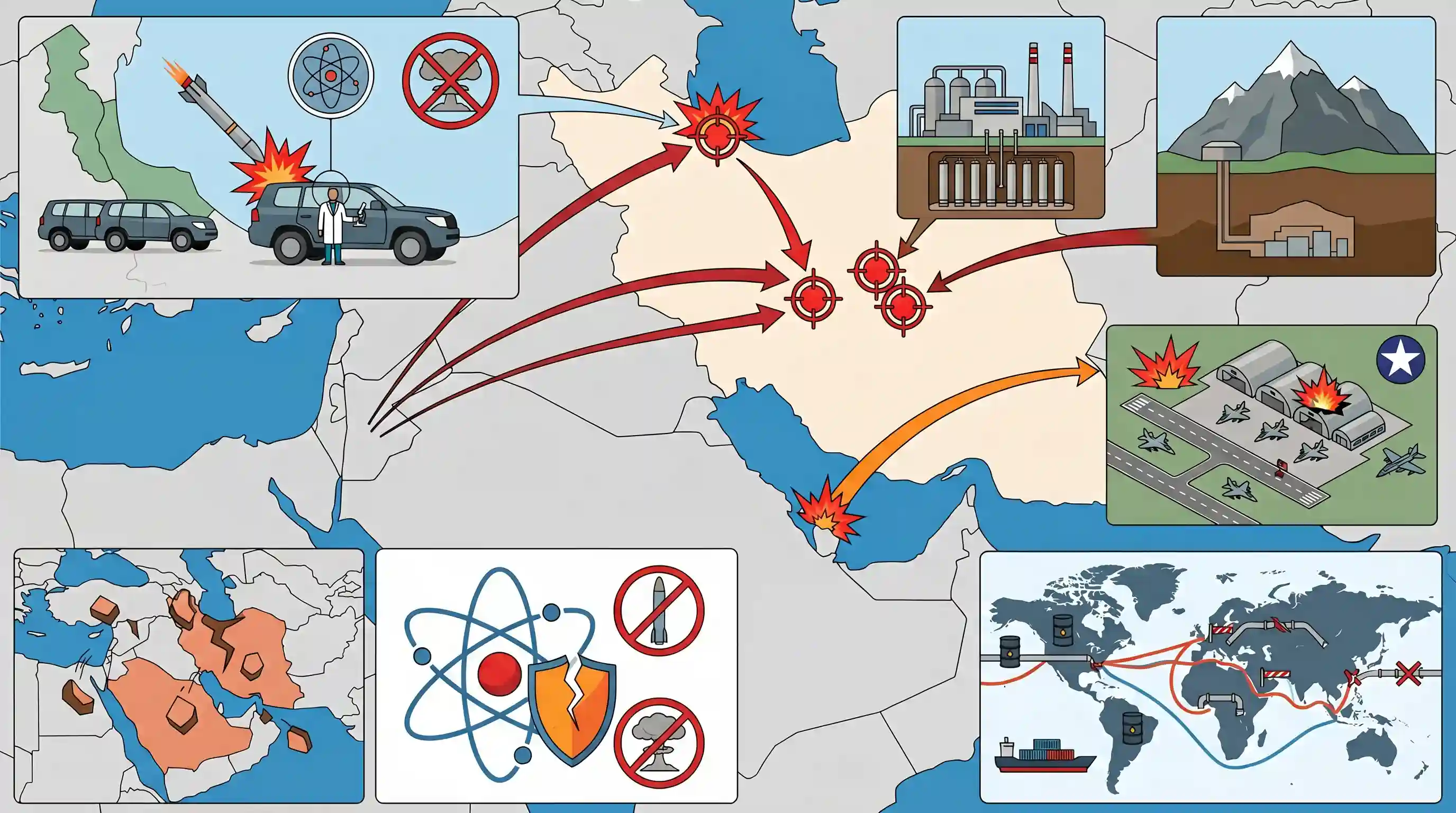
The Israel-Iran conflict has escalated drastically with an Israeli strike killing top Iranian nuclear scientist Mohammad Reza Seddiqi Saber in Gilan province. Saber, who headed the Shahid Karimi Group under the Organisation of Defensive Innovation and Research (SPND), was crucial to Iran's nuclear equipment procurement and had recently been sanctioned by the US. Israel concurrently struck major Iranian nuclear sites at Natanz, Isfahan, and Fordow. Iran retaliated by attacking the US-run Al Udeid Air Base in Qatar, directly pulling US assets into the confrontation. The widening conflict poses significant risks to Middle Eastern stability, global nuclear non-proliferation efforts, and energy security.
Key Points
- Mohammad Reza Seddiqi Saber, a prominent Iranian nuclear scientist, was assassinated in an Israeli strike in Iran's Gilan province.
- Saber led the Shahid Karimi Group under Iran's SPND, playing a critical role in procuring equipment for Iran's nuclear projects.
- The US had recently imposed sanctions on him for his involvement in Iran's nuclear and missile programs.
- The Israeli strikes targeted major Iranian nuclear facilities, including those at Natanz, Isfahan, and Fordow.
- In retaliation, Iran targeted the US-operated Al Udeid Air Base in Doha, Qatar, marking a severe escalation involving American military assets in the region.
Important Terms
SPND (Organisation of Defensive Innovation and Research)

An Iranian Ministry of Defence agency (Sepand) responsible for dual-use military R&D. International bodies link it to the 'Amad Plan' for nuclear weaponization and missile technology development.
UPSC context
GS Paper II & III: International Relations and Security; tests knowledge of Iranian nuclear infrastructure and global non-proliferation regimes.
Shahid Karimi Group
A specialized subunit of SPND focused on explosives and materials research. It is sanctioned for its role in testing technologies applicable to nuclear explosive devices and missile components.
UPSC context
GS Paper II: International Relations; tests understanding of targeted sanctions and their role in global nuclear diplomacy.
Mohammad Reza Seddiqi Saber
A senior Iranian scientist and head of the Shahid Karimi Group. Sanctioned by the U.S. for supervising research on nuclear explosives and weaponization-related materials.
UPSC context
GS Paper II: International Relations; relevant for 'Places and Personalities in News' regarding Middle East geopolitics.
Al Udeid Air Base
The largest U.S. military facility in the Middle East, located in Qatar. It serves as the forward headquarters for the U.S. Central Command (CENTCOM).
UPSC context
GS Paper II: International Relations; tests knowledge of strategic military assets and regional power dynamics in West Asia.
Natanz and Fordow
Iran's primary uranium enrichment facilities. Natanz is the main industrial site; Fordow is a highly fortified, underground plant built deep within a mountain to resist airstrikes.
UPSC context
GS Paper III: Science & Technology and Security; tests understanding of the nuclear fuel cycle and proliferation concerns.
JCPOA (Joint Comprehensive Plan of Action)
A 2015 agreement between Iran and the P5+1 (USA, UK, France, Russia, China, Germany) to limit Iran's nuclear activities in exchange for international sanctions relief.
UPSC context
GS Paper II: International Relations; fundamental for understanding West Asian diplomacy and India's energy security interests.
Prelims Trap
"Al Udeid Air Base is a major US military facility located in Saudi Arabia."
UPSC frequently tests the locations of strategic Middle Eastern assets. Al Udeid is actually located in Qatar, not Saudi Arabia or the UAE.
Static Concepts Connected
What are the key Iranian nuclear sites frequently tested in Places in News?
- Natanz: The primary, large-scale uranium enrichment facility in Iran, frequently targeted by cyberattacks (e.g., Stuxnet) and sabotage.
- Fordow: A heavily fortified, underground uranium enrichment facility built into a mountain to protect it from airstrikes.
- Isfahan: Houses Iran's Uranium Conversion Facility (UCF), which converts yellowcake into uranium hexafluoride gas for enrichment.
How does the IAEA monitor nuclear non-proliferation?
- Comprehensive Safeguards Agreement: Mandatory for non-nuclear-weapon states under the NPT to verify that nuclear material is not diverted to weapons.
- Additional Protocol: A voluntary agreement that grants the IAEA expanded rights of access to undeclared sites and information.
- JCPOA Limits: The 2015 deal (JCPOA) strictly capped Iran's enrichment levels (at 3.67%) and stockpiles in exchange for sanctions relief.
Cross-Topic Patterns
Middle East escalation + India's Energy Security
Escalations involving Iran threaten the Strait of Hormuz, linking geopolitical instability directly to India's macroeconomic stability, imported inflation, and the necessity of Strategic Petroleum Reserves.
Abraham Accords vs Axis of Resistance
The direct attack on US assets in Qatar complicates regional diplomacy, contrasting the US-backed Abraham Accords with the aggressive posture of Iran's "Axis of Resistance."

Expect a Prelims matching question mapping Middle East strategic bases (Al Udeid/Qatar) or Iranian nuclear sites in 2026.
Linked PYQs · 4
Linked PYQs · 4
- 2018MainsGS2
In what ways would the ongoing US-Iran Nuclear Pact Controversy affect the national interest of India? How should India respond to this situation?
- 2025MainsGS2
"Energy security constitutes the dominant kingpin of India's foreign policy, and is linked with India's overarching influence in Middle Eastern countries.” How would you integrate energy security with India's foreign policy trajectories in the coming years?
- 2023PrelimsGS1
Consider the following pairs: Regions often mentioned in news Reason for being in news 1. North Kivu and Ituri : War between Armenia and Azerbaijan 2. Nagorno-Karabakh : Insurgency in Mozambique 3. Kherson and Zaporizhzhia : Dispute between Israel and Lebanon How many of the above pairs are correctly matched?
- 2015PrelimsGS1
The area known as 'Golan Heights' sometimes appears in the news in the context of the events related to
