West Asia Conflict: Military Escalation and Global Implications
Source:Indian Express ↗
Why It Matters
The Iran-Israel conflict significantly impacts India's strategic interests, including energy security, the safety of the massive Indian diaspora in West Asia, and regional connectivity projects. Understanding the dynamics of this flare-up is essential for grasping contemporary international relations and global security challenges.
Summary
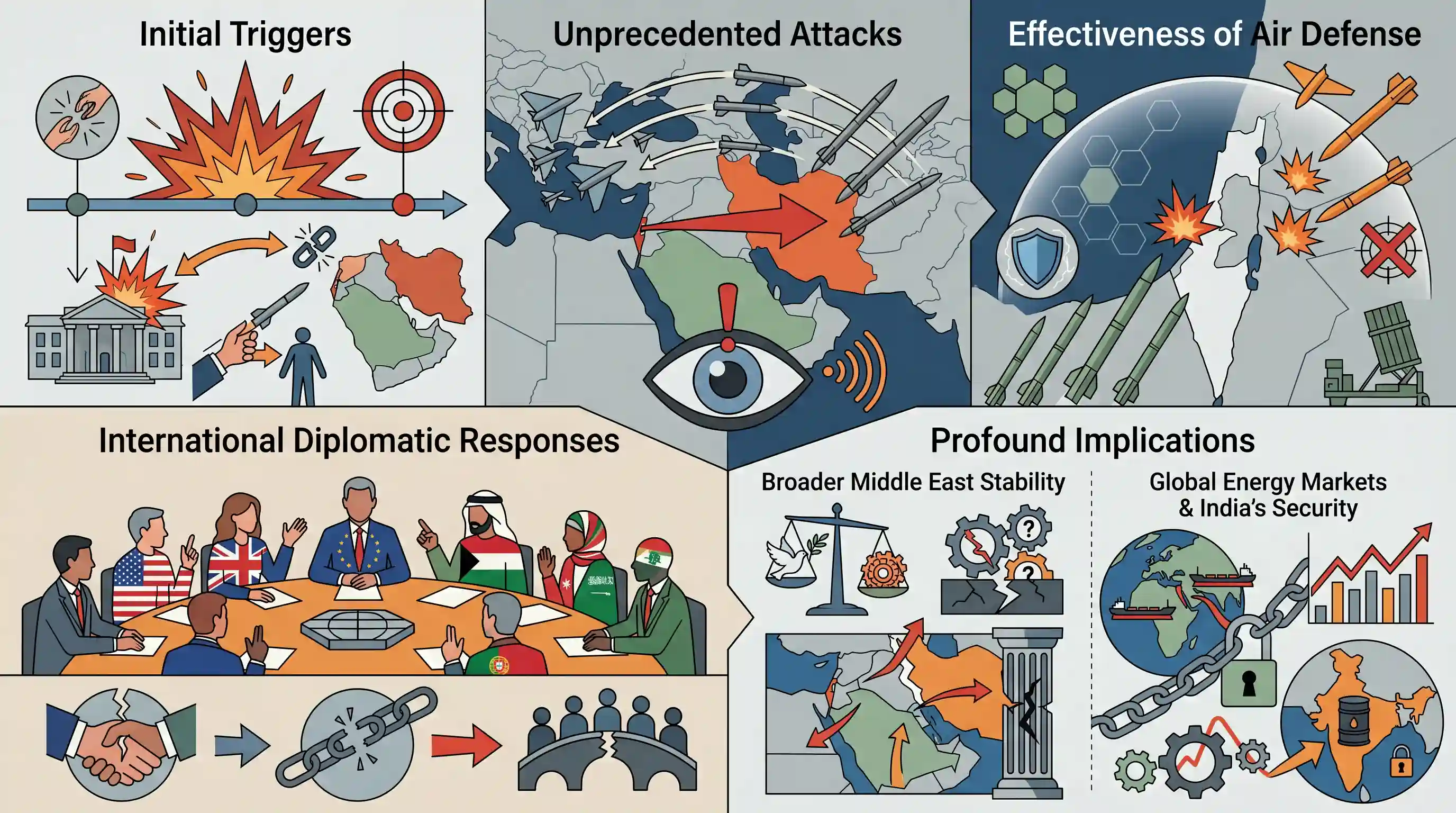
The article explains the recent military escalation between Iran and Israel, breaking down the crisis into five key aspects. It covers the initial triggers, the unprecedented direct drone and missile strikes, the effectiveness of air defense systems, international diplomatic responses, and the profound implications for broader Middle East stability and global energy markets.
Key Points
- Details the shift from a proxy 'shadow war' to direct military confrontation between Iran and Israel.
- Highlights the extensive use of unmanned aerial vehicles (UAVs), cruise missiles, and ballistic missiles in the retaliatory strikes.
- Discusses the critical role of Israel's air defense networks, including the Iron Dome, and interception support from allied forces.
- Examines the global diplomatic efforts, particularly by the United States and the UN, to urge restraint and prevent a full-scale regional war.
- Assesses the geopolitical fallout, including potential disruptions to global oil supplies, impacts on strategic shipping routes, and consequences for India's energy security.
Important Terms
Islamic Revolutionary Guard Corps (IRGC)

A powerful branch of the Iranian Armed Forces established after the 1979 Revolution to safeguard the clerical regime. It manages its own military branches and oversees regional proxy operations via the Quds Force.
UPSC context
GS Paper 2 (International Relations); critical for understanding West Asian power dynamics, proxy warfare, and India’s strategic interests in the Persian Gulf.
Hezbollah
An Iran-backed Shia militant organization and political party in Lebanon. Founded in 1982 to oppose Israeli occupation, it has evolved into a major regional military force and key member of the "Axis of Resistance."
UPSC context
GS Paper 2 (International Relations); tests knowledge of non-state actors, regional instability, and its impact on the safety of the Indian diaspora.
Israel Defense Forces (IDF)
The unified national military of Israel, integrating ground, air, and naval forces. It is central to Israel's national security doctrine and operates advanced defense systems like the Iron Dome and Arrow.
UPSC context
GS Paper 2 (Bilateral Relations) and Paper 3 (Defense Technology); relevant for India-Israel defense cooperation and modern military doctrines.
UN Security Council (UNSC)
The primary United Nations body tasked with maintaining global peace and security. It consists of 15 members, including five permanent members (P5) with the power to veto substantive resolutions.
UPSC context
GS Paper 2 (International Institutions); examines the paralysis of global governance during conflicts and the ongoing debate regarding UNSC structural reforms.
Strait of Hormuz
A narrow, strategic waterway between the Persian Gulf and Gulf of Oman. As the world's most critical oil chokepoint, it facilitates the transit of a significant portion of global petroleum and LNG.
UPSC context
GS Paper 1 (Geography) and Paper 3 (Energy Security); vital for India as nearly 90% of its LPG imports transit this route.
Energy Security
The reliable and affordable availability of energy sources. For India, it involves diversifying suppliers, expanding Strategic Petroleum Reserves (SPR), and mitigating the impact of geopolitical volatility on fuel prices.
UPSC context
GS Paper 3 (Economic Development/Energy); focuses on India's import dependence, macro-economic stability, and resilience against regional West Asian shocks.
Prelims Trap
"Israel's Iron Dome system is primarily designed to intercept exo-atmospheric ballistic missiles fired from long distances."
Iron Dome is strictly for short-range unguided rockets and drones. Israel relies on the 'Arrow' system (Arrow 2/3) to intercept exo-atmospheric ballistic missiles.
Static Concepts Connected
What are the three tiers of Israel's integrated air defense system?
- Iron Dome: Designed for short-range threats like unguided rockets, artillery shells, and low-flying drones.
- David's Sling: Intercepts medium-to-long-range tactical ballistic missiles, cruise missiles, and advanced aircraft.
- Arrow System: Designed for high-altitude, exo-atmospheric interception of long-range ballistic missiles (Arrow-2 and Arrow-3).
Why is the Strait of Hormuz a critical maritime chokepoint for India?
- Geographical Location: It connects the Persian Gulf to the Gulf of Oman and the Arabian Sea, acting as the only sea passage from the Persian Gulf.
- Energy Transit: Over 45% of India's crude oil and 90% of its LPG imports transit through this narrow strait, making it a lifeline for domestic energy.
- Vulnerability: Any closure or blockade threatens immediate macroeconomic instability in India due to massive spikes in fuel and fertilizer import costs.
Cross-Topic Patterns
Drone swarms + Asymmetric warfare
The use of cheap loitering munitions (Shahed-136) to overwhelm billion-dollar defense networks highlights the changing cost-benefit calculus in modern asymmetric warfare, relevant for India's border defense.
Gulf volatility + Fertilizer subsidy bill
Disruptions in the Strait of Hormuz don't just affect crude oil; they spike LNG prices, which directly inflates India's domestic urea production costs and balloons the government's fertilizer subsidy bill.
Non-state proxies to direct confrontation
The shift from utilizing the "Axis of Resistance" (Hezbollah, Houthis) to direct state-on-state strikes fundamentally alters the regional escalation ladder and challenges existing UN peacekeeping mandates.

Expect a 2026 prelims matching question on global air defense systems (Arrow/Iron Dome/S-400) or a map question on Middle East chokepoints.
Linked PYQs · 4
Linked PYQs · 4
- 2018MainsGS2
“India’s relations with Israel have, of late, acquired a depth and diversity, which cannot be rolled back.” Discuss.
- 2025MainsGS2
"Energy security constitutes the dominant kingpin of India's foreign policy, and is linked with India's overarching influence in Middle Eastern countries.” How would you integrate energy security with India's foreign policy trajectories in the coming years?
- 2022PrelimsGS1
The term "Levant" often heard in the news roughly corresponds to which of the following regions?
- 2023MainsGS3
The use of unmanned aerial vehicles (UAVs) by our adversaries across the borders to ferry arms/ammunitions, drugs, etc., is a serious threat to the internal security. Comment on the measures being taken to tackle this threat.
