Human Rights Group Reports High Casualties from Israeli Strikes
Source:The Hindu ↗
Why It Matters
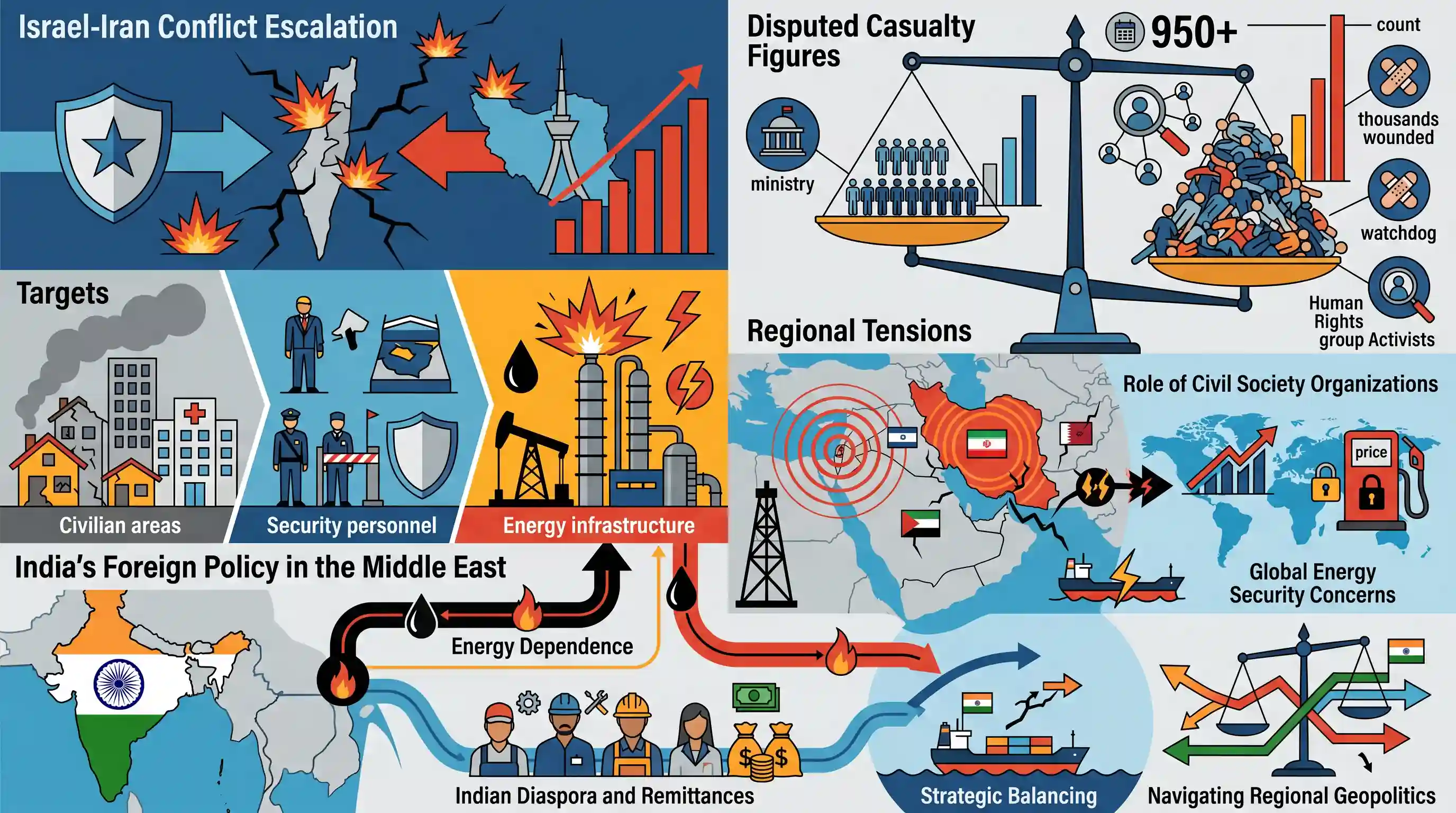
The Israel-Iran conflict directly impacts stability in West Asia, a region crucial to India's energy security and diaspora interests. The situation also underscores the role of independent civil society organizations in providing accurate information in conflict zones where state narratives may be skewed.
Summary
The article reports on the escalating conflict between Israel and Iran, highlighting casualty figures from recent Israeli airstrikes. According to the independent group Human Rights Activists, at least 950 people have been killed and thousands wounded, figures significantly higher than those acknowledged by Iran's Health Ministry. The strikes have targeted civilian areas, security personnel, and critical energy infrastructure like oil refineries, exacerbating regional tensions in the Middle East and raising concerns over global energy security.
Key Points
- Israeli airstrikes on Iran have resulted in at least 950 deaths and 3,450 injuries, according to the Washington-based Human Rights Activists group.
- There is a significant discrepancy between the casualty figures reported by independent monitors and the official numbers from Iran's Health Ministry, suggesting state efforts to minimize domestic fallout.
- The strikes have reportedly hit critical energy infrastructure, including an oil refinery near Tehran, alongside civilian and security targets.
- The escalation highlights the growing volatility in West Asia, with potential ramifications for global energy markets and regional stability.
Important Terms
Human Rights Activists in Iran (HRAI)

A US-based non-governmental organization (founded 2006) that monitors human rights violations in Iran. Its news agency, HRANA, provides data on casualties and arrests during conflicts and protests.
UPSC context
GS Paper II: Important for International Relations (Role of CSOs) and human rights issues in West Asia.
West Asia Geopolitics
The strategic interplay of political, religious, and economic interests in the Middle East, primarily defined by the Israel-Iran rivalry and US involvement in the region.
UPSC context
GS Paper II: Crucial for topics related to India’s extended neighborhood and regional stability.
Energy Security
Ensuring reliable, affordable access to energy sources. For India, this primarily involves securing oil and gas imports from West Asia and protecting maritime trade routes like the Strait of Hormuz.
UPSC context
GS Paper III: Vital for Economic Development and Infrastructure/Energy topics.
Strategic Autonomy
The doctrine guiding a state's ability to pursue its national interests and foreign policy independently, without being constrained by obligations to military blocs or major powers.
UPSC context
GS Paper II: Central to Indian Foreign Policy and its multi-alignment strategy.
International Humanitarian Law (IHL)
A body of law, including the Geneva Conventions, designed to limit the effects of armed conflict by protecting non-combatants and restricting methods of warfare.
UPSC context
GS Paper II: Relevant for International Institutions and Laws governing global conflicts.
Operation Sindhu-II
The specific contingency evacuation plan (referenced in 2026) for rescuing Indian citizens from West Asia during a regional war, successor to operations like Raahat and Ajay.
UPSC context
GS Paper II: Significance of the Indian Diaspora and MEA’s crisis management.
Prelims Trap
The casualty figures in the recent Israel-Iran direct conflict were officially verified by the UN Human Rights Council.
The 950+ casualty figure was reported by 'Human Rights Activists', an independent Washington-based CSO. It is not UN-verified, nor acknowledged by the Iranian state.
Static Concepts Connected
What is India's 'De-hyphenation' policy in West Asia?
- Independent Ties: Dealing with rival nations (e.g., Israel and Iran, or Israel and Palestine) on a bilateral basis, unlinked from their mutual conflicts.
- Strategic Autonomy: Advancing national interests such as energy security, diaspora protection, and defense without yielding to third-party geopolitical pressures.
Why is the Strait of Hormuz a critical global energy chokepoint?
- Geographic Location: A highly strategic, narrow waterway connecting the Persian Gulf to the Gulf of Oman and the Arabian Sea, bordered by Iran and Oman.
- Energy Transit: It facilitates the transit of roughly 20% of global oil consumption. Any blockade or disruption immediately spikes global crude prices.
Cross-Topic Patterns
Geopolitics & Imported Inflation
Direct hits on Iranian oil refineries threaten global crude supply chains, risking imported inflation and a widening Current Account Deficit for highly oil-dependent economies like India.
Geneva Conventions & Kinetic War
The shift from a decades-long covert shadow war to direct territorial strikes tests International Humanitarian Law, specifically the Geneva Convention principles of distinction and proportionality.

Israel-Iran direct conflict will likely spawn a 2026 question merging map locations (Strait of Hormuz) with India's de-hyphenation policy.
Linked PYQs · 2
Linked PYQs · 2
- 2025MainsGS2
"Energy security constitutes the dominant kingpin of India's foreign policy, and is linked with India's overarching influence in Middle Eastern countries.” How would you integrate energy security with India's foreign policy trajectories in the coming years?
- 2025MainsGS2
Civil Society Organizations are often perceived as being anti-State actors than non-State actors. Do you agree? Justify.
