Historical Israel Iran Cooperation and Secret Oil Pipeline
Source:Indian Express ↗
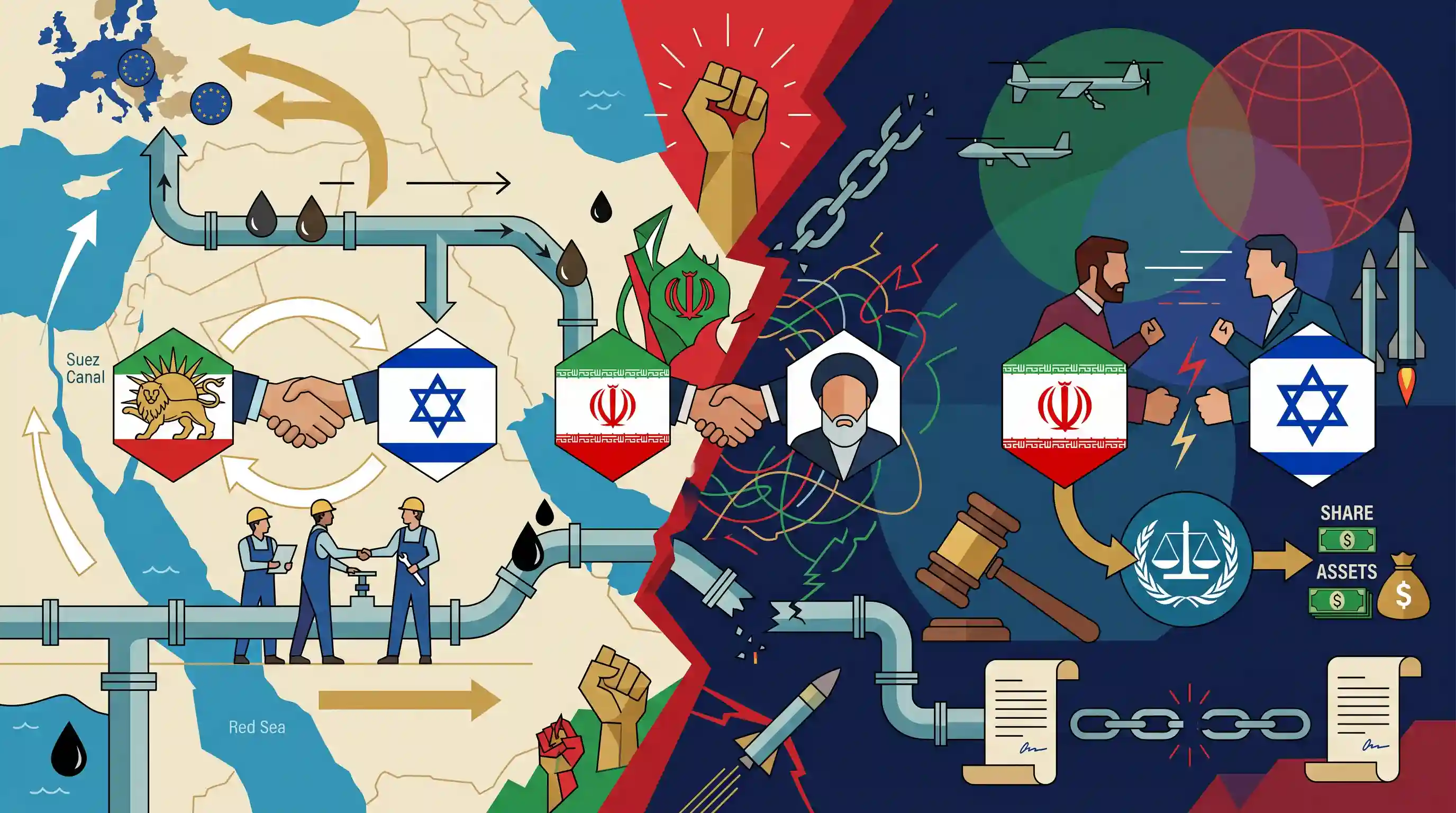
Why It Matters
Understanding the historical cooperation between current adversaries like Israel and Iran provides crucial context for West Asian geopolitics. The concept of bypassing the Suez Canal via the Red Sea-Mediterranean land bridge remains highly relevant for global energy security and modern connectivity projects (e.g., IMEC or the SUMED pipeline).
Summary
The article delves into the historical alliance between Israel and pre-1979 Iran, centered around their joint venture to construct the Trans-Asiatic Oil Pipeline (Eilat-Ashkelon pipeline). Built in the 1960s, the pipeline connected the Red Sea to the Mediterranean, providing a vital route for Iranian oil to reach Europe by bypassing the vulnerable Suez Canal. Following the 1979 Islamic Revolution, Iran abruptly severed ties, turning the former partners into fierce geopolitical adversaries. The article highlights the enduring legacy of this cooperation, as Iran continues to seek compensation through international arbitration for its expropriated share of the pipeline assets, illustrating the profound and lasting economic impacts of sudden geopolitical shifts in West Asia.
Key Points
- Prior to the 1979 Islamic Revolution, Iran and Israel shared strong, albeit discreet, strategic and economic ties to counter shared Arab adversaries in the Middle East.
- The two nations formed a joint venture to build the Trans-Asiatic Oil Pipeline (also known as the Eilat-Ashkelon pipeline), linking the Red Sea port of Eilat to the Mediterranean port of Ashkelon.
- This pipeline served as a crucial strategic bypass for the Suez Canal, allowing Iranian oil to reliably reach European markets, especially after the canal was closed during the 1967 Six-Day War.
- The partnership abruptly ended with the 1979 Iranian Revolution, which transformed Iran into a bitter geopolitical rival of Israel.
- Despite the hostility, Iran has spent decades pursuing international arbitration to recover billions of dollars from Israel for its expropriated half-share in the pipeline's assets and revenues.
Important Terms
1979 Islamic Revolution

The 1979 uprising that replaced Iran’s pro-Western monarchy with an anti-Israel Islamic Republic. It fundamentally realigned West Asian geopolitics, ending the strategic alliance between Iran and Israel.
UPSC context
GS Paper II (International Relations); critical for understanding historical shifts in West Asian power dynamics and their impact on global energy security.
Eilat-Ashkelon Pipeline Company (EAPC)
A 1968 joint venture between Israel and Iran to transport oil from the Red Sea to the Mediterranean, bypassing the Suez Canal. It is now a point of legal dispute.
UPSC context
GS Paper II (International Relations/West Asia); tests knowledge of strategic infrastructure and economic consequences of geopolitical ruptures.
Periphery Doctrine
Israel's early foreign policy strategy of building alliances with non-Arab regional powers, like Iran and Turkey, to counter the hostility of the surrounding Arab bloc.
UPSC context
GS Paper II (International Relations); foundational concept for analyzing Middle Eastern alliances and Israel’s historical regional survival strategy.
Trans-Asiatic Oil (TAO)
The international holding company established by Israel and Iran in 1968 to manage their secretive oil-sharing partnership and oversee the Eilat-Ashkelon pipeline project.
UPSC context
GS Paper II (International Relations); relevant for examining institutionalized state-level economic cooperation between now-adversarial regional powers.
Six-Day War (1967)
A 1967 conflict between Israel and its Arab neighbors. The resulting closure of the Suez Canal made the Eilat-Ashkelon pipeline a strategic necessity for Iranian oil exports.
UPSC context
GS Paper I (World History) and GS II (IR); significant as a catalyst for major infrastructure and geopolitical realignments in West Asia.
International Arbitration
The legal process used by Iran in European courts to demand compensation from Israel for expropriated assets and unpaid oil shipments following the 1979 revolution.
UPSC context
GS Paper II (International Law/Dispute Redressal); highlights the persistence of economic claims even amid prolonged geopolitical hostility.
Prelims Trap
"The port of Eilat is strategically located on the Gulf of Suez to bypass the Suez Canal."
Eilat is situated on the Gulf of Aqaba, not the Gulf of Suez. Both gulfs border the Sinai Peninsula, making this a classic UPSC map-based trap.
Static Concepts Connected
What are the key geographical water bodies defining the Sinai Peninsula and Israeli ports?
- Western boundary: Bounded by the Gulf of Suez and the Suez Canal, which connect the Red Sea to the Mediterranean and are controlled by Egypt.
- Eastern boundary: Bounded by the Gulf of Aqaba, which is shared by Egypt, Israel (Port of Eilat), Jordan (Port of Aqaba), and Saudi Arabia.
- Mediterranean ports: Israeli ports like Ashkelon, Ashdod, and Haifa are situated directly on the eastern Mediterranean coast.
How are international disputes over expropriated state or corporate assets resolved?
- ISDS Framework: Investor-State Dispute Settlement (ISDS) mechanisms or specific bilateral/commercial agreements allow entities to sue states for nationalizing joint assets.
- Arbitral Tribunals: Disputes are typically adjudicated by ad-hoc arbitral tribunals (e.g., in Switzerland) or institutional bodies like the Permanent Court of Arbitration.
- Enforcement rules: The 1958 New York Convention ensures that these international arbitral awards are legally recognized and enforceable across member jurisdictions.
Cross-Topic Patterns
IMEC and historic Suez bypasses
The 1960s Eilat-Ashkelon pipeline mirrors modern infrastructure projects like IMEC. Both reflect a recurring geopolitical imperative to create resilient trade corridors bypassing the vulnerable Suez Canal chokepoint.
Regime changes redrawing trade routes
The 1979 Iranian Revolution's destruction of the pipeline partnership illustrates how domestic political upheavals (much like the Taliban takeover or Russian sanctions) instantly rewrite regional geopolitics and global energy supply chains.

Expect a 2026 map-based question pairing West Asian ports (Eilat, Ashkelon, Haifa) with their respective gulfs or adjacent water bodies.
Linked PYQs · 4
Linked PYQs · 4
- 2024PrelimsGS1
Consider the following statements : Statement-I : Sumed pipeline is a strategic route for Persian Gulf oil and natural gas shipments to Europe. Statement-II : Sumed pipeline connects the Red Sea with the Mediterranean Sea. Which one of the following is correct in respect of the above statements?
- 2023PrelimsGS1
Consider the following statements: Statement-I: Israel has established diplomatic relations with some Arab States. Statement-II: The 'Arab Peace Initiative' mediated by Saudi Arabia was signed by Israel and Arab League. Which one of the following is correct in respect of the above statements?
- 2018MainsGS2
“India’s relations with Israel have, of late, acquired a depth and diversity, which cannot be rolled back.” Discuss.
- 2022MainsGS2
How will I2U2 (India, Israel, UAE and USA) grouping transform India's position in global politics?
