Evacuation of Indian Students and West Asia Strategic Autonomy
Source:Indian Express ↗
Why It Matters
The evacuation serves as a practical example of India's strategic autonomy and its robust diplomatic footprint in West Asia. For UPSC aspirants, it is a crucial case study in how India manages its foreign policy to safeguard its diaspora amidst complex geopolitical rivalries, specifically between Israel and Iran.
Summary
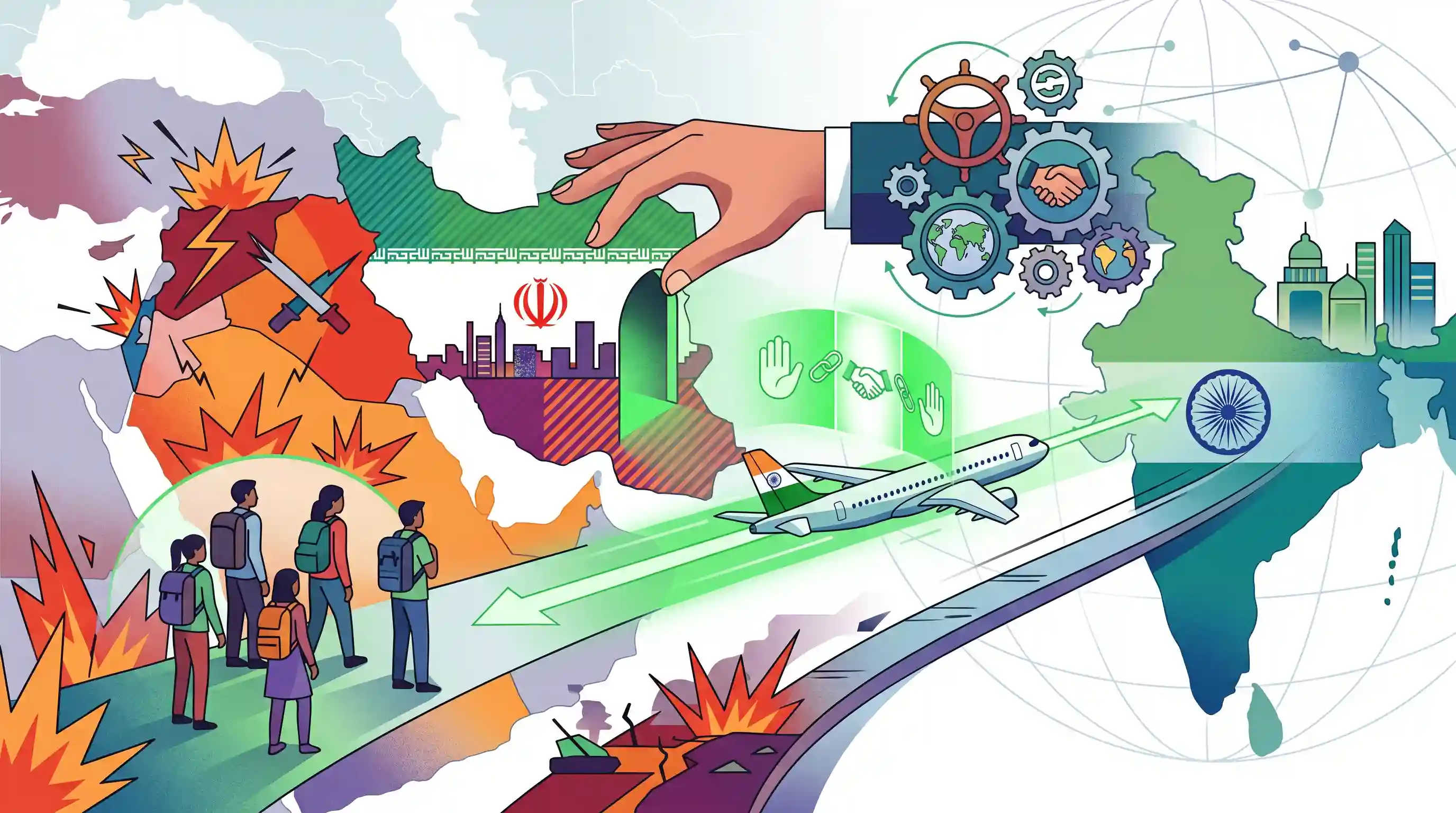
Amidst escalating conflict between Israel and Iran, India has commenced an evacuation operation to safely extract approximately 1,000 Indian students from the region. Notably, Iran has opened its airspace to facilitate the Indian evacuation flights. This development highlights India's successful diplomatic maneuvering and strategic autonomy in West Asia, allowing it to leverage strong bilateral relations with both adversarial nations to protect its diaspora during a crisis.
Key Points
- The Indian government has initiated the evacuation of approximately 1,000 Indian students from the escalating Israel-Iran conflict zone.
- Iran has opened its airspace specifically for Indian evacuation flights, demonstrating the depth and resilience of India-Iran bilateral relations amid regional tensions.
- The diplomatic coordination required for this evacuation underscores India's strategic autonomy and its unique ability to maintain pragmatic ties with both Israel and Iran.
- This operation further reinforces India's proactive policy of ensuring the safety of its diaspora in international crisis situations.
Important Terms
Strategic Autonomy

The ability of a state to pursue its national interests and sovereign foreign policy without being constrained by external powers or alliance obligations.
UPSC context
GS Paper 2 (International Relations); critical for understanding India's 'multi-alignment' and balancing acts between global rivals.
De-hyphenation Policy
A foreign policy approach where India deals with rival nations independently, ensuring that its relationship with one does not dictate or limit its engagement with the other.
UPSC context
GS Paper 2 (IR); specifically tests India's diplomatic maneuvers in the Middle East (Israel-Palestine/Iran) and South Asia.
Non-combatant Evacuation Operation (NEO)
Missions conducted to safely extract citizens (and sometimes foreign nationals) from regions facing conflict, political instability, or natural disasters.
UPSC context
GS Paper 2 (IR) & GS Paper 3 (Security/Disaster Management); tests India's logistical capacity and commitment to its overseas community.
Indian Diaspora
Non-Resident Indians (NRIs) and Persons of Indian Origin (PIOs) who act as a bridge for remittances, soft power, and diplomatic influence abroad.
UPSC context
GS Paper 2 (IR - Diaspora section); specifically mentioned in the syllabus regarding their effect on India’s interests.
West Asia Geopolitics
A strategically vital region for India's energy security (crude oil/LPG), trade, and approximately 9 million Indian expatriates; often managed via the 'Act West' policy.
UPSC context
GS Paper 2 (IR); vital for questions on energy security, maritime trade, and regional stability in India’s 'extended neighborhood'.
Prelims Trap
"The Indian government launched Operation Ajay to facilitate the safe repatriation of citizens from Iran."
Operation Ajay (2023) was launched to repatriate Indian citizens from Israel, not Iran. UPSC frequently swaps evacuation operation names and their corresponding conflict zones in prelims statements.
Static Concepts Connected
What is India's 'De-hyphenation' policy in West Asia?
- Independent Engagement: Engaging with two mutually adversarial nations (e.g., Israel and Iran/Palestine) independently, without letting ties with one dictate ties with the other.
- Issue-based Diplomacy: Bilateral relationships are evaluated strictly on mutual national interests rather than through a zero-sum geopolitical lens.
- Strategic Autonomy: Allows India to secure energy supplies, trade, and diaspora safety while refusing to take sides in regional conflicts.
Why is Iranian geography critical for India's strategic connectivity?
- Bypassing Pakistan: Iran provides crucial overland transit to Afghanistan and the resource-rich Central Asian Republics, successfully circumventing hostile Pakistani territory.
- Chabahar Port: A deep-water Iranian port on the Gulf of Oman offering a direct maritime link from India's western coast.
- INSTC Hub: Iran serves as a vital transit node for the multi-modal route connecting India to Russia and Europe.
Cross-Topic Patterns
Evacuation ops + West Asia Mapping
UPSC frequently tests the geography (bordering seas, straits, neighboring countries) of conflict zones that trigger massive Indian evacuation operations like Operation Ajay, Kaveri, or Raahat.
Diaspora Remittances + Current Account Deficit
Middle East instability simultaneously threatens both sides of India's Current Account. The region is India's primary source for oil imports while also supplying ~40% of its crucial inward remittances.

A match-the-following question pairing recent evacuations (Ajay, Kaveri, Ganga, Raahat) with target countries is highly probable in 2026.
Linked PYQs · 3
Linked PYQs · 3
- 2018MainsGS2
“India’s relations with Israel have, of late, acquired a depth and diversity, which cannot be rolled back.” Discuss.
- 2025MainsGS2
"Energy security constitutes the dominant kingpin of India's foreign policy, and is linked with India's overarching influence in Middle Eastern countries.” How would you integrate energy security with India's foreign policy trajectories in the coming years?
- 2023MainsGS2
Indian diaspora has scaled new heights in the West. Describe its economic and political benefits for India.
