US Military Direct Intervention Escalates Israel Iran Conflict
Source:The Hindu ↗
Why It Matters
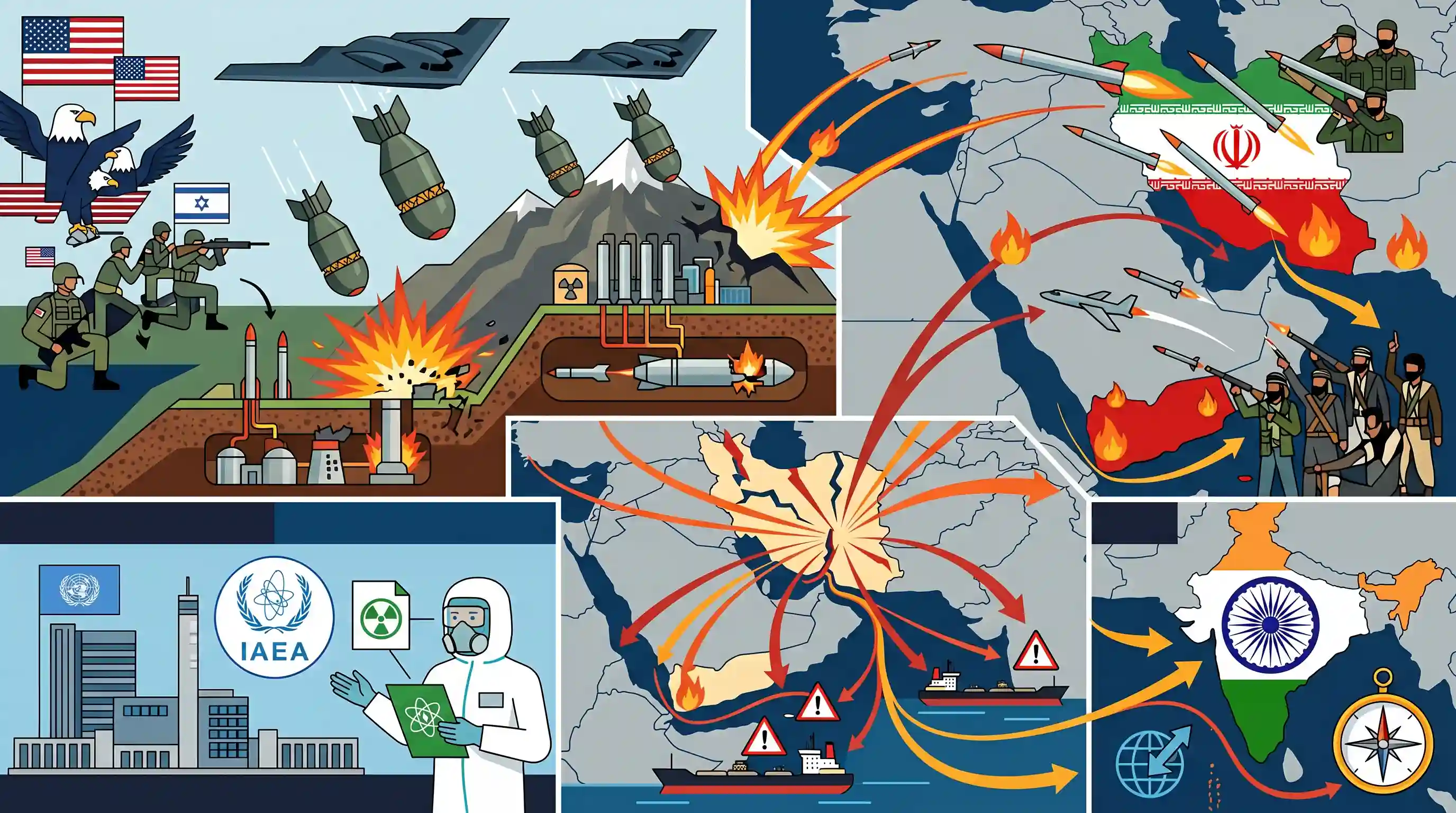
This unprecedented US direct military action against Iran fundamentally alters Middle East geopolitics. For India, the ensuing regional instability heavily impacts energy security, critical trade routes (like the Red Sea and Strait of Hormuz), and diaspora safety in West Asia.
Summary
The United States directly engaged in the Israel-Iran conflict by launching targeted airstrikes against three critical Iranian nuclear and military facilities, including the underground enrichment sites at Fordo and Natanz. Utilizing massive 30,000-pound bunker-buster bombs alongside Israeli forces, the coordinated operation aimed to cripple Iran's nuclear infrastructure. The strikes prompted immediate retaliatory missile launches from Iran's Revolutionary Guard and heightened threats from Houthi rebels in Yemen, sharply increasing the risk of a wider regional war. While the US claimed the facilities were completely destroyed, the UN nuclear watchdog (IAEA) reported no signs of radioactive contamination. This massive escalation severely threatens Middle Eastern stability and global energy security, particularly given the conflict's proximity to critical maritime transit routes like the Strait of Hormuz.
Key Points
- Unprecedented direct US involvement: The US directly attacked Iranian nuclear and military facilities for the first time, marking a significant escalation in the Middle East.
- Use of heavy weaponry: The operation employed massive 30,000-pound bunker-buster bombs to penetrate deeply fortified underground nuclear sites at Fordo and Natanz.
- Geopolitical fallout: The coordinated US-Israel strike drew retaliation from Iran's IRGC and mobilization calls from Yemen's Houthis, risking a broader regional war.
- Disputed nuclear damage: While US President Donald Trump claimed three nuclear sites were obliterated, the IAEA reported no immediate signs of radioactive release, suggesting core nuclear materials may have been previously moved.
- Economic and strategic chokepoints: The escalating conflict poses a major threat to global energy security, particularly concerning oil transport through the critical Strait of Hormuz.
Important Terms
International Atomic Energy Agency (IAEA)

An autonomous intergovernmental organization within the UN system that promotes peaceful nuclear energy and implements safeguards to ensure nuclear materials are not used for military purposes or weapons development.
UPSC context
GS Paper 2: International Relations; tests knowledge of global watchdogs, nuclear non-proliferation, and their role in maintaining international security.
Islamic Revolutionary Guard Corps (IRGC)
An elite branch of the Iranian Armed Forces reporting directly to the Supreme Leader. It manages Iran's ballistic missile programs, internal security, and regional proxy networks like the Quds Force.
UPSC context
GS Paper 2: International Relations; examines regional security dynamics, non-state actors, and West Asian geopolitics impacting India's interests.
Houthi Rebels
A Zaydi Shia militant group in Yemen, also known as Ansar Allah. Part of Iran’s 'Axis of Resistance,' they control northern Yemen and frequently target Red Sea maritime traffic.
UPSC context
GS Paper 2: International Relations; covers West Asian conflicts, maritime security (Red Sea crisis), and trade route disruptions.
Strait of Hormuz
A critical maritime chokepoint between the Persian Gulf and the Gulf of Oman. It is the world’s most vital oil transit route, through which 20% of global petroleum passes.
UPSC context
GS Paper 1: Geography and GS Paper 3: Energy Security; tests importance of chokepoints and their impact on global trade.
Natanz and Fordo
Iran's primary nuclear enrichment sites. Natanz is the largest facility, while Fordo is a heavily fortified underground site designed to withstand aerial strikes and protect advanced centrifuges.
UPSC context
GS Paper 2: International Relations; relevant for nuclear diplomacy, JCPOA status, and regional stability in West Asia.
Uranium Enrichment
The technical process of increasing the concentration of Uranium-235. Low enrichment (3-5%) is used for energy, while high enrichment (90%+) is required for nuclear weapons.
UPSC context
GS Paper 3: Science and Technology; tests understanding of nuclear energy, dual-use technology, and non-proliferation safeguards.
Prelims Trap
"The Strait of Hormuz is a critical chokepoint connecting the Red Sea to the Gulf of Aden."
Aspirants frequently confuse Middle Eastern straits. Hormuz connects the Persian Gulf to the Gulf of Oman, whereas Bab-el-Mandeb connects the Red Sea to the Gulf of Aden.
Static Concepts Connected
What are the key maritime chokepoints in West Asia?
- Strait of Hormuz: Connects the Persian Gulf to the Gulf of Oman and Arabian Sea. Over 20% of global petroleum consumption transits through this narrow passage.
- Bab-el-Mandeb: Connects the Red Sea to the Gulf of Aden. It is a critical gateway for maritime trade flowing toward the Suez Canal.
What is the mandate and reporting structure of the IAEA?
- Core Mandate: An autonomous international organization within the UN system tasked with verifying that states use nuclear technology solely for peaceful purposes.
- Reporting Structure: While it reports annually to the UN General Assembly, instances of non-compliance with nuclear safeguards are reported directly to the UN Security Council.
- Additional Protocol: Grants the IAEA expanded rights of access to information and locations in a state, enabling short-notice inspections of undeclared nuclear sites.
Cross-Topic Patterns
Gulf conflict & India's Current Account
Disruptions in the Strait of Hormuz spike crude prices, instantly widening India's Current Account Deficit (CAD) and fueling imported inflation, which complicates RBI's monetary policy stance.
Dual-chokepoint risks: Red Sea to Hormuz
Houthi disruption in the Red Sea combined with Iranian control over Hormuz creates a dual-chokepoint crisis, forcing global shipping to detour via the Cape of Good Hope, raising freight costs.

Mapping of Middle East straits (Hormuz/Bab-el-Mandeb) + IAEA's reporting structure likely to appear as a blended Prelims question.
Linked PYQs · 4
Linked PYQs · 4
- 2025MainsGS2
"Energy security constitutes the dominant kingpin of India's foreign policy, and is linked with India's overarching influence in Middle Eastern countries.” How would you integrate energy security with India's foreign policy trajectories in the coming years?
- 2018MainsGS2
“India’s relations with Israel have, of late, acquired a depth and diversity, which cannot be rolled back.” Discuss.
- 2017MainsGS2
The question of India's Energy Security constitutes the most important part of India's economic progress. Analyze India's energy policy cooperation with West Asian countries.
- 2024PrelimsGS1
Consider the following statements : Statement-I : Sumed pipeline is a strategic route for Persian Gulf oil and natural gas shipments to Europe. Statement-II : Sumed pipeline connects the Red Sea with the Mediterranean Sea. Which one of the following is correct in respect of the above statements?
