Gaza Ceasefire Violations and International Conflict Mediation
Source:Indian Express ↗
Why It Matters
This development highlights the evolving role of the US (under a new administration) and the UN in conflict resolution and post-war reconstruction in West Asia. Understanding the mechanics of international mediation, ceasefire demarcations, and stabilization forces is crucial for GS2 topics on international relations, global security, and the Middle East conflict.
Summary
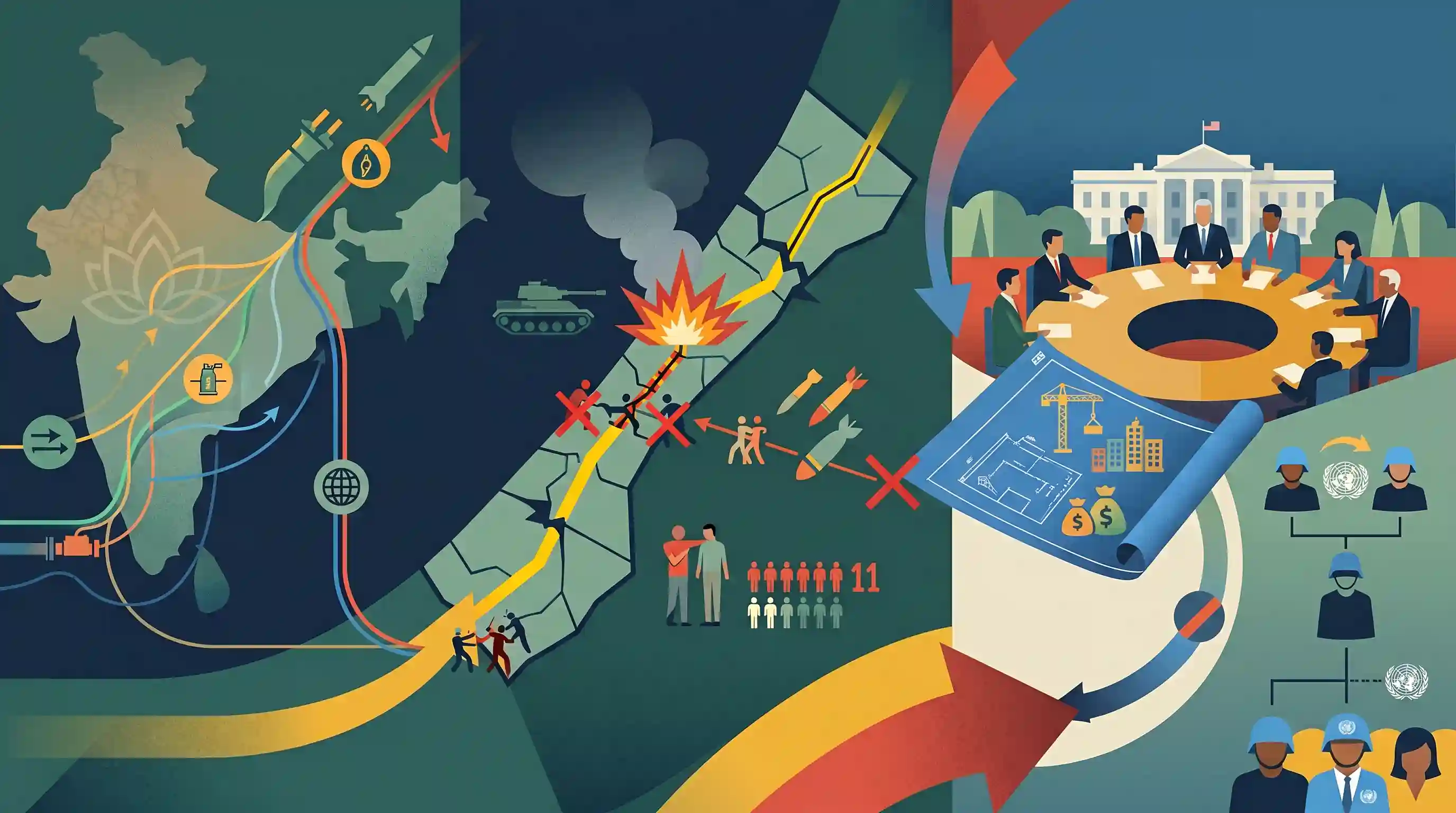
A fragile ceasefire in Gaza was shattered when Israeli airstrikes killed 11 Palestinians in response to an alleged Hamas breach of the 'Yellow Line'. The escalation coincides with the inaugural meeting of Donald Trump's 'Board of Peace' in Washington, which aims to unveil a multi-billion-dollar reconstruction plan and deploy a UN-authorized stabilization force in Gaza. The incident highlights the precarious nature of international mediation and the critical role of external powers in resolving the Middle East conflict.
Key Points
- Israeli airstrikes killed 11 Palestinians in Gaza, reacting to an alleged Hamas breach of the 'Yellow Line' ceasefire demarcation.
- Donald Trump’s newly established 'Board of Peace' is holding its first meeting in Washington to address the Middle East crisis.
- The US plans to announce a multi-billion-dollar reconstruction initiative for Gaza, which includes the deployment of a UN-authorized stabilization force.
- The 'Yellow Line' serves as a crucial geographical and political boundary separating Israeli and Hamas-controlled territories to sustain the fragile truce.
- The resurgence of violence threatens international mediation efforts aimed at stabilizing the region after the devastating war that began in October 2023.
Important Terms
Yellow Line Ceasefire Agreement

A notional boundary inside Gaza established under a 2025 US-brokered ceasefire, separating Israeli-controlled areas from Palestinian zones; its breach or shifting triggers renewed military escalation.
UPSC context
GS Paper 2: International Relations. Tests understanding of geopolitical boundaries, ceasefire mechanisms, and West Asia stability.
Board of Peace (BoP)
A transitional authority chaired by Donald Trump, mandated by UNSC Resolution 2803 to oversee Gaza's reconstruction and governance following the 2023-2025 conflict.
UPSC context
GS Paper 2: Important International institutions. Tests knowledge of ad-hoc international bodies and evolving global governance structures.
International Stabilization Force (ISF)
A multinational security force authorized by the UN to stabilize Gaza, oversee demilitarization, and maintain order during the reconstruction phase under the Board of Peace.
UPSC context
GS Paper 3: Security. Relates to peacekeeping operations, demilitarization challenges, and global security architecture.
Hamas
A Palestinian Sunni-Islamic fundamentalist, militant, and nationalist organization that has governed the Gaza Strip since 2007; a central party in the ongoing conflict and ceasefire negotiations.
UPSC context
GS Paper 2 & 3: International Relations and Internal Security. Focuses on non-state actors, terrorism, and regional political dynamics.
UNSC Resolution 2803
The 2025 measure that endorsed the Trump-led peace plan, authorized the Board of Peace, and established the legal framework for international intervention in post-war Gaza.
UPSC context
GS Paper 2: International Institutions. Tests ability to analyze specific UN mandates and their impact on global conflict resolution.
Two-State Solution
A proposed diplomatic solution for the Israeli-Palestinian conflict that envisions an independent State of Palestine alongside the State of Israel, a core tenet of India's foreign policy.
UPSC context
GS Paper 2: India's Foreign Policy. Critical for questions on India's balanced approach and historical stance in West Asia.
Prelims Trap
The Board of Peace is a UN agency enforcing the Yellow Line, an internationally recognized border between Israel and Palestine.
The Board is a US-led initiative, not a UN agency. Furthermore, the 'Yellow Line' is an Israeli-created military buffer inside Gaza, not a UN-recognized international border.
Static Concepts Connected
How do UN-authorized multinational forces differ from traditional UN Peacekeeping Operations?
- Command structure: UN peacekeepers (Blue Helmets) fall under direct UN command, whereas multinational forces (like the ISF) are commanded by a lead nation or a coalition of willing states.
- Funding mechanism: Traditional UN operations use assessed UN peacekeeping budgets, while multinational forces rely entirely on voluntary funding and resources provided by the participating countries.
- Mandate basis: UN peacekeeping generally relies on Chapter VI (pacific settlement), whereas UN-authorized multinational forces are often authorized under Chapter VII for active peace enforcement.
What is the procedural significance of an abstention in the UN Security Council?
- Non-veto passage: Under Article 27, a resolution passes if it secures nine affirmative votes and no P5 veto. A P5 abstention is not counted as a veto and allows passage.
- Political signaling: Abstentions allow permanent members (like Russia/China on Res 2803) to express political dissatisfaction or withhold endorsement without actively blocking crucial regional stabilization efforts.
Cross-Topic Patterns
De-hyphenation policy in the Middle East
India's 'observer status' in the Board of Peace reflects its continued de-hyphenation strategy, engaging with post-war reconstruction while avoiding direct endorsement of structures undermining UN primacy.
Lines of Control in West Asia
UPSC frequently tests West Asian boundary lines. The 'Yellow Line' (Gaza internal buffer) joins the 'Blue Line' (Israel-Lebanon) and 'Green Line' (1949 armistice) as a critical geographical marker for Prelims.

Mapping 'Yellow Line' (Gaza) vs 'Blue Line' (Lebanon) alongside the non-UN mandate of the ISF is highly probable in 2026 Prelims.
Linked PYQs · 3
Linked PYQs · 3
- 2025MainsGS2
"The reform process in the United Nations remains unresolved, because of the delicate imbalance of East and West and entanglement of the USA vs. Russo-Chinese alliance.” Examine and critically evaluate the East-West policy confrontations in this regard.
- 2018MainsGS2
“India’s relations with Israel have, of late, acquired a depth and diversity, which cannot be rolled back.” Discuss.
- 2023PrelimsGS1
Consider the following pairs: Area of conflict mentioned in news Country where it is located 1. Donbas : Syria 2. Kachin : Ethiopia 3. Tigray : North Yemen How many of the above pairs are correctly matched?
