US Brokered Ceasefire Takes Effect in Gaza Conflict
Source:The Hindu ↗
Why It Matters
The end of the Israel-Hamas war shapes the geopolitical landscape of West Asia, a region vital to India's energy security, diaspora, and economic initiatives like the I2U2 and IMEC. Additionally, the role of external powers like the US in brokering peace agreements is a recurring theme in global governance and international relations.
Summary
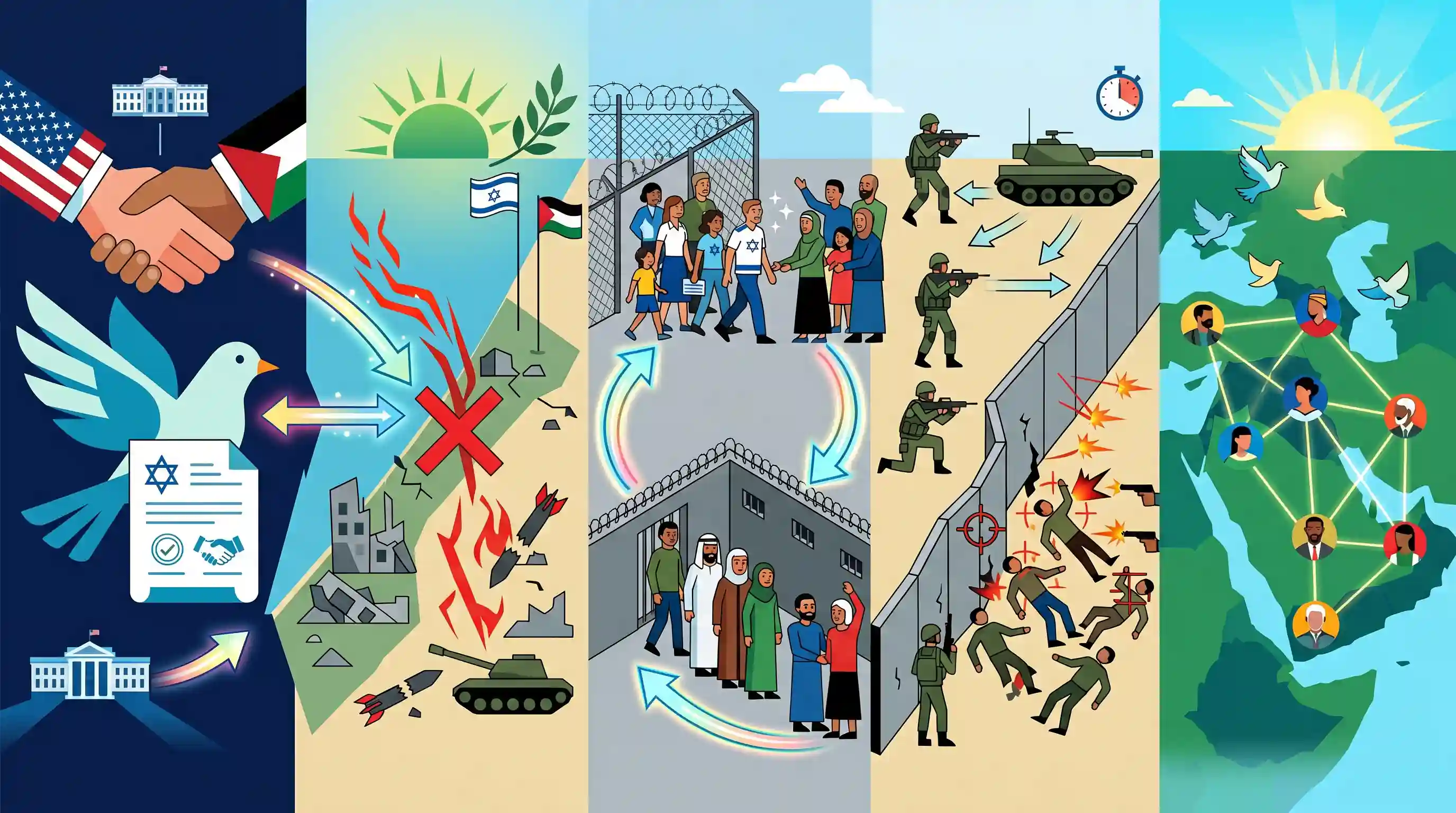
A U.S.-brokered ceasefire has taken effect in the Gaza Strip, marking the end of the two-year Israel-Hamas war, as declared by U.S. President Donald Trump. As part of the truce, Hamas released the last living Israeli hostages while Israel freed Palestinian detainees. Despite the agreement, tensions remain high; Israeli forces killed at least six Palestinians who crossed a boundary line during the initial stages of the Israeli pullback. The conflict's end aims to restore stability to the volatile West Asia region.
Key Points
- A U.S.-brokered ceasefire has commenced in Gaza, intended to end the two-year Israel-Hamas war.
- Violence occurred during the initial Israeli pullback when the Israeli military fatally shot at least six Palestinians approaching a boundary line.
- The ceasefire was accompanied by a hostage and prisoner exchange, with Hamas releasing the last living Israeli hostages and Israel returning Palestinian detainees.
- U.S. President Donald Trump formally declared the end of the conflict, which has heavily destabilized the broader West Asia region.
Important Terms
Hamas

A Palestinian Sunni-Islamic militant and political organization that has governed the Gaza Strip since 2007. It is designated as a terrorist group by several Western nations and Israel.
UPSC context
GS Paper 2 (International Relations); crucial for analyzing non-state actors and regional stability in West Asia.
Two-State Solution
A proposed diplomatic resolution envisioning an independent State of Palestine alongside the State of Israel, aimed at providing self-determination for both peoples based on pre-1967 borders.
UPSC context
GS Paper 2 (International Relations); represents India's consistent and long-standing diplomatic stance on the conflict.
West Asia
A strategically vital subregion of Asia including Israel, Palestine, Iran, and Saudi Arabia. It is a focal point of global politics due to energy resources and religious history.
UPSC context
GS Paper 2 (International Relations); vital for India’s energy security and "Look West" policy.
Gaza Strip
A small, densely populated Palestinian territory on the Mediterranean coast. It is a central flashpoint in the conflict and has been under a blockade for nearly two decades.
UPSC context
GS Paper 1 (Geography) and GS Paper 2; essential for map-based questions and territorial dispute analysis.
International Humanitarian Law (IHL)
A set of rules, including the Geneva Conventions, that limit the effects of armed conflict by protecting civilians and restricting the means and methods of warfare.
UPSC context
GS Paper 2 (International Laws); relevant to discussions on war crimes, civilian protection, and global human rights.
Hostage-Detainee Exchange
A diplomatic arrangement for the simultaneous release of captives held by opposing sides, often used as a humanitarian measure to facilitate ceasefires or peace negotiations.
UPSC context
GS Paper 2 (International Relations); reflects the humanitarian and negotiation aspects of modern conflict resolution.
Prelims Trap
"The Gaza Strip shares land borders with Israel, Egypt, and Jordan."
Gaza only borders Israel and Egypt. It is the West Bank that shares a border with Jordan. UPSC frequently swaps these territories in map-based questions.
Static Concepts Connected
What are the key geographical borders and crossings of the Gaza Strip?
- Land Borders: It is bounded by the Mediterranean Sea to the west, Israel to the north and east, and Egypt to the southwest.
- Rafah Crossing: The only exit point from Gaza into Egypt's Sinai Peninsula. It is strategically crucial because it is the only crossing that does not lead into Israeli territory.
What distinguishes the Abraham Accords from the traditional West Asian peace process?
- Traditional Process: Historically hinged on the "Two-State Solution," requiring the establishment of an independent Palestinian state as a strict prerequisite for broader Arab-Israeli peace.
- Abraham Accords: A 2020 US-brokered framework that normalized diplomatic and trade relations between Israel and Arab states (like UAE and Bahrain) independent of resolving Palestinian statehood.
Cross-Topic Patterns
Ceasefire impact on IMEC Corridor
Stability in Israel and the broader Arab region is critical for reviving the India-Middle East-Europe Economic Corridor (IMEC), which was stalled by the Gaza conflict.
De-hyphenation in Indian Foreign Policy
India's parallel diplomacy—supporting Israel's security while advocating for a Two-State Solution—will be tested as post-war Gaza reconstruction and peace-building negotiations begin.

Map questions matching Mediterranean littoral states, Gaza crossings (Rafah), and West Asian corridors are highly probable in Prelims 2026.
Linked PYQs · 3
Linked PYQs · 3
- 2015PrelimsGS1
Which one of the following countries of South-West Asia does not open out to the Mediterranean Sea?
- 2017PrelimsGS1
Mediterranean Sea is a border of which of the following countries? 1. Jordan 2. Iraq 3. Lebanon 4. Syria Select the correct answer using the code given below:
- 2022MainsGS2
How will I2U2 (India, Israel, UAE and USA) grouping transform India's position in global politics?
