Rafah Border Crossing Reopening and Humanitarian Crisis in Gaza
Source:The Hindu ↗
Why It Matters
The Rafah crossing is of immense geopolitical and geographic importance, serving as Gaza's sole border not controlled by Israel. This development is crucial for UPSC aspirants as it touches upon West Asia geopolitics, the complexities of the Israel-Palestine conflict, and the role of international mediators (like the US and EU) in resolving humanitarian crises, subjects frequently tested in GS Paper 2 and Prelims mapping questions.
Summary
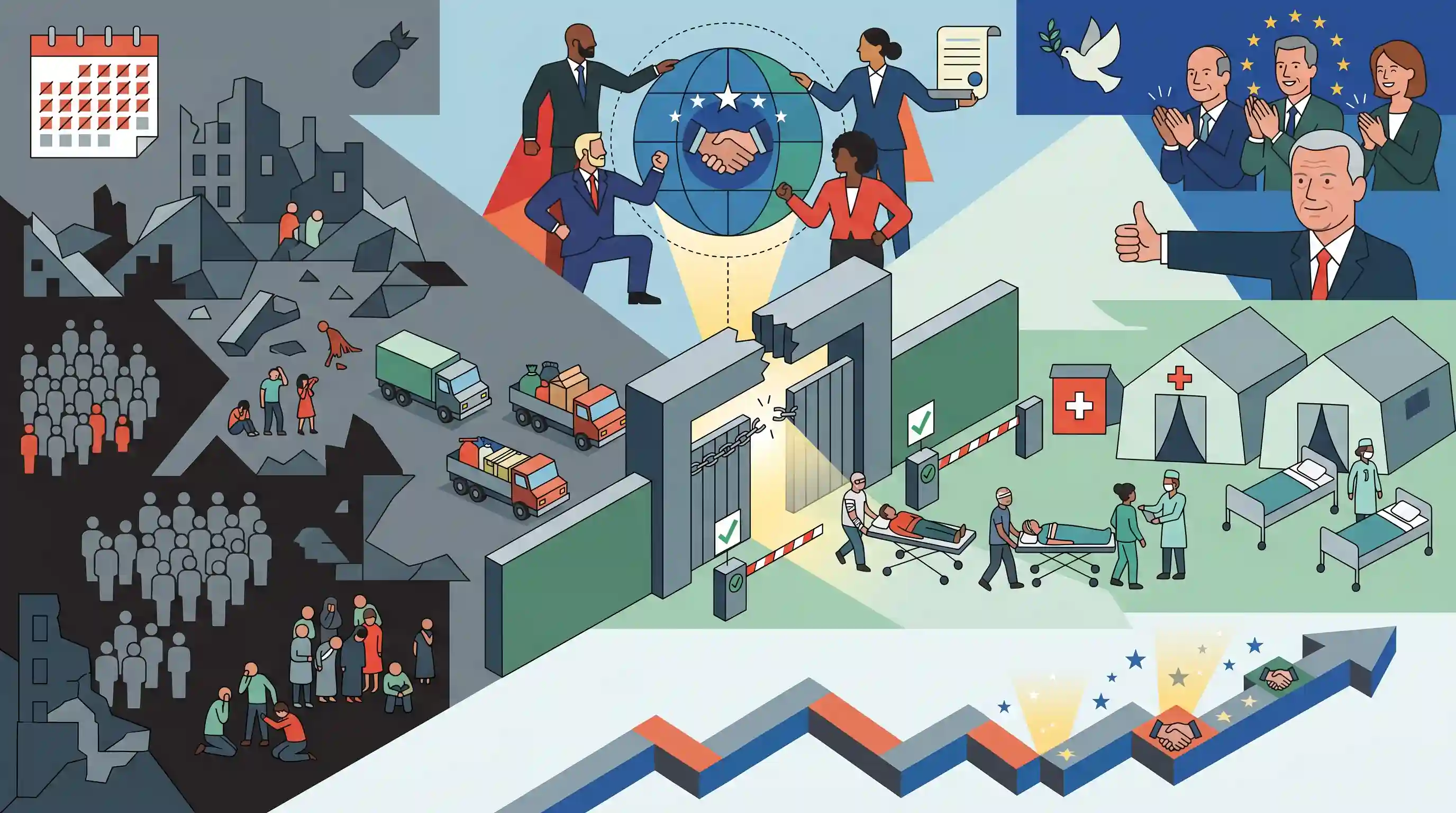
The Rafah border crossing between Gaza and Egypt has partially reopened for the first time since its capture by Israeli forces in May 2024. Operating under a US-brokered ceasefire agreement, the crossing has resumed limited functions, primarily allowing patients to leave for Egypt and facilitating restricted entry into Gaza. The reopening is seen as a critical step in addressing the severe humanitarian crisis stemming from a two-year war that claimed over 71,800 lives and caused mass displacement. The development was welcomed by international figures, including the EU foreign policy chief, as a positive stride in the ongoing peace process.
Key Points
- The Rafah border crossing between Gaza and Egypt partially reopened for the first time since being seized by Israeli forces in May 2024.
- The reopening is part of a US-brokered ceasefire plan aimed at ending the two-year Gaza conflict.
- The crossing will initially allow limited movement, facilitating the exit of patients to Egypt and specific entries into Gaza.
- The two-year conflict resulted in a severe humanitarian crisis, with over 71,800 fatalities and mass displacement of Gaza's population.
Important Terms
Rafah Border Crossing

The sole border crossing between Egypt and the Gaza Strip not controlled by Israel, serving as a vital conduit for humanitarian aid and civilian movement.
UPSC context
GS Paper-II (International Relations); critical for West Asia geopolitics, humanitarian logistics, and regional stability.
Hamas
A Palestinian political and militant organization that governed Gaza since 2007; categorized as a terrorist group by Israel, the US, and the EU.
UPSC context
GS Paper-II; central actor in the Israel-Palestine conflict and regional security dynamics.
Philadelphi Corridor
A 14-km strategic buffer zone along the Egypt-Gaza border, intended to prevent smuggling and control movement between the territories.
UPSC context
GS Paper-II; key point of contention in ceasefire negotiations and border security.
EUBAM Rafah
An EU civilian mission established to provide a neutral, third-party presence at the Rafah crossing to monitor operations and support Palestinian border guards.
UPSC context
GS Paper-II; illustrates the role of international organizations in conflict resolution and border management.
20-Point Peace Plan
A US-brokered diplomatic framework aiming to end the Gaza conflict through phased hostage releases, ceasefire zones (Yellow Line), and humanitarian restoration.
UPSC context
GS Paper-II; tests understanding of external mediation and complex peace treaties in West Asia.
Palestinian Authority (PA)
The interim governing body established to exercise limited self-rule in parts of the West Bank and Gaza Strip, following the 1993 Oslo Accords.
UPSC context
GS Paper-II; essential for discussing Palestinian statehood and internal political governance.
Prelims Trap
"The Rafah crossing is a crucial transit point connecting the Gaza Strip directly to Israel."
Aspirants often assume all Gaza crossings lead into Israel. Rafah is the sole exit point connecting Gaza directly to Egypt's Sinai Peninsula, not Israel.
Static Concepts Connected
What are the key border crossings of the Gaza Strip and their locations?
- Rafah Crossing: Located in the south, it is the sole crossing connecting Gaza to Egypt's Sinai Peninsula.
- Erez Crossing: Located in the north, it connects Gaza to Israel and is primarily used for pedestrian and civilian movement.
- Kerem Shalom: Located in the south near the Egyptian border, it connects Gaza to Israel and functions as the main commercial goods junction.
What is India's 'De-hyphenation' policy in West Asia?
- Independent Ties: Treating diplomatic relations with Israel and Palestine as mutually independent, rather than linked or as a zero-sum game.
- Strategic Pragmatism: It allows India to pursue deep defense and strategic ties with Israel while maintaining historical support for a sovereign Palestinian state.
Cross-Topic Patterns
Levant Geography + Mediterranean Map
UPSC frequently asks map questions matching regions to seas. Expect Rafah, Sinai, and Gaza to be tested against Mediterranean border countries or the broader Levant region geography.
UNSC Paralysis + Rise of Minilaterals
The reliance on the US or regional actors (Egypt) for ceasefires highlights UNSC ineffectiveness, paving the way for alternative regional minilaterals like I2U2 and IMEEC.

Expect a Prelims match-the-following on Gaza border crossings (Rafah, Erez, Kerem Shalom) and their adjacent nations in 2026.
Linked PYQs · 2
Linked PYQs · 2
- 2022PrelimsGS1
The term "Levant" often heard in the news roughly corresponds to which of the following regions?
- 2018MainsGS2
“India’s relations with Israel have, of late, acquired a depth and diversity, which cannot be rolled back.” Discuss.
