Gaza Conflict Escalation and UN Diplomatic Recognition of Palestine
Source:The Hindu ↗
Why It Matters
The collective move by Western nations to recognize Palestinian statehood at the UN represents a significant geopolitical shift that challenges traditional diplomatic paradigms in the Middle East. For UPSC aspirants, understanding the interplay of domestic politics, international law, and multilateral institutions (UN) in managing persistent global conflicts is crucial for IR analysis.
Summary
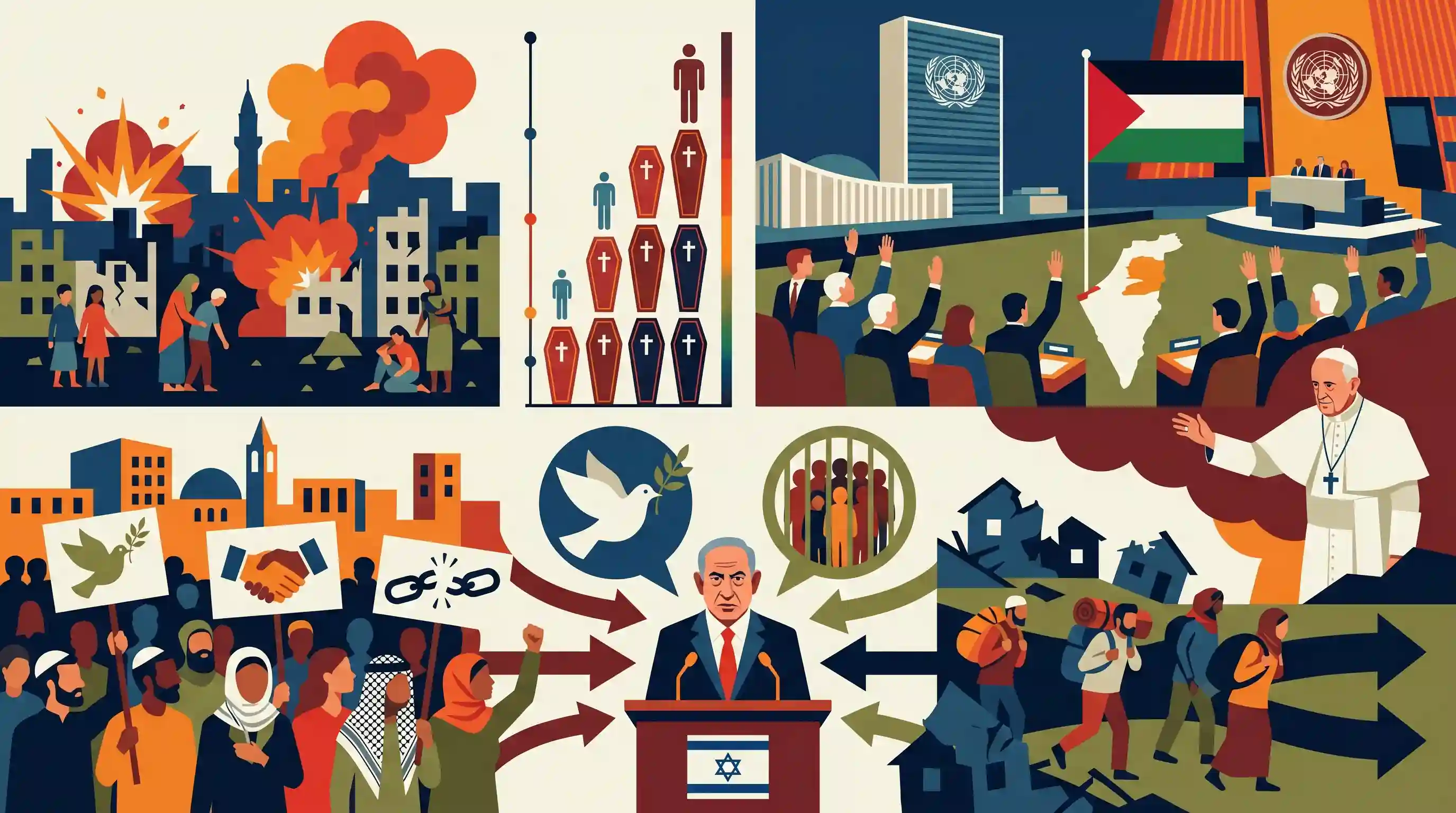
The 23-month-old Israel-Hamas war has escalated further with deadly Israeli strikes in Gaza City exacerbating a dire humanitarian crisis, prompting international and domestic uproar. As the death toll reaches 65,000, several Western nations plan to formally recognise Palestinian statehood at the upcoming UN General Assembly. Meanwhile, Pope Leo XIV has condemned the forced displacement of Palestinians, and massive civil protests within Israel—including a Jewish-Arab alliance called the "It's Time Coalition"—are heavily pressuring PM Benjamin Netanyahu to agree to a ceasefire and hostage-release deal.
Key Points
- An Israeli strike on a residential block in Gaza City killed at least 14 Palestinians, pushing the total death toll of the 23-month war to nearly 65,000.
- Western nations, including the UK, France, and Canada, are preparing to formally recognise an independent Palestinian state at the upcoming UN General Assembly.
- The UN reports extreme humanitarian suffering in Gaza, citing mass forced displacement to the south and widespread famine.
- Pope Leo XIV issued a strong appeal for peace, explicitly condemning the "forced exile" of Palestinians.
- Domestic pressure on Israeli PM Benjamin Netanyahu is intensifying, with mass protests and groups like the 'It's Time Coalition' demanding an immediate hostage deal, ceasefire, and recognition of a Palestinian state.
Important Terms
United Nations General Assembly (UNGA)

The primary deliberative and policymaking organ of the United Nations where all 193 member states have equal representation to discuss global issues like peace, security, and international law.
UPSC context
GS Paper II (International Relations). Crucial for understanding global governance, UN reforms, and India's voting patterns on multilateral resolutions.
It’s Time Coalition
An alliance of over 60 Jewish and Arab civil society and peace organizations in Israel advocating for a ceasefire, hostage release, and a political solution based on mutual self-determination.
UPSC context
GS Paper II (International Relations/Civil Society). Tests knowledge of pressure groups, internal domestic dynamics in conflict zones, and grassroots peacebuilding efforts.
Two-State Solution
A proposed diplomatic resolution to the Israeli-Palestinian conflict establishing an independent State of Palestine alongside the State of Israel, based on pre-1967 borders and mutual security.
UPSC context
GS Paper II (International Relations). The cornerstone of India's West Asia policy and a recurring topic regarding Middle East stability.
Palestinian Statehood
The formal diplomatic recognition of Palestine as a sovereign, independent entity by nations and international bodies, granting it the legal capacity to conduct inter-state relations.
UPSC context
GS Paper II (International Relations). Key for analyzing sovereignty, international recognition criteria (Montevideo Convention), and the shifting stance of Western powers.
International Humanitarian Law (IHL)
A set of international rules, including the Geneva Conventions, established to limit the effects of armed conflict by protecting civilians and restricting the methods of warfare.
UPSC context
GS Paper II (Important International Institutions/Law). Essential for questions on war crimes, human rights in conflict, and the role of the ICC/ICJ.
Non-member Observer State
A status granted by the UNGA (since 2012) allowing Palestine to participate in proceedings and join international treaties (like the Rome Statute) without full membership or voting rights.
UPSC context
GS Paper II (International Relations). Relevant for understanding the hierarchy of UN membership and the procedural steps toward full state recognition.
Prelims Trap
Palestine gained full UN membership after formal recognition by Western nations at the UN General Assembly.
Individual state recognition doesn't confer UN membership. Full UN membership strictly requires a UNSC recommendation (subject to P5 veto) followed by a 2/3 UNGA majority.
Static Concepts Connected
How does a state gain full membership in the United Nations?
- UNSC Recommendation: Requires an affirmative vote of 9 out of 15 members, with no vetoes from the five permanent members (P5).
- UNGA Approval: Following the UNSC recommendation, admission requires a two-thirds majority vote in the UN General Assembly.
- Observer Status: Palestine is currently a 'non-member observer state', allowing it to participate in UNGA debates and join treaties, but without UN voting rights.
How does International Humanitarian Law protect civilians from displacement?
- Geneva Conventions: The Fourth Geneva Convention (1949) specifically establishes the protections for civilian populations in conflict zones and occupied territories.
- Article 49 Prohibition: Article 49 strictly prohibits individual or mass forcible transfers and deportations of protected persons from occupied territory to the territory of the Occupying Power or any other country.
- Collective Punishment: It strictly forbids collective penalties, intimidation, and the destruction of personal or real property during an armed conflict.
Cross-Topic Patterns
India's 'De-hyphenation' West Asia policy
India decoupled its Israel and Palestine policies to maintain independent, standalone ties with both. This balances strategic defense partnerships with Israel and historical solidarity and capacity building for Palestine.
Levant mapping and Mediterranean borders
UPSC frequently tests West Asian geography. The conflict renews focus on the borders of Gaza, Israel, West Bank, Golan Heights, Lebanon, and the Mediterranean coastline (the Levant).

Expect a multi-statement question in 2026 pairing Levant map boundaries with the specific veto-dependent UN membership admission process.
Linked PYQs · 5
Linked PYQs · 5
- 2023PrelimsGS1
Consider the following statements: Statement-I: Israel has established diplomatic relations with some Arab States. Statement-II: The 'Arab Peace Initiative' mediated by Saudi Arabia was signed by Israel and Arab League. Which one of the following is correct in respect of the above statements?
- 2023PrelimsGS1
Consider the following pairs: Regions often mentioned in news Reason for being in news 1. North Kivu and Ituri : War between Armenia and Azerbaijan 2. Nagorno-Karabakh : Insurgency in Mozambique 3. Kherson and Zaporizhzhia : Dispute between Israel and Lebanon How many of the above pairs are correctly matched?
- 2022PrelimsGS1
The term "Levant" often heard in the news roughly corresponds to which of the following regions?
- 2018MainsGS2
“India’s relations with Israel have, of late, acquired a depth and diversity, which cannot be rolled back.” Discuss.
- 2019MainsGS2
‘Too little cash, too much politics, leaves UNESCO fighting for life.’ Discuss the statement in the light of US' withdrawal and its accusation of the cultural body as being 'anti-Israel bias'.
