Israel Doubts Success of Doha Airstrike Against Hamas
Source:Indian Express ↗
Why It Matters
The escalation of Israeli military operations into sovereign third-party states (Qatar) fundamentally shifts West Asian geopolitics and mediation dynamics. Understanding the responses of major powers like the US and EU is crucial for UPSC aspirants analyzing international diplomacy, sovereign rights, and global conflict resolution mechanisms.
Summary
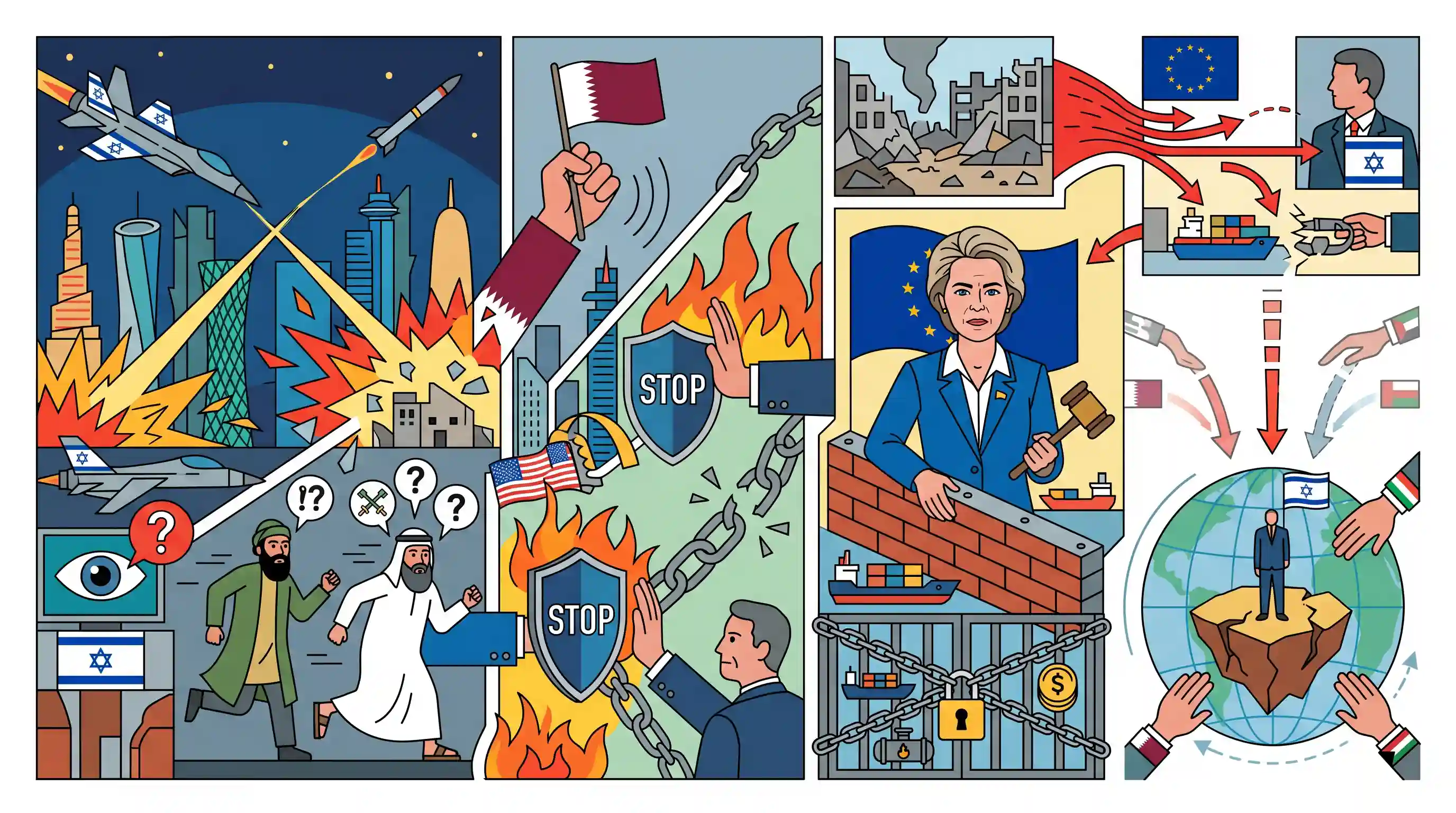
Israel has cast doubt on the success of its recent airstrike in Doha, Qatar, dubbed \"Operation Summit of Fire,\" which intended to assassinate senior Hamas leaders Khaled Meshaal and Khalil al-Hayya. The unilateral military action on Qatari soil has drawn significant international pushback. The United States quickly distanced itself from the strike, highlighting the diplomatic sensitivity of bombing a close regional ally. Meanwhile, European Commission President Ursula von der Leyen announced she will seek to impose sanctions and suspend trade with Israel in response to its broader conduct in Gaza, reflecting Israel's growing diplomatic isolation.
Key Points
- Israel launched \"Operation Summit of Fire,\" an airstrike in Doha, Qatar, targeting senior Hamas leaders, but now doubts its success.
- The unilateral strike on Qatari soil prompted the US to distance itself, reflecting tensions over military actions inside a close allied state.
- European Commission President Ursula von der Leyen signaled intent to propose trade suspensions and sanctions against Israel over its actions in Gaza.
- The event highlights Israel's increasingly strained diplomatic ties and the growing push for international accountability measures.
Important Terms
Hamas

A Palestinian Sunni-Islamic fundamentalist organization governing the Gaza Strip, operating both political and military wings.
UPSC context
GS Paper II (West Asia Geopolitics). Tests understanding of non-state actors and regional stability.
West Asia Geopolitics
The interplay of political, military, and economic power in the Middle East, influenced by regional rivalries and external interests.
UPSC context
Core GS Paper II topic. Essential for understanding India’s strategic interests and energy security.
Unilateralism
A state policy of taking decisive military or diplomatic action without consulting or seeking the consent of international allies.
UPSC context
GS Paper II (International Relations). Relates to state sovereignty and the breakdown of multilateralism.
Economic Sanctions
Commercial and financial penalties applied by countries to a state or group to influence behavior or punish policy.
UPSC context
GS Paper II. Tests knowledge of non-military tools of coercion in global statecraft.
Diplomatic Isolation
A state of being excluded from international engagement due to widespread condemnation of a nation's actions.
UPSC context
GS Paper II. Relevant for analyzing soft power and the impact of international norms.
European Union (EU)
A supranational political and economic union of 27 member states that coordinates common foreign and trade policies.
UPSC context
GS Paper II (Global Groupings). Crucial for understanding regional blocs in global governance.
Doha (Qatar)
The capital of Qatar and a key regional diplomatic hub serving as a mediator between global powers and militant groups.
UPSC context
Prelims (Places in News) and GS II. Highlighting Qatar's role as a strategic mediator.
Qualified Majority Voting (QMV)
The EU's voting method requiring 55% of member states representing 65% of the population to approve high-stakes decisions.
UPSC context
GS Paper II (International Institutions). Tests knowledge of decision-making processes in supranational bodies.
Prelims Trap
The 'unwilling or unable' doctrine is an explicitly codified exception under Chapter VII of the UN Charter.
It is not codified in the UN Charter. It is a controversial, customary international law argument used by states to justify extraterritorial strikes against non-state actors.
Static Concepts Connected
What are the strategic geographical borders and features of Qatar?
- Land border: It shares its only terrestrial border with Saudi Arabia to the south.
- Maritime boundaries: It shares maritime boundaries with Bahrain, Iran, and the United Arab Emirates.
- Geoeconomic significance: Located in the Persian Gulf, it contains the massive North Field, making it a critical global node for Liquefied Natural Gas (LNG) supplies.
How does the UN Charter govern extraterritorial military strikes?
- Article 2(4): Prohibits the threat or use of force against the territorial integrity or political independence of any sovereign state.
- Article 51 exception: Permits the use of force strictly as an inherent right of individual or collective self-defense if an armed attack occurs.
- Customary gray areas: States increasingly invoke the controversial "unwilling or unable" doctrine to justify self-defense strikes against militants in third-party states that allegedly fail to mitigate the threat.
Cross-Topic Patterns
EU FTAs and human rights clauses
The EU leverages human rights conditionalities (Article 2) to suspend trade. This mirrors the non-trade barriers and sustainability/rights clauses that remain major sticking points in ongoing India-EU FTA negotiations.
Levant to Persian Gulf spillover
Israel's military reach expanding from the Levant into the Persian Gulf (Qatar) threatens vital global maritime chokepoints like the Strait of Hormuz, directly impacting India's energy security and diaspora.

Expect 2026 map questions contrasting Levant/Persian Gulf borders, or a conceptual IR prelims statement on the 'unwilling or unable' doctrine.
Linked PYQs · 5
Linked PYQs · 5
- 2018MainsGS2
“India’s relations with Israel have, of late, acquired a depth and diversity, which cannot be rolled back.” Discuss.
- 2025MainsGS2
"Energy security constitutes the dominant kingpin of India's foreign policy, and is linked with India's overarching influence in Middle Eastern countries.” How would you integrate energy security with India's foreign policy trajectories in the coming years?
- 2023PrelimsGS1
Consider the following pairs: Area of conflict mentioned in news Country where it is located 1. Donbas : Syria 2. Kachin : Ethiopia 3. Tigray : North Yemen How many of the above pairs are correctly matched?
- 2023PrelimsGS1
Consider the following pairs: Regions often mentioned in news Reason for being in news 1. North Kivu and Ituri : War between Armenia and Azerbaijan 2. Nagorno-Karabakh : Insurgency in Mozambique 3. Kherson and Zaporizhzhia : Dispute between Israel and Lebanon How many of the above pairs are correctly matched?
- 2022PrelimsGS1
The term "Levant" often heard in the news roughly corresponds to which of the following regions?
