Israel Palestine conflict escalation and humanitarian crisis in Gaza
Source:The Hindu ↗
Why It Matters
The ongoing Israel-Hamas conflict is a core topic for UPSC GS2 (International Relations). The article highlights the strategic military maneuvers in Gaza, the severe humanitarian crisis, and the response of international bodies like the UN. This context is essential for questions regarding global conflicts, the effectiveness of the UN in maintaining peace, and India's geopolitical considerations in West Asia.
Summary
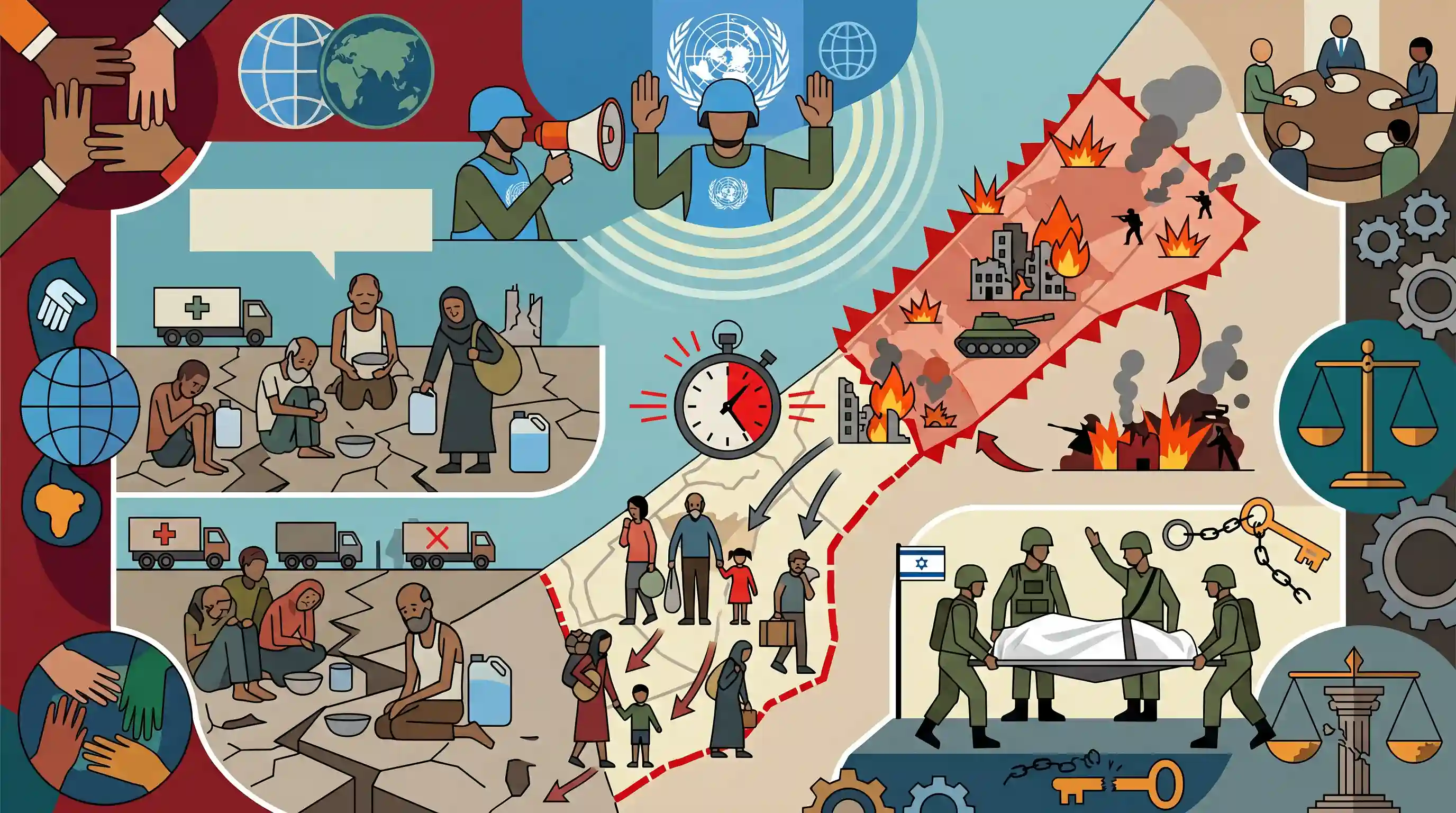
Israel has declared Gaza's largest city, Gaza City, a dangerous combat zone and halted mid-day humanitarian pauses, urging remaining civilians to flee south. The resumption of intense hostilities in neighborhoods like Shujaiyah and Sabra has displaced thousands more, prompting grave warnings from the U.N. humanitarian agency regarding the dire conditions of exhausted and malnourished Palestinians. Amidst the fighting, Israeli forces and the Shin Bet recovered the body of a hostage, Ilan Weiss. The developments highlight the continuing complexities of the Israel-Hamas conflict and the worsening humanitarian catastrophe in the region.
Key Points
- Israel has declared Gaza City a dangerous combat zone, urging residents to flee southwards, thus worsening the mass displacement crisis.
- The Israeli military halted mid-day humanitarian pauses in the fighting in Gaza, exacerbating the humanitarian disaster.
- The UN humanitarian agency warned that hundreds of thousands of exhausted and malnourished Palestinians have been forced to flee again.
- Israeli forces recovered the body of 56-year-old hostage Ilan Weiss during the operations in Gaza.
- Israel's stated objective remains dismantling Hamas militarily and politically to secure its territory and retrieve hostages.
Important Terms
Hamas

A Palestinian Sunni-Islamic fundamentalist and militant organization that has governed the Gaza Strip since 2007; its name is an acronym for 'Harakat al-Muqawamah al-Islamiya' (Islamic Resistance Movement).
UPSC context
GS Paper II (International Relations): Relevant for understanding West Asian geopolitics, non-state actors in conflict, and India's balanced diplomatic stance in the region.
Shin Bet
Israel's internal security agency (Israel Security Agency - ISA), responsible for counter-intelligence and counter-terrorism within Israel and the Palestinian territories; it reports directly to the Prime Minister.
UPSC context
GS Paper III (Security): Important for comparative study of global intelligence agencies and their role in regional security and counter-terrorism operations.
UNRWA (U.N. Humanitarian Agency)
The primary United Nations agency established in 1949 to provide education, healthcare, and relief services to Palestinian refugees displaced during the 1948 and 1967 conflicts.
UPSC context
GS Paper II (International Institutions): Focuses on the role of global agencies in humanitarian crises and India's continued financial/diplomatic support for Palestinian aid.
Israeli Defense Forces (IDF)
The unified military forces of the State of Israel, comprising ground forces, air force, and navy, tasked with national defense and security operations in Gaza and the West Bank.
UPSC context
GS Paper II (International Relations): Essential for analyzing India-Israel defense cooperation and the military dynamics of the West Asian conflict.
International Humanitarian Law (IHL)
A set of international rules (Jus in Bello) established by the Geneva Conventions to limit the effects of armed conflict and protect non-combatants like civilians and aid workers.
UPSC context
GS Paper II (Ethics/International Relations): Tests knowledge of global legal frameworks, human rights protections in war zones, and the ethics of proportional military response.
Humanitarian Pause
A temporary cessation of hostilities for a defined period and specific geographic area to allow the delivery of aid, medical evacuations, or safe passage for civilians.
UPSC context
GS Paper II (International Relations): Relevant for discussing conflict resolution mechanisms and the diplomatic challenges of maintaining humanitarian access during active warfare.
Prelims Trap
"A humanitarian pause is a legally binding, permanent ceasefire mandated by the United Nations Security Council."
A humanitarian pause is a temporary, often informal cessation of hostilities for relief purposes. It is practically and legally distinct from a formal, negotiated political ceasefire.
Static Concepts Connected
What are the core principles of International Humanitarian Law during armed conflicts?
- Distinction: Warring parties must strictly distinguish between combatants and non-combatants, directing attacks solely at military objectives.
- Proportionality: Incidental loss of civilian life or damage to civilian property must not outweigh the anticipated direct military advantage of an attack.
- Precaution: Constant care must be taken in all military operations to spare the civilian population and civilian objects from harm.
What are the key geographical boundaries and crossings of the Gaza Strip?
- Geographical Borders: Bounded by the Mediterranean Sea to the west, Israel to the north and east, and Egypt (Sinai Peninsula) to the south.
- Key Transit Crossings: The Rafah crossing connects Gaza to Egypt; the Kerem Shalom and Erez crossings connect it to Israel.
Cross-Topic Patterns
UNSC Gridlock and Global South
The inability to enforce humanitarian pauses highlights UNSC paralysis, strengthening India's diplomatic push for urgent multilateral reforms and championing Global South interests in global governance.
Urban Warfare & Asymmetric Conflicts
The tactical challenges of fighting non-state actors in dense areas (Gaza) overlap with internal security syllabus topics on counter-insurgency doctrines, collateral damage, and human rights.

Map locations of the Levant (Gaza, Rafah) combined with Geneva Convention principles (IHL) form a highly probable Prelims question in 2026.
Linked PYQs · 3
Linked PYQs · 3
- 2022PrelimsGS1
The term "Levant" often heard in the news roughly corresponds to which of the following regions?
- 2023PrelimsGS1
Consider the following statements: Statement-I: Israel has established diplomatic relations with some Arab States. Statement-II: The 'Arab Peace Initiative' mediated by Saudi Arabia was signed by Israel and Arab League. Which one of the following is correct in respect of the above statements?
- 2018MainsGS2
“India’s relations with Israel have, of late, acquired a depth and diversity, which cannot be rolled back.” Discuss.
