Israel Launches Ground Offensive to Occupy Gaza City
Source:Indian Express ↗
Why It Matters
The Israel-Palestine conflict is a major geopolitical flashpoint that affects global security, diplomatic alignments, and potentially energy markets. For UPSC aspirants, understanding the evolving dynamics of this conflict, the role of mediators like the US and Qatar, and the geographical layout of the region (often tested in Prelims) is crucial for analyzing India's foreign policy approach towards West Asia.
Summary
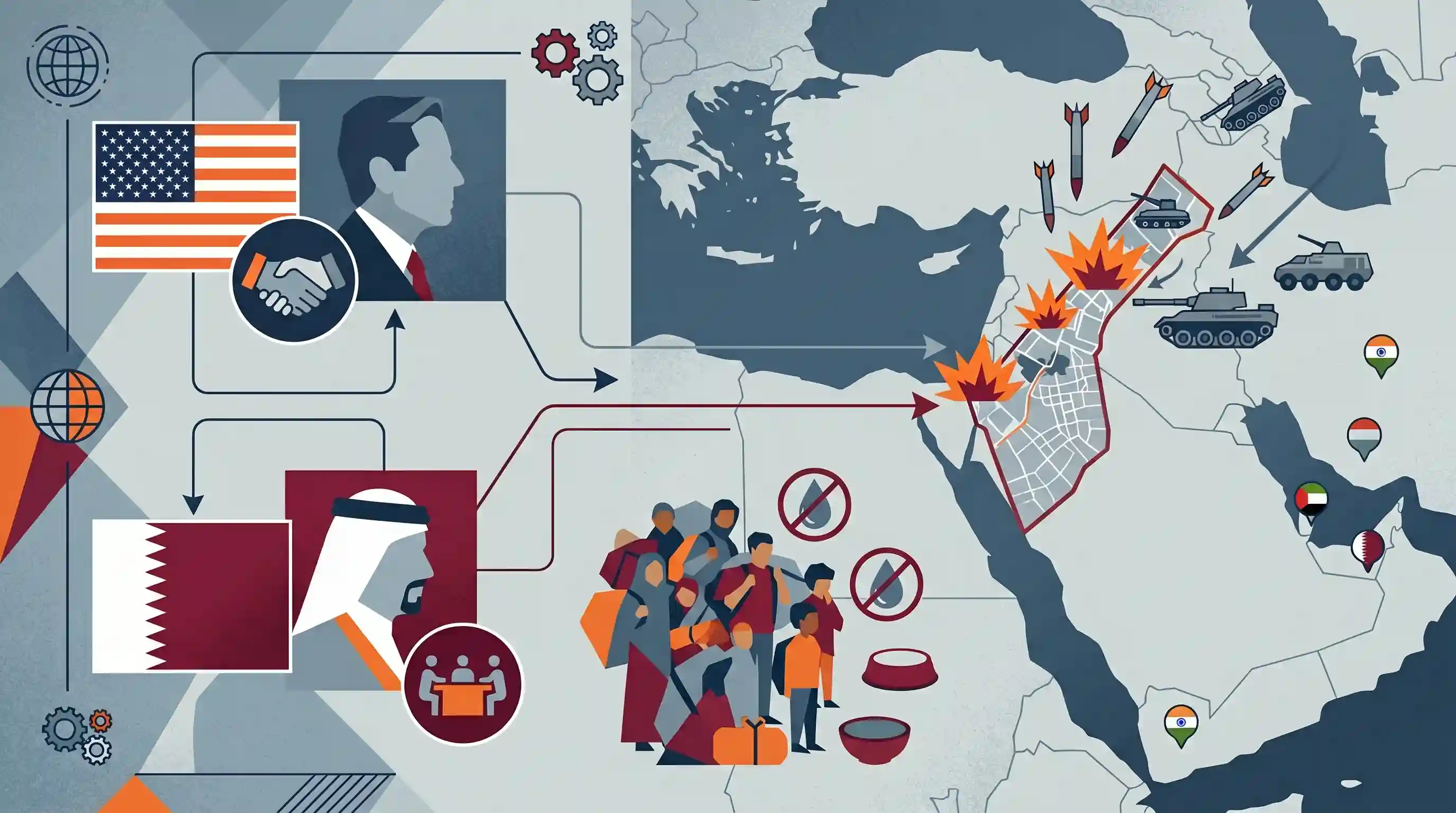
Israel has initiated a ground offensive aimed at occupying Gaza City, marking a significant escalation in the ongoing conflict that began after the October 2023 Hamas attacks. The Israeli Defense Forces (IDF) have intensified their bombardment of the region. Concurrently, international diplomatic efforts persist, with figures like US Secretary of State Marco Rubio and Qatari mediators working to broker a ceasefire agreement amidst the worsening humanitarian and geopolitical crisis.
Key Points
- Israel has launched a ground offensive with the objective of occupying Gaza City, significantly escalating the conflict.
- The military action is accompanied by intensified bombardment by the Israel Defense Forces (IDF).
- The offensive continues the military campaign that began following the October 2023 attacks by Hamas.
- Simultaneously, international diplomatic efforts are underway, with the US (represented by Secretary of State Marco Rubio) and Qatar involved in ceasefire negotiations.
Important Terms
Hamas

A Palestinian Sunni-Islamic fundamentalist organization that governs the Gaza Strip. Founded in 1987, it combines social welfare with a militant wing (Al-Qassam Brigades) and is designated a terrorist group by many nations.
UPSC context
GS Paper II: International Relations and Security. Tests understanding of non-state actors, Middle East conflict, and their impact on global security.
Israel Defense Forces (IDF)
The national military of Israel, established in 1948. It comprises ground, air, and naval branches and operates under a doctrine of rapid mobilization to defend against regional threats.
UPSC context
GS Paper II: International Relations. Relevant for studying state-level military operations and defense cooperation (including India-Israel strategic ties).
Two-State Solution
A proposed diplomatic framework for the Israeli-Palestinian conflict that envisions two independent states—Israel and Palestine—living side-by-side in peace based on the 1967 borders.
UPSC context
GS Paper II: International Relations. India's longstanding official stance; tests knowledge of diplomatic resolutions to global conflicts.
Gaza Strip
A narrow coastal territory on the eastern Mediterranean, bordered by Israel and Egypt. It is a central flashpoint of the conflict and has been under an Israeli-led blockade since 2007.
UPSC context
GS Paper I: World Geography. Essential for map-based questions and understanding the physical and geopolitical constraints of West Asia.
Abraham Accords
A series of US-brokered normalization agreements signed in 2020 between Israel and several Arab nations (UAE, Bahrain, Sudan, Morocco), reshaping West Asian geopolitics.
UPSC context
GS Paper II: IR. Tests knowledge of shifting regional alliances and their impact on India's 'Link West' policy.
West Asia Geopolitics
The study of the intersection of politics, geography, and power in the Middle East, including regional rivalries (e.g., Iran-Israel) and India's strategic energy and diaspora interests.
UPSC context
GS Paper II: International Relations. Critical for analyzing the 'Effect of policies of developed/developing countries on India's interests'.
Prelims Trap
"The Philadelphi Corridor is a demilitarized buffer zone separating Israel and the Gaza Strip."
The Philadelphi Corridor is located along the border between the Gaza Strip and Egypt, not Israel. It encompasses the vital Rafah crossing.
Static Concepts Connected
What is India's 'De-hyphenation' policy in West Asia?
- Standalone ties: India treats its relations with Israel and Palestine as mutually independent, refusing to view one through the lens of the other.
- Strategic shift: It marks a departure from historical balancing, allowing deep defense/tech ties with Israel without abandoning diplomatic support for the Palestinian cause.
What are the geographical boundaries of the Gaza Strip?
- Southwest border: Borders Egypt, separated by the 14-km demilitarized Philadelphi Corridor and the Rafah border crossing.
- North and East: Shares heavily fortified land borders entirely with Israel.
- Western boundary: Bounded by the Mediterranean Sea, though its maritime access and coastal waters are heavily restricted.
Cross-Topic Patterns
Spillover into maritime chokepoints
Prolonged Gaza operations frequently trigger secondary conflicts, such as Houthi strikes in the Red Sea, directly threatening India's energy security and maritime transit costs.
Mediation as diplomatic capital
Qatar's role in hosting both US military bases and Hamas political offices mirrors a growing global trend of middle-power 'mediation diplomacy' in asymmetric conflicts.

Map questions combining Levant chokepoints (Philadelphi, Rafah) with India’s de-hyphenation diplomacy are highly likely in 2026.
Linked PYQs · 2
Linked PYQs · 2
- 2017PrelimsGS1
Mediterranean Sea is a border of which of the following countries? 1. Jordan 2. Iraq 3. Lebanon 4. Syria Select the correct answer using the code given below:
- 2018MainsGS2
“India’s relations with Israel have, of late, acquired a depth and diversity, which cannot be rolled back.” Discuss.
