Strait of Hormuz Closure and Global Energy Disruption
Source:The Hindu ↗
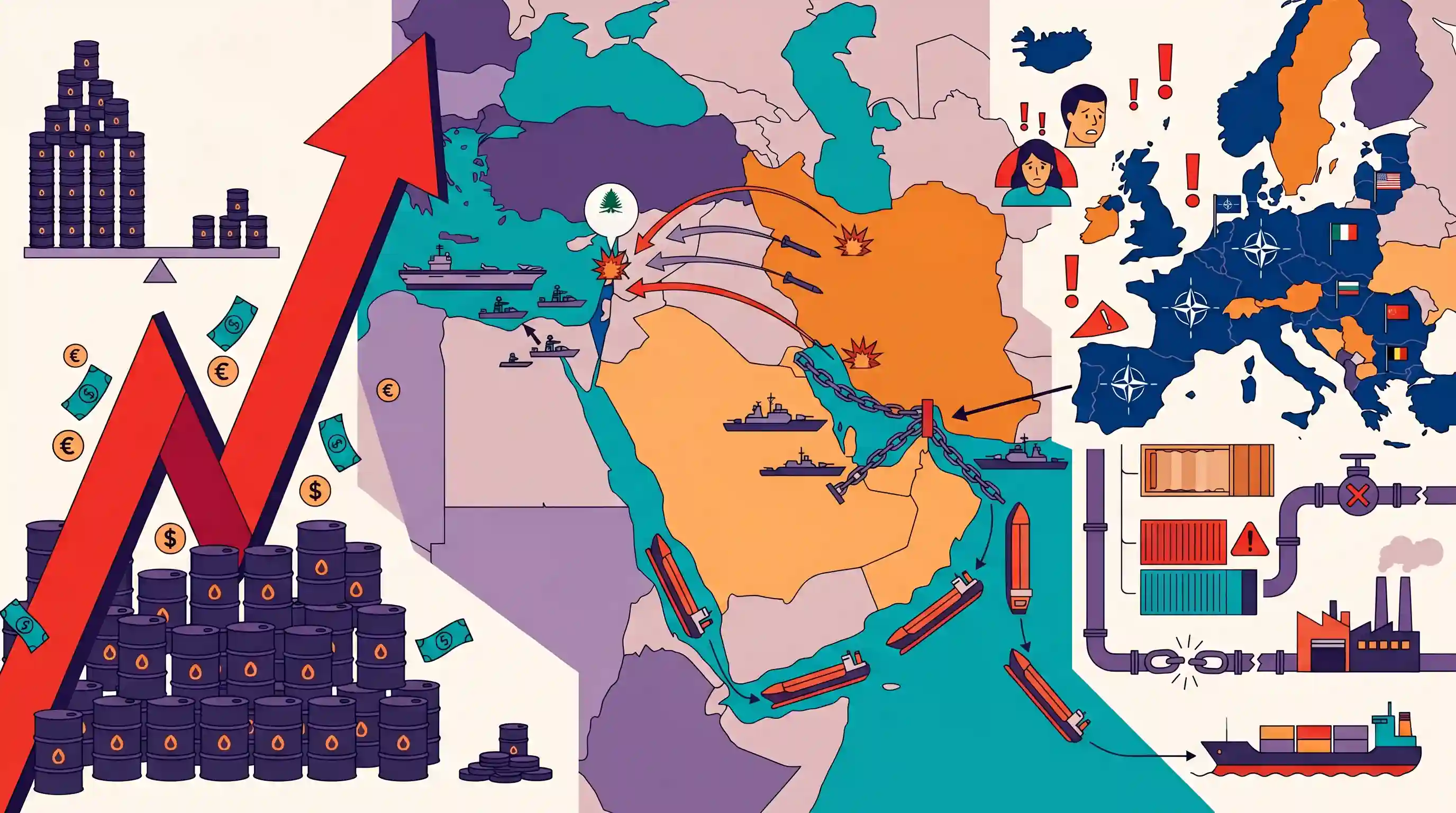
Why It Matters
The ongoing conflict highlights the strategic vulnerability of global energy supply chains, specifically around the Strait of Hormuz. For UPSC aspirants, this illustrates the intersection of West Asian geopolitics (GS2), international trade, and India's energy and macroeconomic security (GS3), as well as critical maritime geography (GS1).
Summary
Tensions in West Asia have escalated sharply following Israel's retaliatory strikes on Iranian military sites and Hezbollah targets in Beirut, prompting the United States to deploy Marines to the Mediterranean. The ensuing conflict has effectively closed the Strait of Hormuz, a critical global maritime choke point, leading to a dramatic 50% spike in oil prices. The situation has raised alarm among European NATO allies regarding energy security and supply chain disruptions, highlighting the fragile nature of global energy dependence on the region.
Key Points
- Israel launched direct military strikes on military installations in Tehran and suspected Hezbollah strongholds in Beirut's southern suburbs.
- The United States deployed approximately 2,000 Marines and an amphibious assault ship to the eastern Mediterranean to deter further regional escalation.
- The Strait of Hormuz, a critical maritime choke point through which a fifth of global oil and LNG passes, has effectively been closed due to the conflict.
- Global crude oil prices spiked by 50% in response to the disruptions, threatening global macroeconomic stability.
- European NATO allies, particularly France and Germany, remain hesitant to join direct fighting but are prioritizing the security of maritime transit routes in the Persian Gulf.
Important Terms
Strait of Hormuz

A narrow waterway between the Persian Gulf and Gulf of Oman. It is the world's most critical oil transit choke point, handling approximately 20% of global consumption.
UPSC context
GS-I (Geography) and GS-II (IR). Critical for energy security; disruptions impact India’s oil prices and inflation.
Hezbollah
A Lebanon-based Shia militant group and political party backed by Iran. It is a major non-state actor in the "Axis of Resistance" opposing Israel.
UPSC context
GS-II (IR). Tests understanding of regional security, non-state actors, and proxy conflicts in West Asia.
NATO (North Atlantic Treaty Organization)
An intergovernmental military alliance of 32 North American and European countries based on collective defense, where an attack on one is an attack on all.
UPSC context
GS-II (International Organizations). Relevant for collective security, global response to conflicts, and impacts on European energy security.
West Asia
The westernmost subregion of Asia, vital for global energy supplies and home to over 9 million Indian expatriates who provide significant remittances.
UPSC context
GS-II (IR). Essential for India's "Link West" policy, energy security, and strategic diaspora engagement.
Maritime Choke Point
Strategic, narrow passages on global sea routes where maritime traffic is concentrated, making trade and energy flows vulnerable to blockades or disruptions.
UPSC context
GS-I (Geography) and GS-III (Security). Critical for mapping and analyzing global trade vulnerabilities and energy supply chains.
Energy Security
The uninterrupted availability of energy sources at an affordable price, vital for a country's economic stability and continuous industrial production.
UPSC context
GS-III (Economy/Environment). Key to India’s growth strategy and resilience against global oil price shocks.
Prelims Trap
"The Strait of Hormuz is bordered by Iran and Saudi Arabia."
While crucial for Saudi oil exports, the Strait is actually bordered by Iran to the north, and Oman (Musandam exclave) and the UAE to the south.
Static Concepts Connected
How do crude oil price shocks affect India's macroeconomic indicators?
- Inflation dynamics: Causes direct 'imported inflation', which hits the Wholesale Price Index (WPI) harder than the CPI because fuel holds a significantly higher weightage (10.4%) in WPI.
- External sector: Higher import bills immediately widen the Current Account Deficit (CAD) and exert depreciative pressure on the Indian Rupee against the dollar.
What are the critical maritime chokepoints in West Asia?
- Strait of Hormuz: Connects the Persian Gulf to the Gulf of Oman and Arabian Sea. Bordered by Iran, Oman, and the UAE. Critical for global oil and LNG transport.
- Bab-el-Mandeb: Connects the Red Sea to the Gulf of Aden and Arabian Sea. Bordered by Yemen on the Arabian Peninsula, and Djibouti and Eritrea in Africa.
Cross-Topic Patterns
Geopolitics & Strategic Petroleum Reserves
Frequent West Asian disruptions push India to expand its Strategic Petroleum Reserves (SPR) program and rapidly diversify crude imports to non-OPEC suppliers like Russia and the US.
Maritime Chokepoints & the IMEC Corridor
The vulnerability of the Strait of Hormuz and Red Sea shipping lanes accelerates the strategic imperative for the India-Middle East-Europe Economic Corridor (IMEC) to bypass maritime choke points.

Mapping of West Asian straits paired with imported inflation (WPI vs CPI dynamics) is highly probable as a multi-statement Prelims question.
Linked PYQs · 5
Linked PYQs · 5
- 2018MainsGS2
“India’s relations with Israel have, of late, acquired a depth and diversity, which cannot be rolled back.” Discuss.
- 2018MainsGS2
In what ways would the ongoing US-Iran Nuclear Pact Controversy affect the national interest of India? How should India respond to this situation?
- 2012MainsGS2
How have the US sanctions against Iran affected India's bilateral relations with Iran?
- 2024PrelimsGS1
Consider the following statements : Statement-I : Sumed pipeline is a strategic route for Persian Gulf oil and natural gas shipments to Europe. Statement-II : Sumed pipeline connects the Red Sea with the Mediterranean Sea. Which one of the following is correct in respect of the above statements?
- 2014PrelimsGS1
Turkey is located between
