Israeli Airstrikes Target Houthi Infrastructure in Yemen
Source:The Hindu ↗
Why It Matters
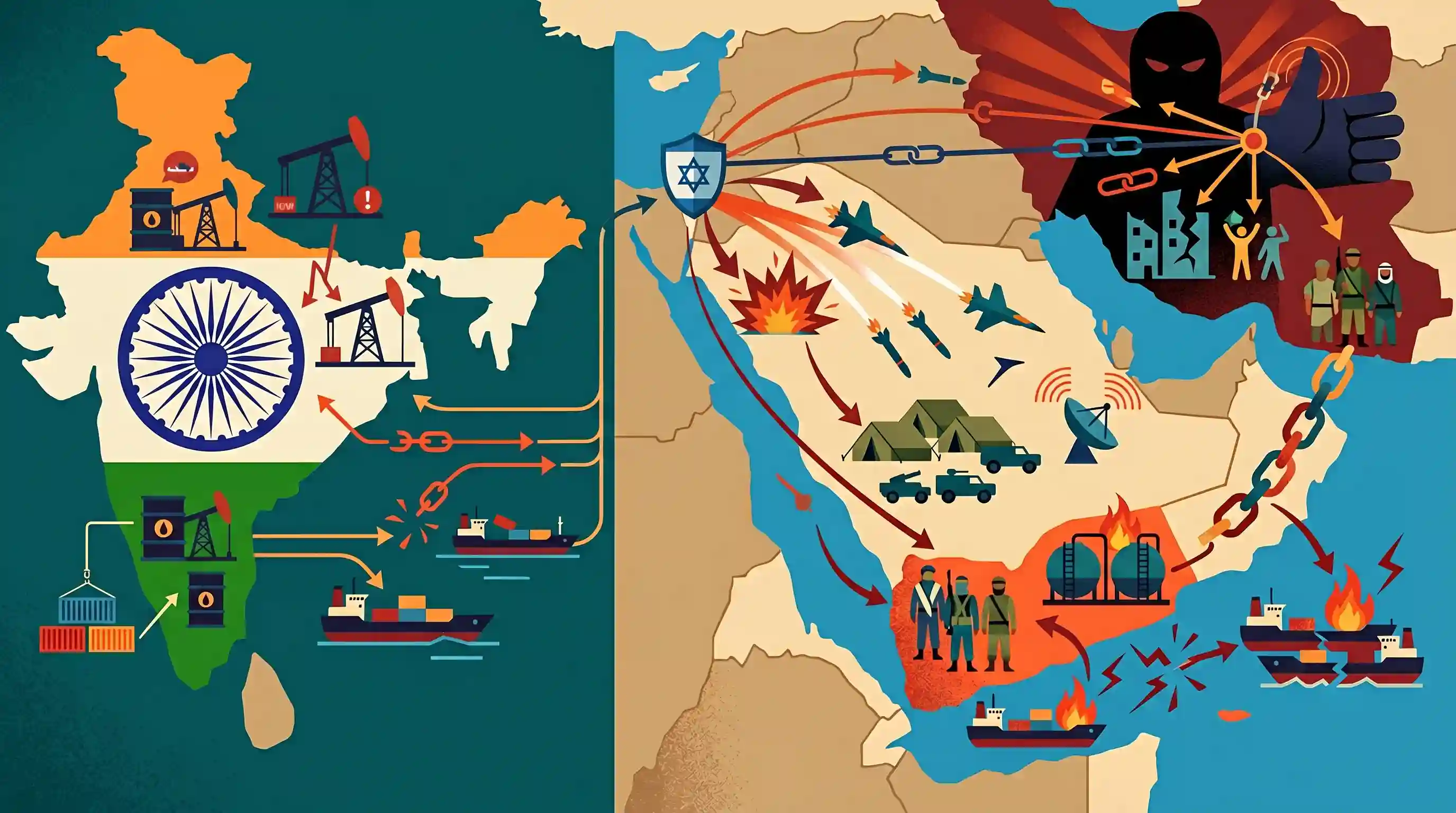
The expansion of the Israel-Hamas war into the Red Sea directly threatens global maritime trade and energy security. The disruption of shipping lanes through the Suez Canal and Red Sea impacts India's imports and exports, causing logistical delays and increased freight costs. Understanding the geopolitical dynamics of the Middle East is crucial for UPSC aspirants, as it frequently appears in Prelims (Places in News) and Mains (International Relations).
Summary
The article reports on Israeli military strikes against Houthi targets in Sanaa and Al Jawf, Yemen. The strikes, which hit military camps, propaganda centers, and fuel infrastructure, are a retaliation for Houthi missile attacks on Israel and their ongoing disruption of commercial shipping in the Red Sea. The Houthis, acting in solidarity with Palestinians in Gaza, are part of the broader Iran-aligned 'Axis of Resistance'. This military action highlights the continuous regional spillover of the Israel-Hamas war into a multi-front conflict involving various Middle Eastern non-state actors.
Key Points
- Israel conducted air strikes on the Houthi-controlled Yemeni capital Sanaa and the northern province of Al Jawf.
- The military strikes targeted Houthi military camps, propaganda headquarters, and fuel storage infrastructure.
- Israel's action was a direct retaliation for Houthi ballistic missile and drone attacks on Israeli territory and international shipping in the Red Sea.
- The Iran-aligned Houthis claim their attacks are acts of solidarity with Palestinians amid the ongoing war in Gaza.
- This development underscores the widening scope of the Middle East conflict, increasingly involving multiple proxies within Iran's Axis of Resistance.
Important Terms
Houthis

An Iran-aligned Zaydi Shia militant and political group (officially Ansar Allah) that controls northern Yemen, including Sanaa. They are central to Yemen's civil war and recent maritime disruptions.
UPSC context
GS Paper II (IR); tests knowledge of non-state actors affecting global maritime security and India's trade.
Axis of Resistance
An informal, Iran-led geopolitical and military coalition of state and non-state actors (including Hezbollah, Hamas, and Houthis) dedicated to countering Western and Israeli influence in West Asia.
UPSC context
GS Paper II (International Relations); examines regional power dynamics and Iran’s strategic depth in the Middle East.
Sanaa
The capital of Yemen and one of the world's oldest continuously inhabited cities. It is a UNESCO World Heritage site currently under the control of the Houthi movement.
UPSC context
Prelims (Places in News); relevant for geographical locations and cultural heritage sites under threat due to conflict.
Red Sea
A critical maritime corridor connecting the Mediterranean (via Suez Canal) to the Indian Ocean (via Bab el-Mandeb). It is a vital choke point for global trade.
UPSC context
GS Paper III (Security/Economy); tests impact of maritime instability on India’s energy security and export costs.
Al Jawf
A strategic northern province in Yemen bordering Saudi Arabia, serving as a significant operational and military hub for Houthi forces and frequently targeted in regional strikes.
UPSC context
Prelims (Places in News); identification of regions involved in the West Asian conflict landscape.
Hamas
A Palestinian Sunni Islamist political and militant organization that has governed the Gaza Strip since 2007 and is a core member of the Iran-backed Axis of Resistance.
UPSC context
GS Paper II (IR); relates to regional instability and the spillover effects of the Israel-Palestine conflict.
Prelims Trap
"The Houthi-controlled Bab el-Mandeb Strait connects the Red Sea to the Persian Gulf."
The Bab el-Mandeb strait connects the Red Sea to the Gulf of Aden and the Arabian Sea. The Strait of Hormuz connects to the Persian Gulf.
Static Concepts Connected
Which countries border the Red Sea and what are its key chokepoints?
- Eastern border: Saudi Arabia and Yemen.
- Western border: Egypt, Sudan, Eritrea, and Djibouti.
- Northern chokepoints: Suez Canal (connecting to Mediterranean) and Gulf of Aqaba.
- Southern chokepoint: Bab el-Mandeb strait, a crucial bottleneck separating Yemen from Djibouti and Eritrea, leading to the Gulf of Aden.
How do Red Sea disruptions impact India's macroeconomic stability?
- Freight cost surge: Rerouting via the Cape of Good Hope increases transit time by 12-15 days, drastically surging container freight rates and insurance premiums.
- Export competitiveness: Low-margin, high-volume Indian exports like textiles, chemicals, and agricultural goods lose price competitiveness in European and US East Coast markets.
- Imported inflation: Increased supply chain costs and delayed shipments of crucial inputs (like crude oil and fertilizers) feed directly into domestic inflation.
Cross-Topic Patterns
Red Sea crisis & Strategic Petroleum Reserves
Rerouting vessels around Africa exposes India's oil and fertilizer import vulnerability, elevating the policy urgency to expand India's Strategic Petroleum Reserves (ISPRL) and diversify supply chains.
Asymmetric warfare in the maritime domain
The deployment of cheap, Iranian-designed loitering munitions by the Houthis against advanced naval vessels demonstrates asymmetric maritime warfare, directly relevant to GS-3 internal security and defense technology themes.

2026 Prelims will likely feature a map question pairing West Asian conflict zones (Sanaa, Al Jawf) with controlling factions or straits.
Linked PYQs · 5
Linked PYQs · 5
- 2023PrelimsGS1
Consider the following pairs: Area of conflict mentioned in news Country where it is located 1. Donbas : Syria 2. Kachin : Ethiopia 3. Tigray : North Yemen How many of the above pairs are correctly matched?
- 2022PrelimsGS1
The term "Levant" often heard in the news roughly corresponds to which of the following regions?
- 2023PrelimsGS1
Consider the following statements: Statement-I: Israel has established diplomatic relations with some Arab States. Statement-II: The 'Arab Peace Initiative' mediated by Saudi Arabia was signed by Israel and Arab League. Which one of the following is correct in respect of the above statements?
- 2024PrelimsGS1
Consider the following statements : Statement-I : Sumed pipeline is a strategic route for Persian Gulf oil and natural gas shipments to Europe. Statement-II : Sumed pipeline connects the Red Sea with the Mediterranean Sea. Which one of the following is correct in respect of the above statements?
- 2018MainsGS2
“India’s relations with Israel have, of late, acquired a depth and diversity, which cannot be rolled back.” Discuss.
