Israel Lebanon Conflict and Establishment of Yellow Line
Source:The Hindu ↗
Why It Matters
Understanding geopolitical dynamics and conflict resolution mechanisms in the Middle East is vital for international relations, as regional instability affects global security, energy supply chains, and Indian foreign policy.
Summary
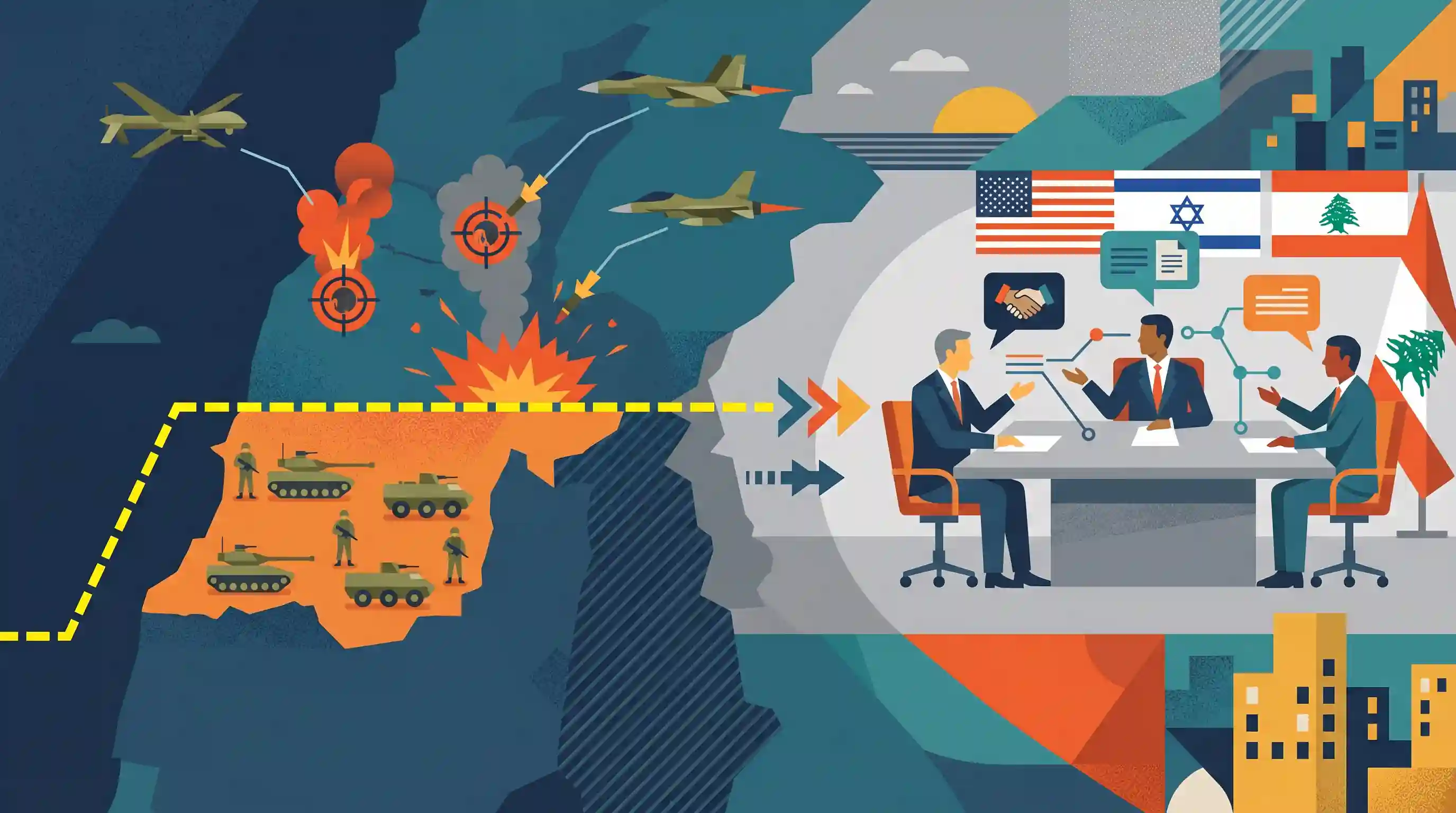
The Israeli military has established a 'Yellow Line' in southern Lebanon to demarcate its troop presence amid an ongoing 10-day ceasefire. Mirroring a tactic used in Gaza against Hamas, this line aims to secure operational boundaries, although Israel continues to launch airstrikes against suspected Hezbollah elements perceived as threats. The developments occur alongside negotiations involving US, Israeli, and Lebanese leadership to end the broader conflict.
Key Points
- The Israeli military established a "Yellow Line" in southern Lebanon as a demarcation line for its troops amidst a 10-day ceasefire.
- A similar tactical line was previously created in the Gaza Strip to separate forces from Hamas-controlled zones.
- Despite the ceasefire, Israeli forces struck "terrorist cells" that allegedly approached troops along the newly established line.
- The ongoing negotiations involve Israeli PM Benjamin Netanyahu, Lebanese President Joseph Aoun, and US President Donald Trump to end the conflict with Hezbollah.
Important Terms
Hezbollah

A Lebanese Shia militant group and political party founded in 1982 with Iranian support. It operates as a powerful military force and is a key member of the 'Axis of Resistance.'
UPSC context
GS Paper II: International Relations. Crucial for understanding West Asian geopolitics, non-state actors, and India's energy security interests.
Hamas
A Palestinian Sunni-Islamist organization that has governed the Gaza Strip since 2007. It is a primary combatant in the Israel-Palestine conflict, seeking to replace Israel with a Palestinian state.
UPSC context
GS Paper II: International Relations. Essential for analyzing the Israel-Palestine conflict and its impact on regional stability.
Yellow Line
A unilateral 10-kilometer-deep military buffer zone established by Israel in southern Lebanon (2026) to secure operational boundaries and prevent the return of residents and militants.
UPSC context
Prelims: Places in News. Represents a shift in tactical warfare and territorial control in the 2026 Israel-Lebanon conflict.
Blue Line
The UN-demarcated line established in 2000 to verify Israel's withdrawal from Lebanon. It serves as the de facto international boundary between the two nations.
UPSC context
GS Paper II: Regional security. Foundational term for understanding border disputes and UNIFIL's peacekeeping mandate in Lebanon.
Israel Defense Forces (IDF)
The unified military forces of the State of Israel, encompassing land, air, and sea branches. It is central to Israel's national security strategy and regional operations.
UPSC context
GS Paper II: International Relations. Relevant for studying security dynamics and defense cooperation in the Middle East.
10-day ceasefire deal
A temporary cessation of hostilities brokered by the US between Israel and Lebanon in April 2026, intended to facilitate negotiations for a permanent peace settlement.
UPSC context
Prelims/Mains: Current Affairs. Tests understanding of diplomatic mediation and the fragility of peace agreements in conflict zones.
Prelims Trap
The "Yellow Line" is a UN-mandated boundary established to enforce the ceasefire in Lebanon.
Aspirants confuse it with the UN's "Blue Line" (2000). The Yellow Line is a unilateral, tactical military buffer declared by Israel, not an international mandate.
Static Concepts Connected
What is the Blue Line and UN Security Council Resolution 1701?
- Blue Line: A UN-demarcated de facto boundary drawn in 2000 to verify Israel's withdrawal from southern Lebanon.
- UNSC Res 1701: Ended the 2006 Lebanon War, mandating that the zone between the Blue Line and the Litani River be completely free of unauthorized (Hezbollah) weapons.
- UNIFIL Mandate: The UN Interim Force in Lebanon is mandated to monitor the cessation of hostilities and assist Lebanese Armed Forces in the buffer zone.
What are the key geographical flashpoints in the Israel-Lebanon border region?
- Shebaa Farms: A heavily disputed strip near the Israel-Lebanon-Syria tri-junction, claimed by Lebanon but occupied by Israel alongside the Golan Heights.
- Litani River: A crucial water resource located entirely within Lebanon. It serves as the strategic northern boundary for the UN-mandated weapons-free buffer zone.
- Golan Heights: A strategic rocky plateau captured by Israel from Syria in 1967, overlooking southern Lebanon and the Jordan Valley.
Cross-Topic Patterns
Unilateral Buffers and IHL
Unilaterally declared buffer zones inside sovereign territory test the limits of International Humanitarian Law (Geneva Conventions) regarding military occupation, proportionality, and forced civilian displacement.
UN Peacekeeping Efficacy (UNIFIL)
Israel’s unilateral security lines expose the operational limitations of UNIFIL forces in enforcing UNSC Resolution 1701 during active regional conflicts, highlighting UN systemic weakness.

Expect a Prelims 'places in news' pairing question confusing the Blue Line (UN), Green Line (1949 armistice), and new Yellow Line (IDF).
Linked PYQs · 3
Linked PYQs · 3
- 2018MainsGS2
“India’s relations with Israel have, of late, acquired a depth and diversity, which cannot be rolled back.” Discuss.
- 2023PrelimsGS1
Consider the following pairs: Regions often mentioned in news Reason for being in news 1. North Kivu and Ituri : War between Armenia and Azerbaijan 2. Nagorno-Karabakh : Insurgency in Mozambique 3. Kherson and Zaporizhzhia : Dispute between Israel and Lebanon How many of the above pairs are correctly matched?
- 2015PrelimsGS1
The area known as 'Golan Heights' sometimes appears in the news in the context of the events related to
