Gaza Humanitarian Crisis Deepens Following Renewed Military Strikes
Source:The Hindu ↗
Why It Matters
The Israel-Hamas conflict remains a critical geopolitical issue in the Middle East with vast humanitarian consequences and profound effects on international relations. For UPSC aspirants, understanding the dynamics of the conflict, the role of international bodies (like UNRWA), and shifting U.S. foreign policy—such as leveraging economic tools like tariffs alongside security support—is essential for grasping global geopolitics and International Relations in GS Paper 2.
Summary
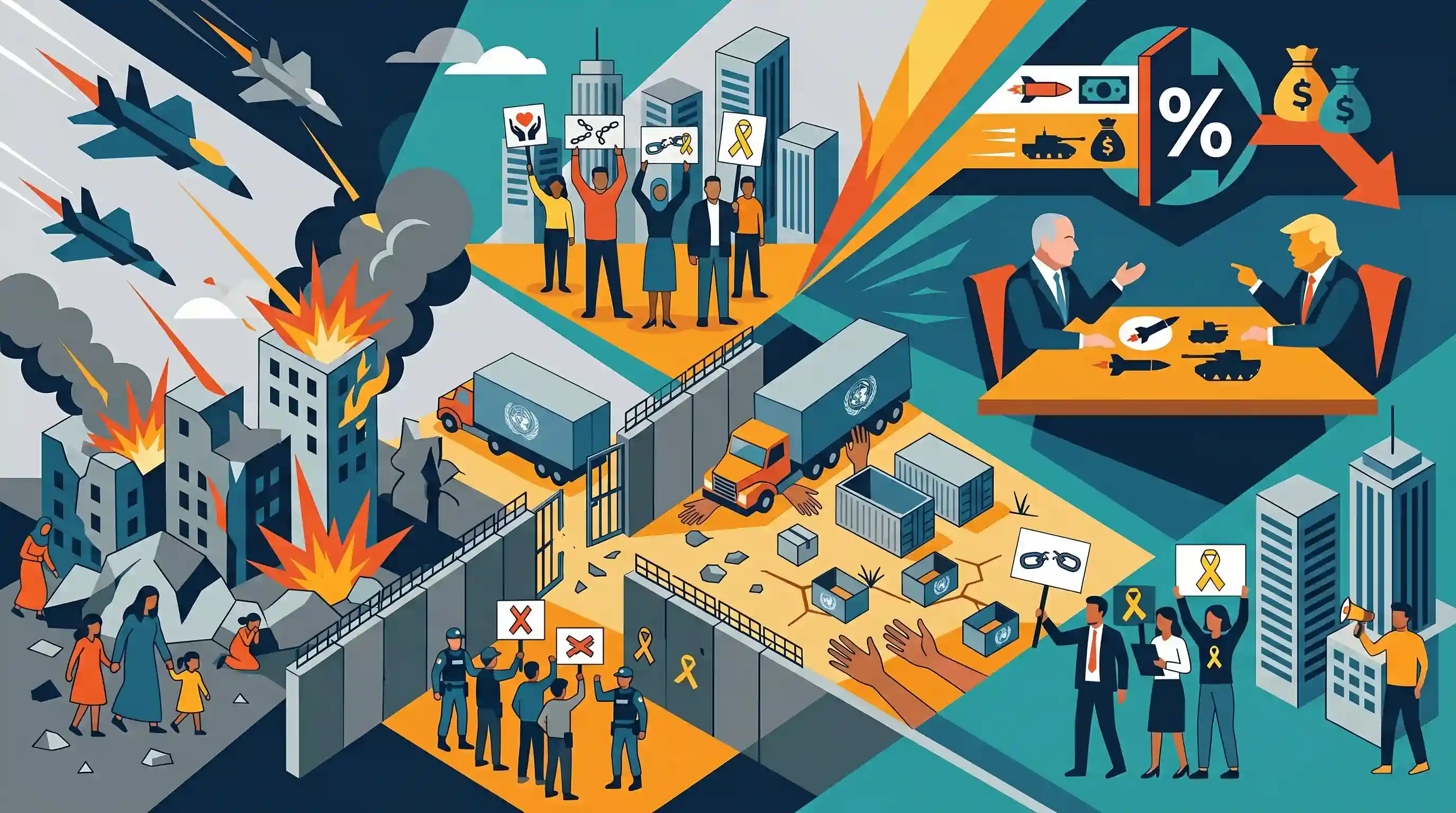
Israeli airstrikes on the Gaza Strip have killed at least 32 people, predominantly women and children, amid a continued offensive after the collapse of last month's ceasefire with Hamas. The ongoing blockade of food, fuel, and humanitarian aid has exacerbated a dire humanitarian crisis, prompting desperate warnings from UN agencies like UNRWA. Concurrently, domestic pressure is mounting with anti-war protests emerging from hostage families in Israel, as well as rare anti-Hamas demonstrations within Gaza. On the diplomatic front, Israeli Prime Minister Benjamin Netanyahu met with U.S. President Donald Trump to discuss the ongoing war and address a newly imposed 17% U.S. tariff on Israel, reflecting the complex interplay of human security and global geopolitics.
Key Points
- Renewed Israeli strikes on Gaza killed at least 32 people, largely women and children, bringing the total reported Palestinian death toll to over 50,000.
- The humanitarian situation in Gaza is deteriorating rapidly, with UNRWA issuing warnings about depleted stocks due to Israel's month-long blockade of food and aid.
- Domestic pressure is mounting on multiple fronts, with rare anti-Hamas protests in Gaza and hostage families in Israel pushing for an end to the fighting.
- Israeli PM Benjamin Netanyahu is engaging with U.S. President Donald Trump to navigate the conflict's trajectory and address a sweeping new 17% U.S. tariff placed on Israel.
Important Terms
Hamas

A Palestinian Sunni-Islamic fundamentalist organization that has governed Gaza since 2007. It functions as both a political entity and a militant group, advocating for the liberation of Palestine.
UPSC context
GS Paper 2: International Relations; critical for understanding Middle East geopolitics, non-state actors, and India's 'Link West' and 'de-hyphenation' policies.
UNRWA
A UN agency established in 1949 specifically to provide relief, healthcare, and education to Palestinian refugees. It is the primary humanitarian provider in the Gaza Strip.
UPSC context
GS Paper 2: International Institutions; tests knowledge of specialized UN bodies and India's consistent financial and diplomatic support for Palestinian welfare.
United Nations (UN)
The principal intergovernmental organization established in 1945 to maintain international peace and security. In Gaza, it operates through the Security Council and General Assembly mandates.
UPSC context
GS Paper 2: International Institutions; focuses on the effectiveness of global governance, the veto power of P5 nations, and conflict resolution mechanisms.
International Humanitarian Law (IHL)
Also known as the 'Law of Armed Conflict,' it is a set of rules seeking to limit the effects of war by protecting non-combatants and restricting weapons.
UPSC context
GS Paper 2: International Relations; critical for analyzing legal obligations of state and non-state actors during sieges, blockades, and urban warfare.
International Committee of the Red Cross (ICRC)
A neutral, independent humanitarian institution directing the International Red Cross movement’s response in conflict zones to ensure the protection and assistance of victims of war.
UPSC context
GS Paper 2: International Relations; relevant for questions on International Humanitarian Law (IHL) and the protection of civilians during armed conflicts.
Red Crescent
The emblem and name used by the International Red Cross movement in most Muslim-majority countries, performing identical humanitarian functions such as emergency medical services and aid.
UPSC context
GS Paper 2: International Relations; significant for understanding regional humanitarian frameworks and the role of the Palestine Red Crescent Society in Gaza.
Prelims Trap
"UNRWA is the primary UN agency responsible for refugee protection globally, including in Gaza."
UNRWA's mandate is strictly limited to Palestinian refugees in five specific areas (Gaza, West Bank, Jordan, Lebanon, Syria). UNHCR handles the global refugee mandate everywhere else.
Static Concepts Connected
How does UNRWA differ from the UNHCR in its mandate?
- Target Group: UNRWA exclusively assists Palestinian refugees displaced by the 1948 conflict and their descendants. UNHCR serves refugees and stateless people globally.
- Nature of Mandate: UNRWA provides direct relief, education, and healthcare services. UNHCR focuses on legal protection, voluntary repatriation, and local integration or resettlement.
- Geographical Scope: UNRWA operates strictly in five fields: Gaza, West Bank, Lebanon, Syria, and Jordan. UNHCR operates worldwide.
What are the geographical boundaries and key crossings of the Gaza Strip?
- Borders: Bounded by the Mediterranean Sea to the west, Israel to the north and east, and Egypt to the southwest.
- Rafah Crossing: The sole pedestrian and limited-goods crossing point between Gaza and Egypt, crucially bypassing direct Israeli territorial control.
- Kerem Shalom Crossing: The primary commercial goods crossing located near the junction of the Gaza, Israel, and Egypt borders.
Cross-Topic Patterns
Strategic alliances vs. trade protectionism
The imposition of a 17% U.S. tariff on Israel highlights a growing trend where even the closest strategic and defense alliances are not immune to aggressive trade protectionism.
India's De-hyphenation Policy in practice
The conflict highlights India's ongoing diplomatic balancing act, maintaining deep defense ties with Israel while continuing humanitarian and developmental assistance to Palestine without linking the two.

Map-based questions on the Levant region (e.g., Rafah crossing, Gaza borders) or statements contrasting UNRWA and UNHCR mandates are prime 2026 Prelims targets.
Linked PYQs · 3
Linked PYQs · 3
- 2018MainsGS2
“India’s relations with Israel have, of late, acquired a depth and diversity, which cannot be rolled back.” Discuss.
- 2022PrelimsGS1
The term "Levant" often heard in the news roughly corresponds to which of the following regions?
- 2025MainsGS2
"The reform process in the United Nations remains unresolved, because of the delicate imbalance of East and West and entanglement of the USA vs. Russo-Chinese alliance.” Examine and critically evaluate the East-West policy confrontations in this regard.
