Gaza Airstrikes Continue Amid US-Israel Ceasefire Talks
Source:The Hindu ↗
Why It Matters
The Middle East's stability is crucial for global energy security, trade corridors (such as the IMEC), and the safety of the Indian diaspora. Continuing conflicts and potential U.S.-brokered peace deals like the Abraham Accords significantly influence regional alignments, which directly affect India's strategic calculations and diplomatic balance in West Asia.
Summary
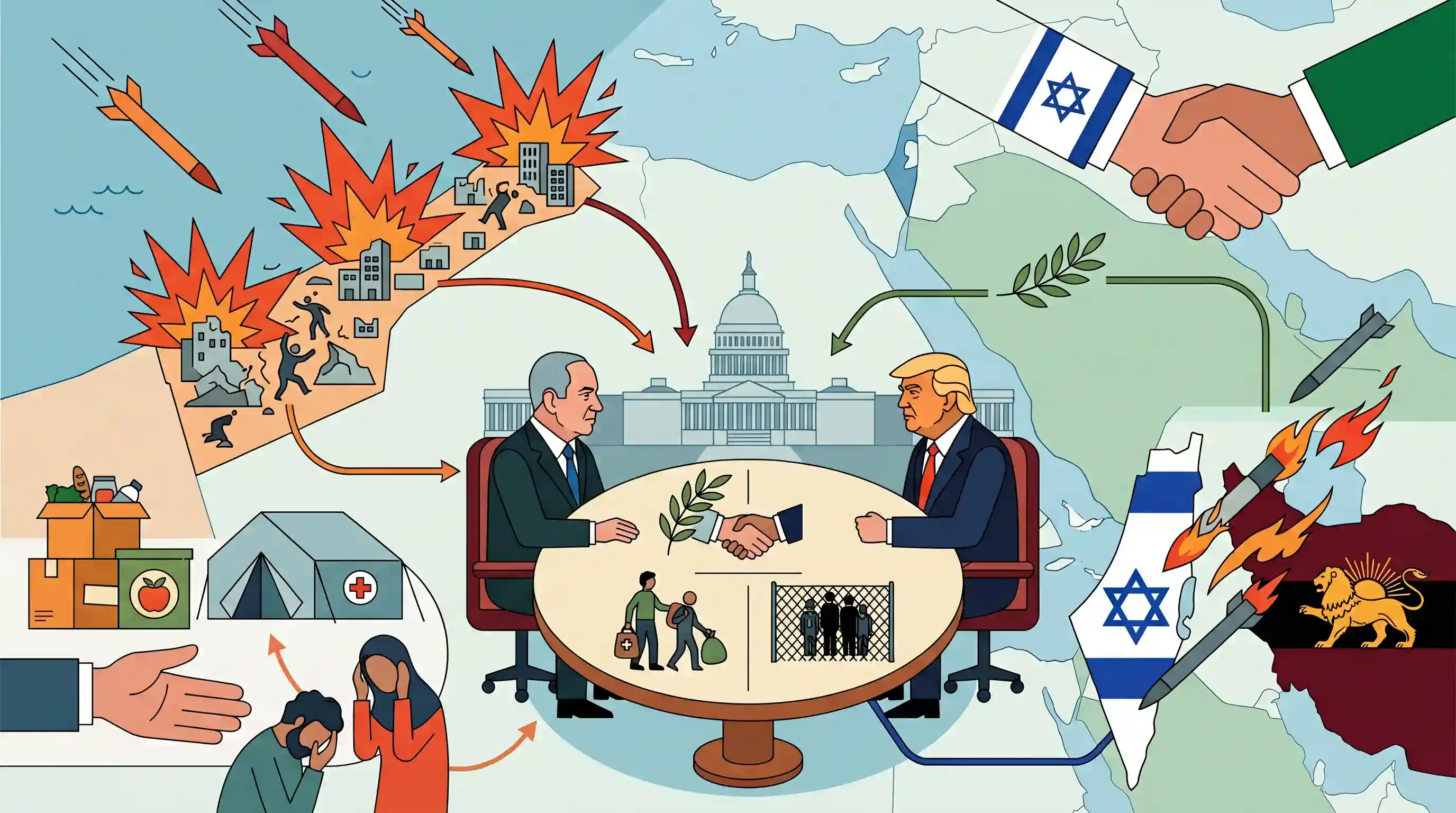
Israeli airstrikes in Gaza have killed at least 40 Palestinians, primarily in Khan Younis and Muwasi, exacerbating an already dire humanitarian situation. The renewed violence comes as Israeli Prime Minister Benjamin Netanyahu meets with U.S. President Donald Trump in Washington to negotiate a potential ceasefire. Trump has advocated for a swift resolution to the conflict, prioritizing a cessation of hostilities, the release of hostages, and the facilitation of humanitarian aid. Simultaneously, broader U.S.-led geopolitical maneuvers are underway, seeking to expand the Abraham Accords by normalizing diplomatic ties between Saudi Arabia and Israel, against the backdrop of recent hostilities between Israel and Iran.
Key Points
- Recent Israeli airstrikes in Gaza, particularly in Khan Younis and Muwasi, resulted in the deaths of at least 40 Palestinians.
- Israeli PM Benjamin Netanyahu and US President Donald Trump met to negotiate a ceasefire, focusing on ending the conflict and securing the release of hostages.
- Trump's administration is pushing for a swift resolution to the Israel-Hamas war alongside increased humanitarian aid deliveries.
- Diplomatic efforts are simultaneously targeting broader regional stability by attempting to broker a normalization deal between Saudi Arabia and Israel under the Abraham Accords framework.
- The region remains highly volatile following a recent 12-day military escalation between Israel and Iran.
Important Terms
Abraham Accords

U.S.-brokered 2020 agreements normalizing diplomatic and economic ties between Israel and several Arab nations (UAE, Bahrain, Sudan, Morocco), bypassing the traditional Palestinian-state-first consensus.
UPSC context
GS-2 (International Relations); tests understanding of West Asian realignments, India’s Link West policy, and the I2U2 grouping.
Two-State Solution
The primary internationally-backed framework for peace, proposing the establishment of an independent State of Palestine (West Bank and Gaza) alongside Israel based on 1967 borders.
UPSC context
GS-2; tests familiarity with global diplomatic resolutions and India’s historical and evolving stance on Palestinian statehood.
Hamas
A Palestinian Islamist militant and political group that has governed the Gaza Strip since 2007, currently engaged in major hostilities with Israel.
UPSC context
GS-2 (International Relations); tests knowledge of non-state actors and their impact on regional stability and global security.
Gaza Strip
A small, densely populated Palestinian enclave on the Mediterranean coast, under blockade since 2007 and the central site of the current humanitarian crisis.
UPSC context
GS-1 (Geography) and GS-2; focus on strategic locations in news and the geopolitical roots of humanitarian disasters.
Saudi-Israel Normalization
U.S.-led diplomatic efforts to establish formal ties between Riyadh and Tel Aviv, involving negotiations over Palestinian concessions, U.S. security guarantees, and nuclear energy.
UPSC context
GS-2; tests analysis of shifting Middle Eastern alliances and their impact on India’s energy security and trade corridors.
Prelims Trap
Saudi Arabia is a key signatory to the Abraham Accords alongside the UAE.
Aspirants confuse ongoing US-led normalization negotiations with finalized agreements. Saudi Arabia is not a signatory to the 2020 Abraham Accords.
Static Concepts Connected
What is India's 'de-hyphenated' West Asia policy?
- Independent diplomacy: India engages with Israel and Palestine independently, untangling its bilateral relations from the historical Israel-Palestine conflict.
- Strategic pragmatism: It allows India to maintain deep defense ties with Israel while officially continuing to support the Two-State Solution for Palestine.
What are the Abraham Accords (2020)?
- Core pact: US-brokered agreements initiated in 2020 to formally normalize diplomatic relations between Israel and several Arab nations.
- Key signatories: Includes the UAE, Bahrain, Morocco, and Sudan, bypassing the traditional Arab prerequisite of establishing an independent Palestinian state first.
Cross-Topic Patterns
Abraham Accords + IMEC viability
Saudi-Israel normalization is the missing geographic and diplomatic link required to successfully operationalize the India-Middle East-Europe Economic Corridor (IMEC).
Gaza conflict + Map locations
Specific tactical locations like Khan Younis, Al-Mawasi, and the Philadelphi Corridor are highly likely to appear in Prelims as 'places in news' matching pairs.

Expect a Prelims pairs-matching question on West Asian conflict locations (Khan Younis, Al-Mawasi, Rafah) and their regional territories.
Linked PYQs · 3
Linked PYQs · 3
- 2022PrelimsGS1
The term "Levant" often heard in the news roughly corresponds to which of the following regions?
- 2018MainsGS2
“India’s relations with Israel have, of late, acquired a depth and diversity, which cannot be rolled back.” Discuss.
- 2025MainsGS2
"The reform process in the United Nations remains unresolved, because of the delicate imbalance of East and West and entanglement of the USA vs. Russo-Chinese alliance.” Examine and critically evaluate the East-West policy confrontations in this regard.
