Cluster Munitions Usage and International Legal Frameworks
Source:Indian Express ↗
Why It Matters
Understanding the mechanics and legal status of cluster munitions is crucial for UPSC aspirants, as it connects defence technology (GS3) with international treaties, human rights, and the geopolitics of the Middle East (GS2).
Summary
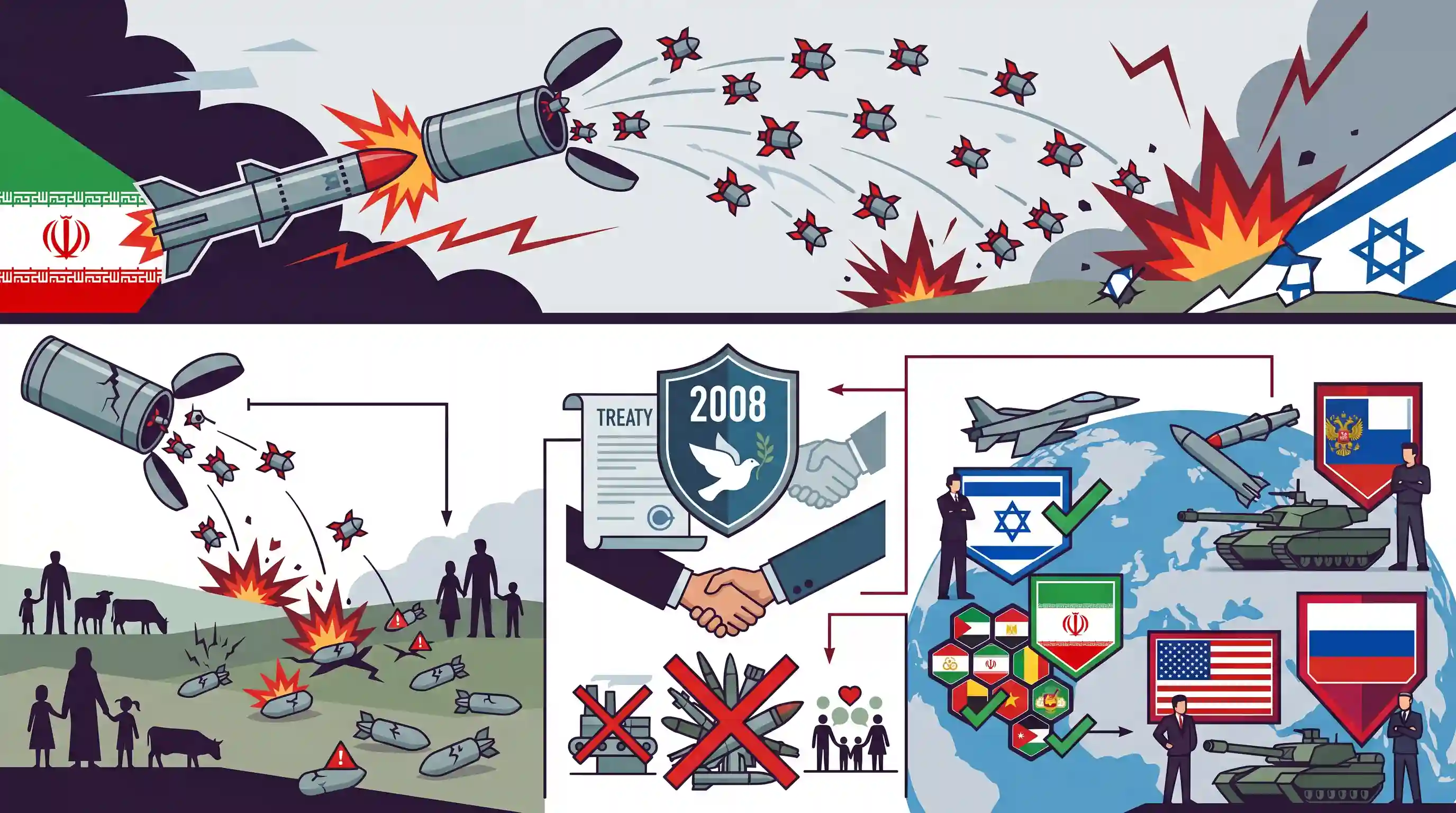
Israel recently accused Iran of firing a cluster bomb during a missile strike, marking a concerning escalation in their ongoing conflict. Cluster bombs are highly controversial weapons designed to open mid-air and disperse smaller submunitions over a broad area. Because a significant percentage of these bomblets fail to detonate upon impact, they leave behind unexploded ordnance that poses severe, long-term risks to civilian populations. To combat this humanitarian threat, the 2008 Convention on Cluster Munitions was established to ban their use, production, and stockpiling. However, the treaty's effectiveness is limited by the fact that several major global military powers, including Israel, Iran, the United States, and Russia, have refused to sign it. The use of such weapons highlights critical challenges in international humanitarian law and global disarmament efforts.
Key Points
- Israel has accused Iran of deploying cluster munitions during a recent missile attack, raising alarms over the escalation of the Middle East conflict.
- Cluster bombs are weapons that scatter numerous smaller bomblets over a wide area, many of which fail to detonate on impact and become long-term hazards to civilians akin to landmines.
- The 2008 Convention on Cluster Munitions prohibits the use, production, transfer, and stockpiling of these weapons.
- Despite the treaty having 111 signatory states, major military powers including the US, Russia, Israel, and Iran are not parties to it, citing military necessity.
Important Terms
Convention on Cluster Munitions (2008)

An international treaty prohibiting the use, production, and stockpiling of cluster bombs. It mandates the destruction of stockpiles and clearance of contaminated areas. India is currently not a signatory.
UPSC context
GS Paper-II/III (International Relations & Security). Tests awareness of global disarmament treaties, humanitarian laws, and India's strategic stance on non-signatory status.
Cluster Munitions
Conventional weapons designed to disperse numerous smaller explosive submunitions (bomblets) over a broad area. They are controversial due to their indiscriminate nature and long-term civilian risk.
UPSC context
GS Paper-III (Security). Evaluates understanding of modern military hardware, indiscriminate warfare, and the ethical challenges posed by area-effect weapons in civilian zones.
Submunitions
Smaller explosive devices, often called bomblets, carried within a cluster munition canister. They are designed to explode on impact but frequently fail, effectively becoming long-term landmines.
UPSC context
GS Paper-III (Security). Relevant for technical aspects of defense technology and the specific mechanisms that cause persistent humanitarian threats in post-conflict regions.
Unexploded Ordnance (UXO)
Explosive weapons that failed to detonate upon landing and remain active. These 'duds' pose a severe, long-term threat to civilians, often requiring decades of hazardous clearance efforts.
UPSC context
GS Paper-III (Internal Security). Highlights the lasting impact of warfare on civilian populations and the logistical challenges of post-conflict reconstruction and safety.
International Humanitarian Law (IHL)
A branch of international law (e.g., Geneva Conventions) that limits the effects of armed conflict. It protects non-combatants and restricts the use of weapons that cause unnecessary suffering.
UPSC context
GS Paper-II (International Relations). Essential for analyzing global conflict regulation, the principles of distinction and proportionality, and the legal accountability of nations.
Prelims Trap
"India, alongside other major democracies, is a signatory to the 2008 Convention on Cluster Munitions."
India is NOT a signatory to the CCM, nor are the US or Israel. India officially views cluster bombs as legitimate weapons of war.
Static Concepts Connected
What is the 2008 Convention on Cluster Munitions (CCM)?
- Prohibition scope: A UN-adopted treaty that categorically prohibits member states from using, producing, stockpiling, and transferring cluster bombs.
- Major non-signatories: The world's most prominent military powers—including the US, Russia, China, Israel, Iran, and India—are not parties to the convention.
- India's stance: India is not a party, views cluster bombs as legitimate weapons of war, and continues to produce and export them.
Why do cluster bombs violate International Humanitarian Law (IHL)?
- Indiscriminate nature: They scatter smaller submunitions over wide areas, making it impossible to distinguish between military targets and civilians.
- Unexploded Ordnance (UXO): High failure rates (10-40%) leave behind live bomblets that act as de facto landmines, posing severe threats to civilians long after a conflict ends.
Cross-Topic Patterns
India's Disarmament Treaty Opt-Outs
The CCM aligns with the NPT, CTBT, and the Ottawa Treaty (landmines) as major global disarmament agreements India has refused to sign citing sovereign security concerns.
Ethics of Modern Warfare & IHL
Links GS4 ethics (proportionality, civilian harm) with GS2 International Humanitarian Law, contrasting the argument of "military necessity" with the long-term humanitarian impact of unexploded ordnance.

Expect a 2026 Prelims multi-statement question asking to identify which disarmament treaties (CWC, BWC, CCM, Ottawa) India has signed.
Linked PYQs · 4
Linked PYQs · 4
- 2020PrelimsGS1
Consider the following pairs: International agreement/set-up Subject 1. Alma-Ata Declaration : Healthcare of the people 2. Hague Convention : Biological and chemical weapons 3. Talanoa Dialogue : Global climate change 4. Under2 Coalition : Child rights Which of the pairs given above is/are correctly matched?
- 2025PrelimsGS1
What is the common characteristic of the chemical substances generally known as CL-20, HMX and LLM-105, which are sometimes talked about in media?
- 2023PrelimsGS1
Consider the following statements: 1. Ballistic missiles are jet-propelled at subsonic speeds throughout their flights, while cruise missiles are rocket-powered only in the initial phase of flight. 2. Agni-V is a medium-range supersonic cruise missile, while BrahMos is a solid-fuelled intercontinental ballistic missile. Which of the statements given above is/are correct?
- 2018MainsGS2
“India’s relations with Israel have, of late, acquired a depth and diversity, which cannot be rolled back.” Discuss.
