Andaman and Nicobar Data Centre Project and Ecological Concerns
Source:The Hindu ↗
ఇది ఎందుకు ముఖ్యం
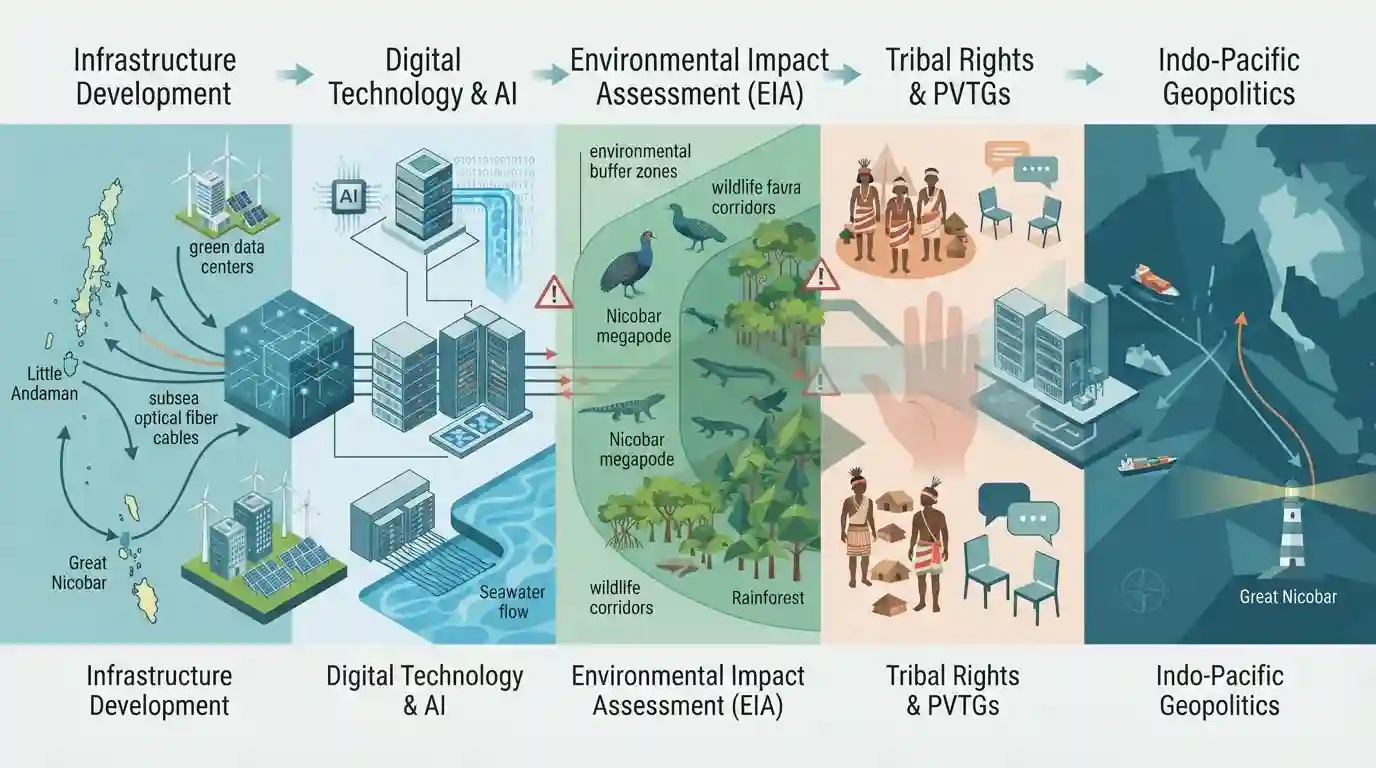
This development represents the intersection of digital sovereignty, high-performance computing (AI/data centres), and the socio-ecological vulnerabilities of frontier regions. It underlines the challenges India faces in balancing strategic infrastructure building in the Indo-Pacific with the rights of PVTGs (like Shompens) and environmental sustainability.
సారాంశం
The Andaman and Nicobar administration has invited feasibility proposals for setting up a green, AI-focused data centre vertical across selected sites in Little Andaman and Great Nicobar. Aiming to leverage subsea optical-fibre connectivity and seawater-based cooling, the project is structured as a green, high-performance computing infrastructure. However, the initiative faces coordination friction and resistance, as local tribal communities feel excluded from consultations, and the proposed sites overlap with designated environmental buffer zones and wildlife corridors under the contested ₹91,000-crore Great Nicobar Island megaproject.
ముఖ్య అంశాలు
- The Andaman and Nicobar administration has floated an Expression of Interest (EoI) seeking feasibility proposals for a private-sector-led 'Green AI / Data Centre Vertical' on the islands.
- Proposed sites include coastal/sea areas at Hutbay and Netaji Nagar in Little Andaman, alongside Campbell Bay, Anderson Bay, Vijay Nagar Bay, and Gandhi Nagar Bay on Great Nicobar Island.
- The EoI envisions sustainable, high-tech features such as renewable-energy-powered operations, freshwater-free (seawater-based) cooling, waste-heat recovery for desalination, and high-performance GPU/AI cloud infrastructure utilizing subsea optical-fibre connectivity.
- Local tribal councils, currently negotiating buffer zones (30m to 100m) around indigenous settlements like Rajiv Nagar and New Chingenh for the ₹91,000-crore GNI master plan, have expressed concern over a lack of prior information or consultation regarding the data centre.
- The proposed coastal zones for the data centre overlap with ecologically sensitive zones, including a planned wildlife corridor (Gandhi Nagar Bay), biodiversity tourism areas, and agricultural land, raising environmental concerns.
ముఖ్యమైన పదాలు
Great Nicobar Island (GNI) Megaproject

A proposed ₹91,000-crore infrastructure project on Great Nicobar Island, comprising an international container transhipment terminal, a greenfield airport, a power plant, and an integrated township.
UPSC context
GS Paper III (Infrastructure & Environment); tests trade-offs between strategic maritime assets and ecological-tribal conservation.
Tribal Council of Great and Little Nicobar
A statutory representative body established under local regulations to advocate for the rights, traditional customs, and environmental interests of the indigenous Nicobarese and Shompen communities.
UPSC context
GS Paper II (Polity & Governance); tests tribal administration and statutory local representation in Scheduled and Scheduled-adjacent regions.
Shompen Tribe
An indigenous, semi-nomadic, hunter-gatherer community inhabiting Great Nicobar Island, numbering under 300 members and classified as a Particularly Vulnerable Tribal Group (PVTG).
UPSC context
GS Paper I (Geography & Social Issues); tests knowledge of vulnerable indigenous populations, demographic traits, and tribal conservation.
Andaman and Nicobar Islands Integrated Development Corporation (ANIIDCO)
A government-owned enterprise responsible for executing and promoting balanced commercial, industrial, and social development within the Union Territory of Andaman and Nicobar.
UPSC context
GS Paper III (Economy & Infrastructure); tests the role of public undertakings executing mega-infrastructure in ecologically fragile areas.
ప్రిలిమ్స్ ఉచ్చు
The Ten Degree Channel separates Great Nicobar Island from the Indonesian island of Sumatra, making it strategically vital for Indo-Pacific security.
Great Nicobar is separated from Sumatra by the Six Degree Channel (Great Channel). The Ten Degree Channel separates the Andaman group from the Nicobar group.
అనుసంధానమైన స్థిర భావనలు
What is Low-Temperature Thermal Desalination (LTTD) technology?
- Working Principle: It utilizes the temperature gradient between warm surface seawater and deep-sea cold water to evaporate and condense water.
- Low Pressure: Seawater is evaporated under low-pressure conditions, which allows boiling and vaporization to occur at room temperature.
- Indigenous Tech: Developed by the National Institute of Ocean Technology, it operates without chemical pre-treatment, making it highly eco-friendly.
What is the legal and demographic profile of the Shompen PVTG?
- PVTG Status: The Shompen are one of the Particularly Vulnerable Tribal Groups (PVTGs) residing exclusively in the interior of Great Nicobar Island.
- Livelihood: They are semi-nomadic hunter-gatherers belonging to the Mongoloid racial stock, unlike the Negrito tribes of the Andaman islands.
- Legal Shield: Protected under the Andaman and Nicobar Islands (Protection of Aboriginal Tribes) Regulation, 1956, and the dedicated Shompen Policy, 2015.
అంతర-అంశ నమూనాలు
Security-Ecology Trade-off
Great Nicobar's dual-use development creates friction between India's Indo-Pacific power projection and the ecological preservation of UNESCO biosphere reserves and turtle nesting sites.
Undersea Cables & Digital Sovereignty
CANI submarine cable integration shows how strategic physical digital infrastructure attracts high-performance commercial assets like green data centers, altering regional tribal-ecological dynamics.

Expect a 2026 Prelims question mapping strategic channels (Six Degree vs Ten Degree) alongside PVTGs and critical habitats like Galathea Bay.
అనుసంధాన PYQలు · 3
అనుసంధాన PYQలు · 3
- 2009PrelimsGS1
In which one of the following places is the Shompen tribe found?
- 2026PrelimsGS1
With reference to the climate of Andaman and Nicobar Islands, which of the following statements is/are correct ? 1. The climate can be defined as a humid, tropical coastal climate. 2. It receives rainfall from both South-west monsoon and North-east monsoon. 3. Maximum precipitation is between December and May. Select the answer using the code given below :
- 2024MainsGS3
What role do environmental NGOs and activists play in influencing Environmental Impact Assessment (EIA) outcomes for major projects in India? Cite four examples with all important details.
