Islamabad Lockdown Amid Uncertainty Over US Iran Talks
Source:The Hindu ↗
Why It Matters
Understanding the US-Iran-Israel conflict and Pakistan's mediation role is crucial for UPSC aspirants, as instability in West Asia directly impacts India's energy security, geopolitical strategy, and diaspora interests.
Summary
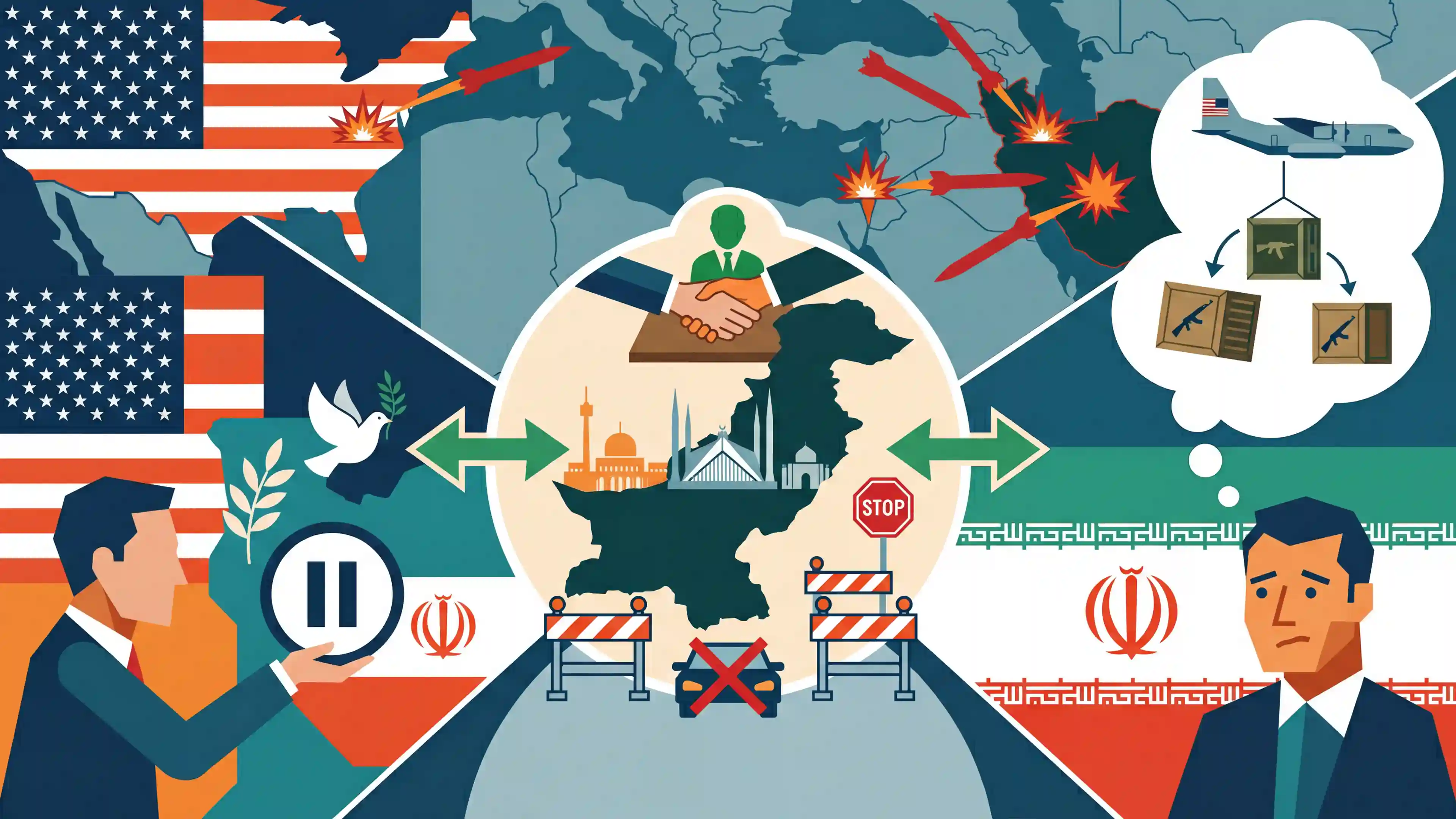
Islamabad has faced partial lockdowns and traffic closures due to uncertainty over hosting the second round of US-Iran peace talks, which are being mediated by Pakistan. The negotiations aim to end a conflict initiated by US-Israeli strikes on Iran in late February. While US President Donald Trump has extended a ceasefire indefinitely, Iran remains undecided on attending the talks, citing concerns that Washington is exploiting the pause to rearm Israel. The situation underscores Pakistan's evolving role as a diplomatic mediator in the highly volatile geopolitical dynamics of the Middle East.
Key Points
- Islamabad faced heavy traffic closures, particularly around its 'Red Zone', due to uncertainty regarding the scheduling of US-Iran peace talks.
- The talks, mediated by Pakistan, aim to resolve the conflict sparked by US-Israeli military strikes on Iran in late February.
- The first round of negotiations held on April 11-12 failed to yield a breakthrough.
- US President Donald Trump has indefinitely extended the ceasefire, though Iran remains hesitant to commit to a second round of talks.
- Iran suspects the US is using the ceasefire window to rearm Israel rather than pursue a genuine diplomatic resolution.
Important Terms
Iranian Foreign Ministry

Iran's executive body responsible for external relations. In the 2026 crisis, it coordinates peace proposals with mediators while navigating internal pressure following the leadership vacuum in Tehran.
UPSC context
GS Paper II: International Relations. Tests understanding of diplomatic machinery and its role in resolving high-stakes regional conflicts.
Shuttle Diplomacy
Negotiations conducted by a third party (Pakistan) moving between conflicting sides that refuse direct contact. It involves conveying proposals between Washington and Tehran to maintain a fragile ceasefire.
UPSC context
GS Paper II: International Relations. Tests knowledge of unconventional diplomatic methods and the role of middle powers in peacemaking.
Strait of Hormuz
A vital global energy chokepoint between the Persian Gulf and Gulf of Oman. Currently restricted by Iran and blockaded by the US, it remains the primary leverage point in negotiations.
UPSC context
GS Paper I: Geography & GS Paper II: IR. Tests importance of maritime corridors and impacts on global energy security.
Maritime Blockade
The use of naval forces to prevent ships from entering or leaving a country's ports. The current US blockade of Iranian ports is cited by Tehran as a primary obstacle to peace.
UPSC context
GS Paper II: IR/Security. Tests concepts of economic warfare, international law, and escalatory military tactics in diplomacy.
Red Zone (Islamabad)
A high-security district in Pakistan's capital housing the Parliament, Presidency, and foreign embassies. It is the designated site for high-level summits and currently under strict lockdown.
UPSC context
GS Paper II: IR. Tests awareness of geopolitical hubs and the logistical/security challenges of hosting high-profile international mediation.
Geopolitical Mediation
Intervention by an acceptable third party to help disputants reach a settlement. Pakistan's current role leverages its geostrategy and history of facilitating Sino-US relations to bridge the US-Iran trust deficit.
UPSC context
GS Paper II: IR. Tests theoretical and practical understanding of conflict resolution and middle-power diplomacy in a multipolar world.
Prelims Trap
Oman or Qatar mediated the April 2026 US-Iran ceasefire negotiations.
While Oman and Qatar are traditional backchannel mediators in the Middle East, the 2026 post-strike talks were explicitly hosted and mediated by Pakistan.
Static Concepts Connected
What is the strategic significance of the Strait of Hormuz?
- Geographic Location: It is a crucial maritime choke point connecting the Persian Gulf to the Gulf of Oman and the Arabian Sea.
- Energy Transit: It handles roughly 20-30% of global oil consumption transit, making it a critical artery for global energy security and India's oil imports.
- Bordering Nations: It is bounded by Iran to the north and the UAE and Oman to the south, heavily exposing it to regional conflicts.
How does the I2U2 grouping contrast with India's interests in Iran?
- I2U2 Focus: A partnership of India, Israel, UAE, and the US focusing on joint investments in water, energy, transport, and economic cooperation.
- Iran Interests: India's strategic investments in the Chabahar port and INSTC require navigating US sanctions and maintaining robust bilateral ties with Tehran.
- Strategic Balancing: India must compartmentalize its growing strategic alignment with the US and Israel from its critical connectivity and energy needs in Iran.
Cross-Topic Patterns
Pakistan's shift to Middle East peace broker
Pakistan is leveraging its geographic and diplomatic position to remain relevant to Washington, transitioning from its Afghan-era utility to mediating Middle Eastern conflicts.
Regional instability vs INSTC and IMEC
The direct US-Iran-Israel conflict threatens the viability of the International North-South Transport Corridor (INSTC), pushing India toward alternative routes like IMEC.
Strait of Hormuz crisis and India's SPR
Threats to the Strait of Hormuz directly test the adequacy of India's Strategic Petroleum Reserves (SPR) and its push for alternative energy sources under green transition.

Expect a 2026 Mains question on balancing India's I2U2 commitments with its INSTC/Chabahar interests amid direct US-Iran-Israel conflict.
Linked PYQs · 3
Linked PYQs · 3
- 2018MainsGS2
“India’s relations with Israel have, of late, acquired a depth and diversity, which cannot be rolled back.” Discuss.
- 2025MainsGS2
"Energy security constitutes the dominant kingpin of India's foreign policy, and is linked with India's overarching influence in Middle Eastern countries.” How would you integrate energy security with India's foreign policy trajectories in the coming years?
- 2022MainsGS2
How will I2U2 (India, Israel, UAE and USA) grouping transform India's position in global politics?
