Peshawar Arrests Linked to Islamabad Mosque Suicide Bombing Attack
Source:The Hindu ↗
Why It Matters
The presence of active terror outfits like ISKP and persistent sectarian violence in Pakistan are critical to understanding regional instability. For UPSC aspirants, this highlights the ongoing security threats in India's immediate neighborhood, which can have ripple effects on cross-border terrorism and global peace.
Summary
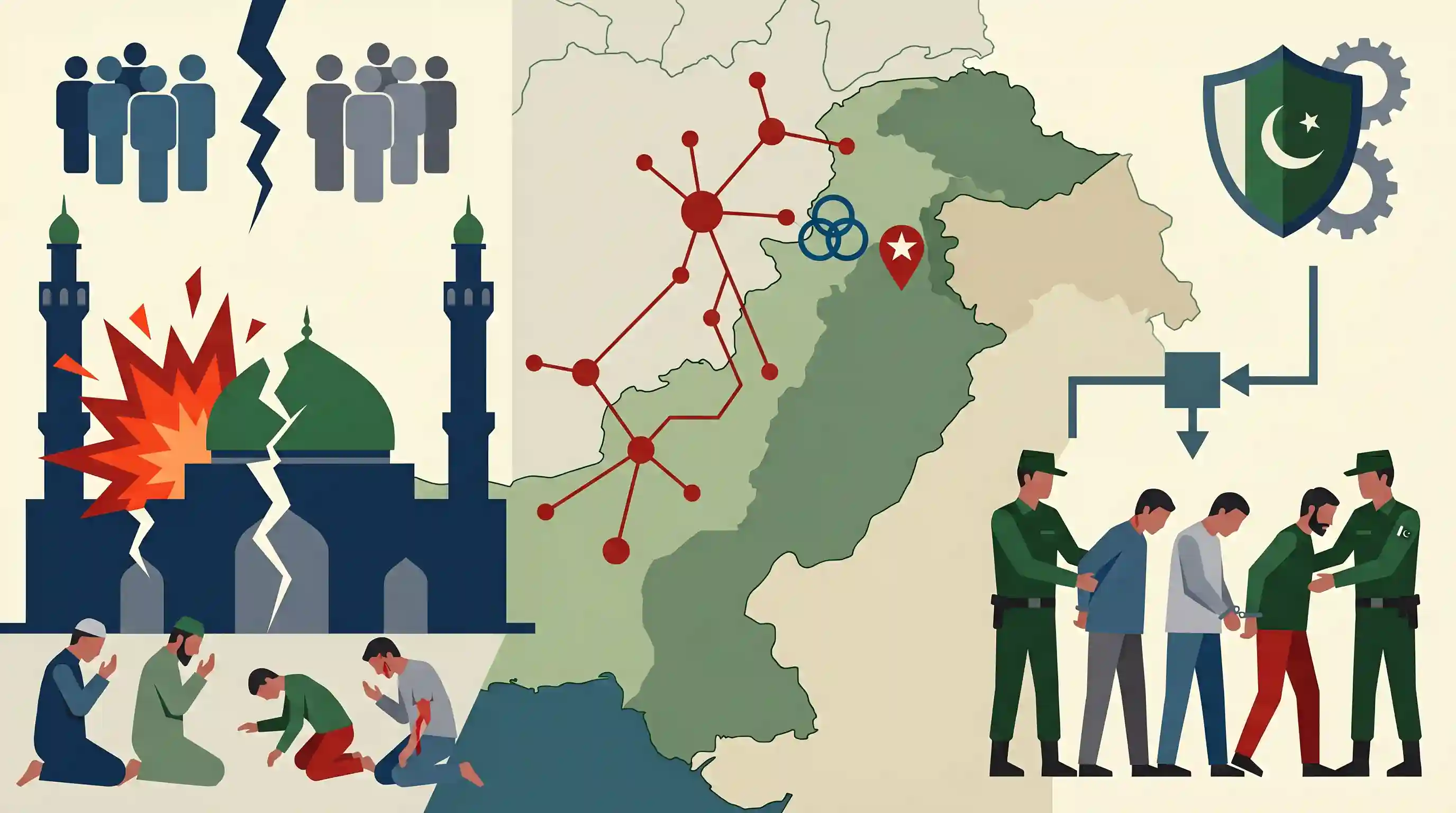
Pakistani authorities have arrested three individuals in Peshawar linked to a recent suicide bombing at a Shia mosque in Islamabad. The attack, which caused multiple casualties, was claimed by the Islamic State Khorasan Province (ISKP). The incident highlights the ongoing internal security challenges, sectarian violence, and the active presence of extremist terror networks operating within Pakistan and its border regions.
Key Points
- Three suspects were arrested in Peshawar for their involvement in a deadly suicide bombing at a Shia mosque in Islamabad.
- The Islamic State Khorasan Province (ISKP) claimed responsibility for the sectarian attack.
- The arrests underscore the persistent threat of terrorism and sectarian violence within Pakistan.
- Authorities acted to prevent further planned attacks by the extremist network on prominent regional targets.
Important Terms
Islamic State Khorasan Province (ISKP)

The Afghanistan-Pakistan regional affiliate of the Islamic State (ISIS), seeking to establish a caliphate in the 'Khorasan' region. It frequently targets religious minorities, particularly Shia Muslims, and government institutions.
UPSC context
Relevant for GS Paper III (Internal Security) and GS II (International Relations); tests knowledge of transnational terror networks threatening regional stability.
Sectarian Violence
Conflict or targeted attacks motivated by antagonism toward a specific religious sect, most prominently Sunni-Shia clashes in the region. It is often fueled by extremist ideologies and regional proxy dynamics.
UPSC context
GS Paper I (Social issues) and GS III (Internal Security); examines the social fabric and security challenges in India's neighborhood.
Counter Terrorism Department (CTD)
Specialized wings of Pakistan's provincial police forces responsible for intelligence-led operations, counter-terrorism investigations, and monitoring proscribed organizations and individuals involved in extremist activities.
UPSC context
GS Paper III (Security); relates to institutional frameworks for managing internal security and cross-border terrorism in the neighborhood.
Radicalization
The process through which individuals adopt extremist ideologies and an eventual willingness to use or support violence to achieve political or religious goals.
UPSC context
GS Paper III (Internal Security); focuses on the ideological roots of terrorism and strategies for de-radicalization.
Internal Security
The maintenance of peace and law within a nation’s borders. For India, this includes managing threats from cross-border terrorism, insurgency, and instability in neighboring countries.
UPSC context
Core GS Paper III topic; tests understanding of factors causing instability and the nexus between regional turmoil and national safety.
Prelims Trap
"UNSC Resolution 1267 sanctions apply universally to all state-sponsored terror groups."
Resolution 1267 is exclusively the ISIL (Da'esh) and Al-Qaida Sanctions Committee. It does not automatically cover all terror groups or state-sponsored militants without specific listing.
Static Concepts Connected
What are the key enforcement measures under the UNSC 1267 Sanctions Regime?
- Asset Freeze: Requires states to freeze funds and financial assets of designated individuals and entities without delay.
- Travel Ban: Prevents the entry into, or transit through, member states' territories by designated individuals.
- Arms Embargo: Prohibits the direct or indirect supply, sale, or transfer of arms and related materiel.
Why is the Durand Line a persistent geopolitical and security friction point?
- Historical Dispute: Drawn by the British in 1893, it arbitrarily splits Pashtun tribal areas. Afghanistan historically refuses to recognize it as a formal international border.
- Porous Terrain: The highly rugged, mountainous 2,640-km terrain makes effective border management nearly impossible, providing a safe haven for militant transit (TTP, ISKP).
Cross-Topic Patterns
Crypto and Terror Financing
Terror groups like ISKP increasingly bypass FATF scrutiny using privacy-enhancing cryptocurrencies (e.g., Monero), linking international security directly to digital asset regulation and cyber laws.
Sectarianism and Regional Proxy Wars
Sectarian targeting of Shias by ISKP in the Af-Pak region complicates regional geopolitics, potentially drawing in Iran and exacerbating instability on India's western periphery.

Expect a combined Prelims question linking ISKP's historical geography (Khorasan), UNSC 1267 sanctions, and FATF crypto regulations.
Linked PYQs · 3
Linked PYQs · 3
- 2025MainsGS3
Terrorism is a global scourge. How has it manifested in India? Elaborate with contemporary examples. What are the counter measures adopted by the State? Explain.
- 2017MainsGS3
The scourge of terrorism is a grave challenge to national security. What solutions do you suggest to curb this growing menace? What are the major sources of terrorist funding?
- 2024MainsGS2
‘Terrorism has become a significant threat to global peace and security.’ Evaluate the effectiveness of the United Nations Security Council's Counter Terrorism Committee (CTC) and its associated bodies in addressing and mitigating this threat at the international level.
