Karnataka Ethanol Blending Levels Exceed E20 Target
Source:The Hindu ↗
Why It Matters
This article is important for UPSC GS3 as it highlights practical execution bottlenecks, regulatory oversight challenges, and technical compatibility issues concerning India's ambitious Ethanol Blending Programme (EBP) and energy transition goals.
Summary
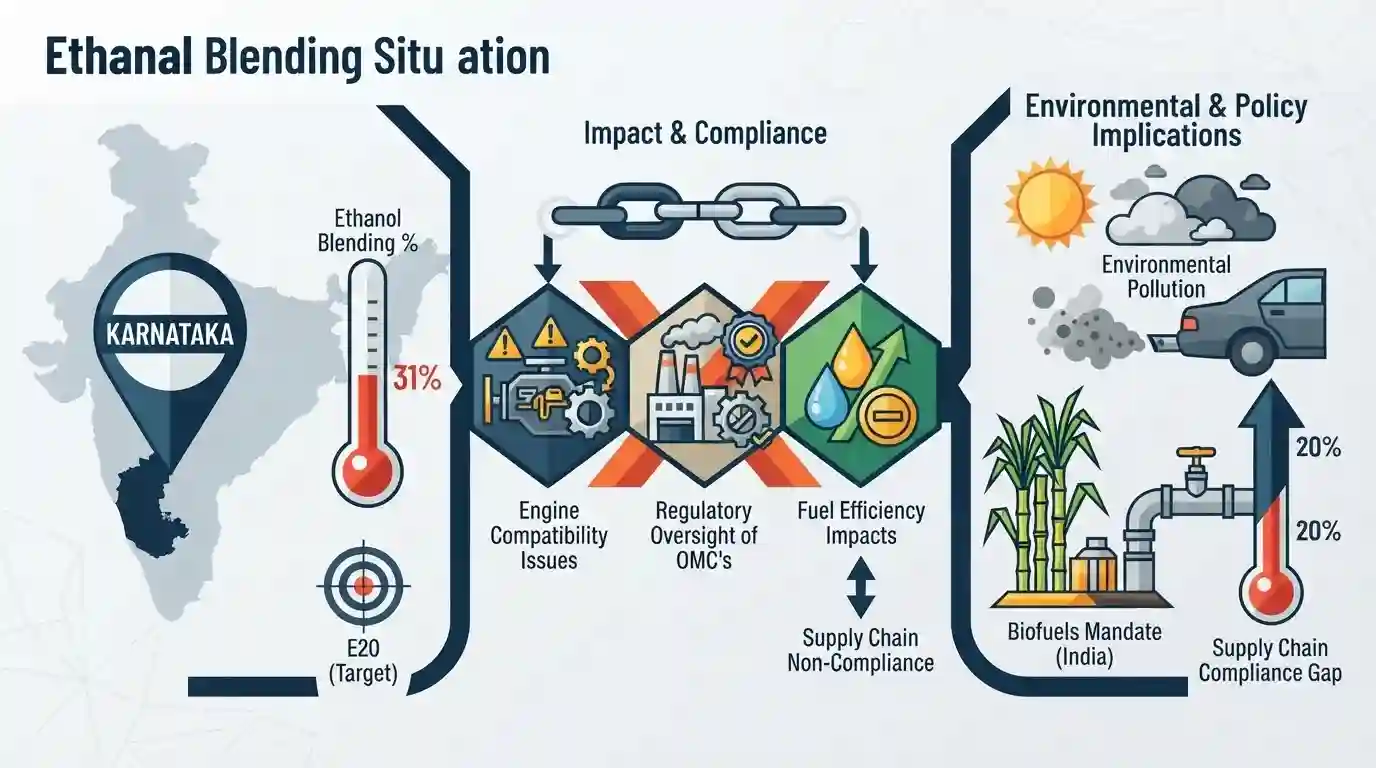
Karnataka has flagged that ethanol blending in petrol samples within the state has reached up to 31%, well above the national E20 (20%) target. This disclosure brings to light critical issues regarding vehicle engine compatibility, regulatory oversight of oil marketing companies, fuel efficiency impacts, and supply chain compliance under India's biofuel mandate.
Key Points
- Karnataka has claimed that tests on petrol samples in the state revealed ethanol blending levels touching up to 31%, significantly higher than the mandated 20% (E20) target.
- Higher-than-authorized ethanol blending (such as E31) poses risks to older internal combustion engine (ICE) vehicles that are not optimized or calibrated for high-ethanol fuel mixtures, potentially causing engine damage and corrosion.
- The findings raise regulatory and quality-control concerns regarding fuel supply chains, oil marketing companies, and compliance with the National Policy on Biofuels.
- Unregulated high blending can also impact fuel efficiency, vehicle performance, and consumer rights if motorists are unaware of the actual composition of the fuel they purchase.
Important Terms
Ethanol Blending Programme

An Indian government initiative aimed at reducing crude oil imports and carbon emissions by mixing ethanol with petrol, scaling up toward the national E20 blending target.
UPSC context
Mains GS Paper III (Energy Security & Environment). Tests knowledge of India's biofuel roadmap, renewable energy goals, and agricultural integration.
E20 Petrol Initiative
A fuel standard designating petrol blended with 20 percent ethanol, introduced to curb fossil fuel dependence and lower vehicular exhaust emissions.
UPSC context
Prelims & Mains GS III (Government Policies & Interventions). Evaluates understanding of green mobility targets, vehicular compatibility, and energy policies.
Static Concepts Connected
What are the key objectives and milestones under India's National Policy on Biofuels?
- Blending Target: Target Acceleration: Accelerated the target of 20% ethanol blending in petrol (E20) to ESY 2025–26 to cut import bills.
- Diverse Feedstock: Feedstock Expansion: Permitted use of surplus foodgrains, damaged food grains, and agricultural residues for biofuel production.
- Support Schemes: Financial Incentives: Provided interest subvention for setting up second-generation (2G) ethanol refineries across India.
Cross-Topic Patterns
Biofuels vs. WTO Agricultural Subsidies
India's aggressive ethanol blending targets intersect with WTO rules on agricultural subsidies and domestic support for sugarcane farmers.
Ethanol Mandates vs. Groundwater Crisis
Pushing for E20+ blending strains water-intensive sugarcane crops in agrarian states like Karnataka, triggering groundwater depletion concerns.

Expect statements on National Policy on Biofuels targets, engine corrosion risks in pre-2023 ICE vehicles, and BIS standards.
Linked PYQs · 2
Linked PYQs · 2
- 2025MainsGS3
How can India achieve energy independence through clean technology by 2047? How can biotechnology can play a crucial role in this endeavour?
- 2025PrelimsGS1
Consider the following statements : Statement I: Of the two major ethanol producers in the world, i.e., Brazil and the United States of America, the former produces more ethanol than the latter. Statement II: Unlike in the United States of America where corn is the principal feedstock for ethanol production, sugarcane is the principal feedstock for ethanol production in Brazil. Which one of the following is correct in respect of the above statements?
