Globalisation Decline Sparks Worldwide Rise in Sovereign Nationalism
Source:Indian Express ↗
Why It Matters
The article directly addresses core themes of recent UPSC Mains examinations, specifically the 2025 GS2 and GS3 papers. It provides the necessary critical framework for understanding the transition from a globalized world order to one defined by protectionism, economic nationalism, and strategic decoupling, which is vital for analyzing contemporary international relations and economic policies.
Summary
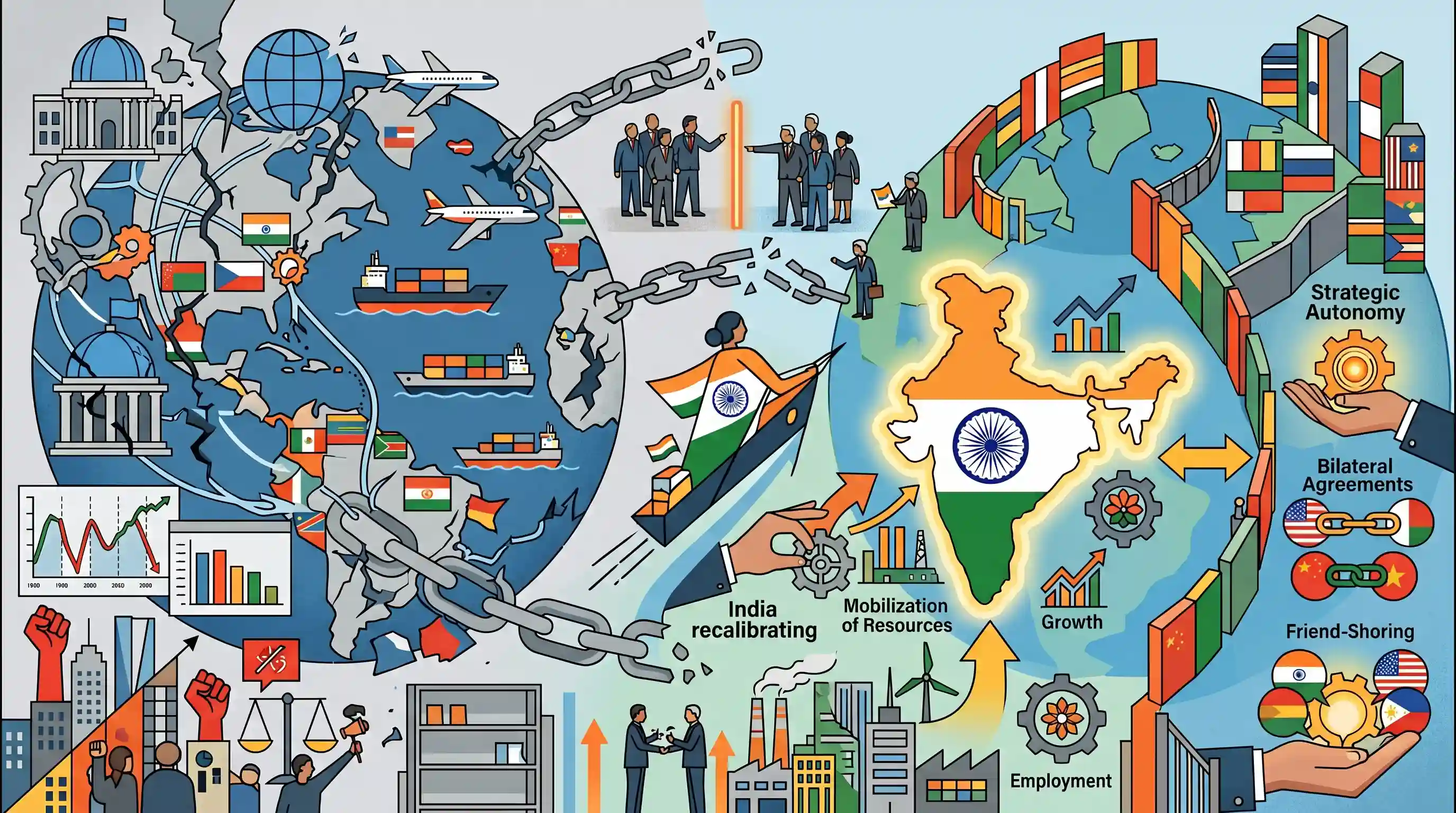
The article analyzes the contemporary global shift from hyper-globalization toward 'sovereign nationalism' and protectionist policies. It explores how the post-Cold War consensus on free trade and multilateralism is fracturing due to geopolitical rivalries, supply chain vulnerabilities exposed by recent crises, and domestic pushback against economic inequalities. As nations prioritize strategic autonomy and national security over global integration, the world is witnessing a rise in bilateralism, friend-shoring, and the weakening of international institutions. The piece evaluates the implications of this fragmented world order, particularly the challenges and strategic recalibrations required by developing economies like India to secure their interests in a de-globalizing landscape.
Key Points
- The post-Cold War era of rapid globalization and unchecked economic integration is significantly waning, replaced by a surge in 'sovereign nationalism'.
- Global disruptions, including the COVID-19 pandemic and rising geopolitical conflicts, have exposed the strategic vulnerabilities of interdependent global supply chains.
- Major economies are pivoting toward protectionism, strategic autonomy, and self-reliance, utilizing tariffs, export controls, and industrial subsidies to shield domestic interests.
- The shift is accelerating the decline of multilateral institutions like the WTO, leading nations to favor bilateral agreements, regional blocs, and concepts like 'friend-shoring'.
- Developing nations, including India, must navigate an increasingly fragmented world order, balancing the need to protect their own economic interests while adapting to restricted global trade environments.
Important Terms
Sovereign Nationalism

A political stance prioritizing national interests, independent authority, and cultural identity over international cooperation, multilateral rules, and deep global economic integration.
UPSC context
GS II/International Relations; tests understanding of the shift from liberal globalism to protectionism in the post-Cold War era.
Strategic Autonomy
The capacity of a state to make independent foreign policy and security decisions based on national interest, without permanent alignment with any major power bloc.
UPSC context
GS II/IR; central to India's 'multi-alignment' strategy and its navigation of a multipolar world order.
Friend-shoring
A trade strategy of relocating supply chains to politically allied countries to minimize economic risks and vulnerabilities from geopolitical rivals.
UPSC context
GS II/III; relevant for topics on de-globalization, supply chain resilience, and international trade groupings like IPEF.
Atmanirbhar Bharat
India's 'Self-Reliant' policy framework focusing on boosting domestic manufacturing, reducing import dependence, and enhancing national resilience through five pillars: Economy, Infrastructure, System, Demography, and Demand.
UPSC context
GS III/Economy; essential for questions regarding industrial growth, self-sufficiency, and import substitution in strategic sectors.
World Trade Organization (WTO)
An international organization that regulates global trade by providing a platform for negotiating trade agreements and resolving disputes under a rules-based system.
UPSC context
GS II/International Institutions; tests awareness of the crisis in global trade governance and India’s interests at ministerial conferences.
Free Trade Agreements (FTAs)
Formal agreements between countries to reduce or eliminate trade barriers like tariffs and quotas to enhance market access for goods and services.
UPSC context
GS II/III; key for trade diplomacy and analyzing India's recent bilateral pacts (e.g., UAE, Australia).
Multilateralism
The practice of multiple nations working together through international institutions to resolve global issues and set collective rules for trade, security, and environment.
UPSC context
GS II/IR; evaluates the current crisis in global governance and the rise of fragmented 'minilateral' groupings.
Prelims Trap
Friend-shoring refers to relocating manufacturing exclusively to geographically neighboring countries to reduce transport costs.
This describes 'near-shoring'. 'Friend-shoring' specifically means relocating supply chains to politically aligned nations with shared values, regardless of geographic proximity.
Static Concepts Connected
Why is the WTO's dispute resolution mechanism currently paralyzed?
- Appellate Body crisis: The AB needs a minimum of three judges to hear appeals, but the US has continuously blocked new appointments since 2019.
- Panel stage functioning: Lower-level dispute panels still operate, but losing parties can appeal into the void, leaving trade disputes legally unresolved.
- MPIA alternative: Several members created the Multi-Party Interim Appeal Arbitration Arrangement as a workaround, but major players like India and the US have not joined.
What are the primary strategies for global supply chain diversification?
- Re-shoring: Bringing manufacturing operations back to the home country to boost domestic employment and self-reliance.
- Near-shoring: Moving operations to geographically close countries to reduce transit risks and logistics costs.
- Friend-shoring: Sourcing from countries that are geopolitical allies, prioritizing political stability and shared values over mere cost efficiency.
Cross-Topic Patterns
SCRI and Indo-Pacific Geopolitics
India, Japan, and Australia's Supply Chain Resilience Initiative (SCRI) directly ties economic security to broader Indo-Pacific strategies, intertwining trade diversification with the Quad's geopolitical goal of countering single-nation dominance.
Green Protectionism via Carbon Taxes
The shift toward sovereign nationalism is merging with climate policy, exemplified by the EU's Carbon Border Adjustment Mechanism (CBAM), which developing nations frequently challenge at the WTO as disguised protectionism.

Expect a 2026 Mains question linking WTO's paralysis to the rise of 'friend-shoring' and mini-lateral supply chain pacts like SCRI.
Linked PYQs · 3
Linked PYQs · 3
- 2025MainsGS2
"With the waning of globalization, post-Cold War world is becoming a site of sovereign nationalism.” Elucidate.
- 2025MainsGS3
What are the challenges before the Indian economy when the world is moving away from free trade and multilateralism to protectionism and bilateralism? How can these challenges be met?
- 2018MainsGS1
Globalization is generally said to promote cultural homogenization but due to this cultural specificities appear to be strengthened in the Indian Society.' Elucidate.
