Plastic Industry Lobbying and Global Plastics Treaty Negotiations
Source:The Hindu ↗
Why It Matters
Understanding the dynamics of international environmental negotiations and the role of corporate lobbying is crucial for UPSC aspirants. It intersects GS3 (environmental conservation, pollution, and global treaties like the Global Plastics Treaty) and GS4 (ethics, conflict of interest, and corporate governance in public policy making).
Summary
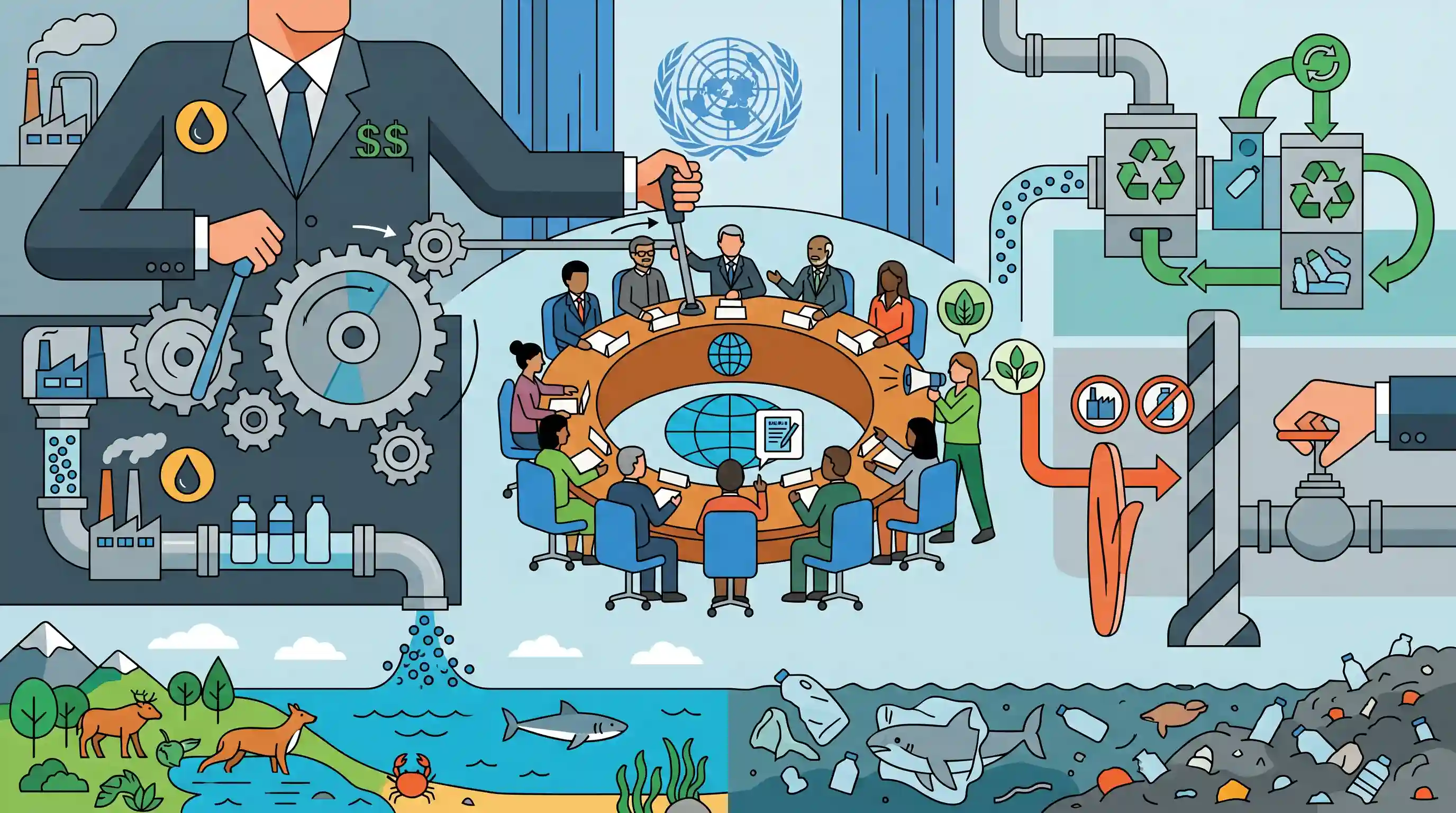
The article critically examines the influence of the plastic and petrochemical industries on environmental policies, with a specific focus on the ongoing negotiations for the UN Global Plastics Treaty. It highlights how industry lobbyists advocate for downstream solutions like recycling and Extended Producer Responsibility (EPR) to avoid binding caps on raw plastic production. Environmental groups argue that this intense corporate lobbying creates a significant conflict of interest, potentially undermining global efforts to comprehensively address the plastic pollution crisis at its source.
Key Points
- The negotiations for a legally binding UN Global Plastics Treaty have seen a substantial increase in the presence of lobbyists from the fossil fuel and petrochemical industries.
- Industry representatives advocate for downstream waste management solutions, such as enhanced recycling and Extended Producer Responsibility (EPR), rather than upstream caps on primary plastic production.
- Environmental organizations raise alarms over conflicts of interest, arguing that corporate lobbying risks diluting the treaty's ambition and effectiveness.
- The core conflict lies between the economic priorities of plastic producers and the urgent global necessity to curb plastic pollution at its source.
Important Terms
Global Plastics Treaty

A proposed legally binding international agreement aimed at ending plastic pollution by addressing the entire lifecycle of plastics, from raw material extraction and production to disposal.
UPSC context
GS Paper III (Environment); critical for understanding international environmental governance and global pollution control measures.
Extended Producer Responsibility (EPR)
A policy framework holding producers financially and operationally responsible for the end-of-life management of their products, incentivizing recycling and eco-friendly design.
UPSC context
GS Paper III (Waste Management); fundamental to India’s Plastic Waste Management Rules and industrial accountability.
UN Environment Programme (UNEP)
The leading global environmental authority within the United Nations that sets the global agenda, promotes sustainable development, and hosts the plastics treaty negotiations.
UPSC context
GS Paper II (International Institutions); the primary agency for multilateral environmental agreements and global conservation.
Intergovernmental Negotiating Committee (INC)
An ad-hoc body established by the UN to negotiate and draft the legally binding international instrument to end plastic pollution through several global sessions.
UPSC context
GS Paper II (International Relations); represents the active diplomatic process for current international environmental lawmaking.
Circular Economy
An economic model focused on minimizing waste by sharing, leasing, reusing, repairing, and recycling existing materials for as long as possible.
UPSC context
GS Paper III (Economy/Environment); a key strategy for sustainable development and resource efficiency.
Prelims Trap
EPR frameworks mandate strict upstream caps on virgin plastic production by manufacturers.
EPR is strictly a downstream waste management tool. It requires producers to handle post-consumer waste but does not cap or restrict the upstream production of new, virgin plastics.
Static Concepts Connected
How is Extended Producer Responsibility (EPR) operationalized in India?
- Legal Framework: Mandated primarily under the Plastic Waste Management Rules, 2016 (alongside E-Waste and Battery rules) under the Environment Protection Act, 1986.
- PIBO Obligations: Producers, Importers, and Brand Owners (PIBOs) must collect, process, or recycle a defined percentage of their post-consumer waste.
- Market Mechanism: The centralized CPCB portal allows entities to purchase and trade EPR certificates to meet their statutory waste management targets.
What is the mandate of the UN Environment Assembly (UNEA) regarding plastics?
- Resolution 5/14: Adopted in 2022, it commits nations to forge a legally binding international agreement to end plastic pollution.
- Full Lifecycle Approach: Unlike previous marine-only frameworks, the mandate explicitly covers the complete lifecycle of plastics: production, design, and disposal.
- INC Mechanism: The Intergovernmental Negotiating Committee (INC) was established to draft the treaty, aiming to balance downstream waste management with upstream production controls.
Cross-Topic Patterns
Conflict of Interest in Global Governance
The petrochemical lobby at the INC mirrors the fossil fuel presence at UNFCCC COP summits, serving as a classic GS4 case study on private profit versus public environmental good.
Fossil Fuels to Petrochemicals Pivot
As global transport transitions to EVs, major oil companies are heavily pivoting to petrochemicals and virgin plastic production to secure their future revenue streams, driving upstream resistance.

Expect a multi-statement question contrasting "upstream" caps (production) with "downstream" (EPR) under the UN Plastics Treaty framework.
Linked PYQs · 4
Linked PYQs · 4
- 2019PrelimsGS1
In India, 'extended producer responsibility' was introduced as an important feature in which of the following?
- 2024PrelimsGS1
Consider the following statements : Statement-I: Many chewing gums found in the market are considered a source of environmental pollution. Statement-II : Many chewing gums contain plastic as gum base. Which one of the following is correct in respect of the above statements?
- 2017MainsGS4
Conflict of interest in the public sector arises when official duties, public interest, and personal interest are taking priority one above the other. How can this conflict in administration be resolved? Describe with an example.
- 2022MainsGS4
You are appointed as an officer heading the section in Environment Pollution Control Board to ensure compliance and its follow-up. In that region, there were large number of small and medium industries which had been granted clearance. You learnt that these industries provide employment to many migrant workers. Most of the industrial units have got environmental clearance certificate in their possession. The environmental clearance seeks to curb industries and projects that supposedly hamper environment and living species in the region. But in practice, most of these units remain to be polluting units in several ways like air, water and soil pollution. As such, local people encountered persistent health problems. It was confirmed that majority of the industries were violating environmental compliance. You issued notice to all the industrial units to apply for fresh environmental clearance certificate from the competent authority. However, your action met with hostile response from a section of the industrial units, other vested interest persons and a section of the local politicians. The workers also became very hostile to you as they felt that your action would lead to the closure of these industrial units, and the resultant unemployment will lead to insecurity and uncertainty in their livelihood. Many owners of the industries approached you with the plea that you should not initiate harsh action as it would compel them to close their units, and cause huge financial loss, shortage of their products in the market. These would obviously add to the sufferings of the labourers and the consumers alike. The labour union also sent you representation requesting against the closure of the units. You simultaneously started receiving threats from unknown corners. You however received supports from some of your colleagues, who advised you to act freely to ensure environmental compliance. Local NGOs also came to your support and they demanded the closure of the polluting units immediately. Critically examine the options listed by you.
