Global Mobility Constraints and Indian Diaspora Challenges
Source:Indian Express ↗
Why It Matters
The article provides a realistic counter-narrative to the celebration of Indian global mobility, essential for UPSC aspirants analyzing the limitations of 'brain drain' and the practical challenges faced by the Indian diaspora. It highlights the intersection of international relations, global protectionism, and domestic employment imperatives.
Summary
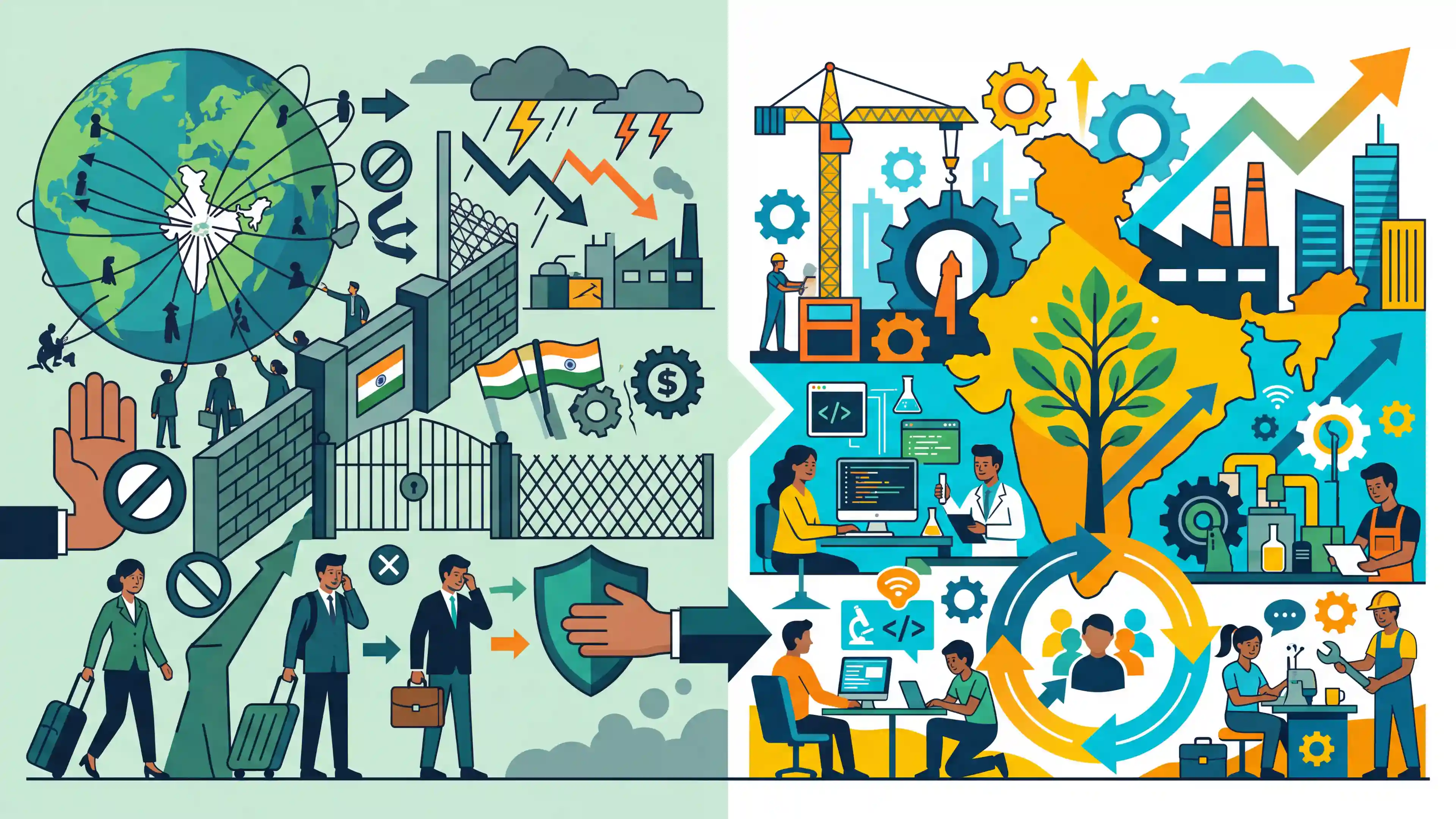
This article critically evaluates the optimistic notion that the globalized world presents boundless opportunities for Indians ('the world is our oyster'). It argues that despite the achievements of the Indian diaspora and strong remittance inflows, global mobility is increasingly constrained. Developed nations are implementing stricter immigration and visa policies, driven by rising domestic protectionism and economic slowdowns. Consequently, Indian professionals and students face significant hurdles abroad. The piece underscores the urgent need for India to shift its focus towards robust domestic job creation, capitalizing on its demographic dividend by retaining talent and building internal capacity, rather than depending on outward migration.
Key Points
- The notion of the world offering limitless opportunities for Indians is increasingly challenged by rising protectionism and stringent immigration policies in developed nations.
- Western countries like the US, UK, and Canada are tightening their visa regimes due to domestic economic pressures, affecting Indian professionals and students.
- While the Indian diaspora continues to provide substantial economic benefits via remittances and soft power, vulnerabilities remain, especially for students and semi-skilled workers.
- India must focus on generating high-quality domestic employment, enhancing skill development, and leveraging its demographic dividend internally rather than relying solely on global migration.
- Geopolitical fragmentation and inward-looking policies globally necessitate a recalibration of India's expectations regarding globalization and talent export.
Important Terms
H-1B Visa Program

A non-immigrant US work visa allowing employers to hire foreign professionals in 'specialty occupations' requiring specialized knowledge and a bachelor's degree.
UPSC context
GS Paper 2: International Relations. A key pillar of India-US ties; Indians receive ~70% of these visas annually.
Demographic Dividend
Economic growth potential resulting from shifts in a population's age structure, specifically when the working-age population (15-64) exceeds the dependent population.
UPSC context
GS Paper 3: Economy/Employment. Tests India's ability to harness its 'youth bulge' for sustainable development.
Indian Diaspora
The global community of persons of Indian birth, descent, or origin living outside India, acting as a 'living bridge' to the world.
UPSC context
GS Paper 2: International Relations. Tests understanding of soft power, political lobbying, and economic contributions to India.
Remittances
Financial transfers made by migrants to their home countries, supporting family consumption and improving national foreign exchange reserves.
UPSC context
GS Paper 3: Economy. India is the world's top recipient ($100B+), crucial for Current Account stability.
Protectionism
Economic policy of restricting imports through tariffs, quotas, or regulations to shield domestic industries and labor from foreign competition.
UPSC context
GS Paper 3: Economy. Essential for analyzing global trade barriers and the 'America First' style challenges to migration.
Prelims Trap
India's inward remittances are so large that they completely offset the country's merchandise trade deficit.
Remittances are the highest globally and crucial for BoP, but they only cover roughly half of India's massive merchandise trade deficit. They rarely offset it entirely.
Static Concepts Connected
What structurally defines India's 'Demographic Dividend' window?
- Working-age ratio: It occurs when the working-age population (15-64 years) is larger than the non-working-age share, lowering the dependency ratio.
- UNFPA projections: India's dividend window spans roughly 50 years (2005-2056), peaking around 2041, making it an unparalleled demographic opportunity globally.
- Realization conditions: It is not automatic; capitalizing on it requires massive, immediate investments in health, education, and labor-intensive domestic job creation.
Where do remittances sit within India's Balance of Payments?
- Current Account: Remittances are recorded under the Current Account, specifically within the 'Invisibles' section, alongside Services and Income.
- Private Transfers: They are classified precisely as 'Private Transfers'—representing one-way transactions by migrants sending money back home without expected economic return.
- Deficit stabilizer: These inflows act as a crucial macroeconomic buffer, historically covering nearly half of India's merchandise trade deficit.
Cross-Topic Patterns
Visa curbs + Labor-intensive exports
Rising protectionism hits India twice: tighter immigration curbs outward migration, while localized supply chains ("friendshoring") hinder the growth of India's labor-intensive exports, doubling the domestic job pressure.
Diaspora soft power vs student vulnerability
The celebration of diaspora success (e.g., remittances, tech CEOs) masks the growing vulnerability of Indian students and semi-skilled workers facing visa caps and economic precarity in Canada and the UK.

Expect a GS2/GS3 Mains question linking Western protectionism (visa curbs) with the urgent domestic pressure of India's demographic dividend.
Linked PYQs · 3
Linked PYQs · 3
- 2023MainsGS2
Indian diaspora has scaled new heights in the West. Describe its economic and political benefits for India.
- 2020MainsGS2
Indian diaspora has a decisive role to play in the politics and economy of America and European Countries'. Comment with examples.
- 2016MainsGS2
The broader aims and objectives of WTO are to manage and promote international trade in the era of globalization. But the Doha round of negotiations seem doomed due to differences between the developed and the developing countries." Discuss in the Indian perspective.
