Constitutional and Human Rights Aspects of Shoot-to-Disable Tactics
Source:The Hindu ↗
ఇది ఎందుకు ముఖ్యం
It addresses a critical governance and security debate regarding police accountability, human rights violations, and adherence to the rule of law during law enforcement operations.
సారాంశం
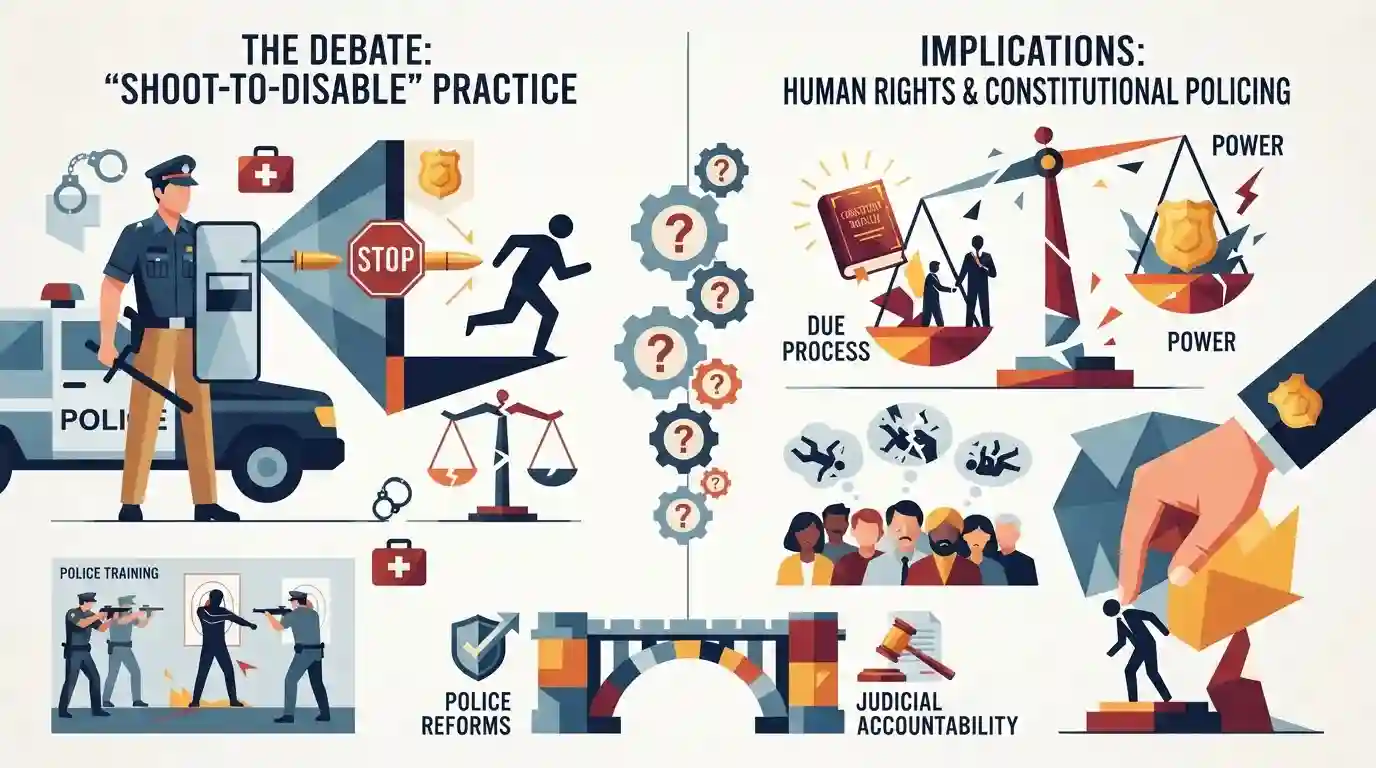
This article from The Hindu discusses the debate surrounding the 'shoot-to-disable' policy or practice by police forces, analyzing its implications for human rights, rule of law, and constitutional policing in India.
ముఖ్య అంశాలు
- The article examines the increasing trend or discussion around 'shoot-to-disable' tactics by law enforcement agencies in India instead of fatal force or standard procedures.
- It raises critical questions regarding legality, proportionality, human rights, and the rule of law in police actions.
- Discusses the guidelines and judicial precedents governing the use of firearms by the police, emphasizing self-defense and minimal necessary force.
- Highlights the thin line between extrajudicial measures and lawful policing, cautioning against normalizing extra-legal enforcement.
ముఖ్యమైన పదాలు
Supreme Court of India

The apex judicial tribunal of India established under Article 124 of the Constitution, possessing final constitutional interpretation and appellate powers, including setting strict guidelines for police encounters to prevent extrajudicial killings.
UPSC context
GS Paper II (Polity & Constitution): Tests judicial accountability, rule of law, enforcement of fundamental rights, and constitutional policing.
National Human Rights Commission (NHRC)
An autonomous statutory body established under the Protection of Human Rights Act, 1993, mandated to protect and promote human rights, including issuing mandatory guidelines on encounter deaths and police accountability.
UPSC context
GS Paper II (Governance): Tests the role, powers, and functioning of statutory bodies in safeguarding human rights against state excesses.
ప్రిలిమ్స్ ఉచ్చు
Shoot-to-disable is a statutorily mandated procedure under criminal procedure codes for effecting arrests in non-heinous crimes.
Aspirants often confuse executive operational guidelines with statutory enactments; shoot-to-disable is not codified under CrPC/BNSS but is an administrative tactic facing judicial scrutiny.
అనుసంధానమైన స్థిర భావనలు
What are the key judicial guidelines governing police encounters and use of firearms in India?
- Mandatory Probe: PUCL v. State of Maharashtra (2014) mandated comprehensive 17-point guidelines for independent criminal investigations into police encounters.
- Minimum Force: Proportionality principle limits police firearm use to strict self-defense or preventing escape of heinous offenders, requiring minimum necessary force.
- Constitutional Limit: Right to Life under Article 21 cannot be arbitrarily curtailed by executive action or pre-trial punitive measures.
అంతర-అంశ నమూనాలు
Police Encounters vs Torture Conventions
Judicial oversight of police force intersects with anti-torture legislation debates and custodial violence standards under international human rights covenants.
Rule of Law vs Executive Efficiency
The shift toward operational shortcuts highlights systemic institutional bottlenecks within the criminal justice delivery chain.

Shoot-to-disable vs minimal force principles will likely be tested via a statement-based GS-2 question on judicial oversight.
అనుసంధాన PYQలు · 1
అనుసంధాన PYQలు · 1
- 2021MainsGS2
Though the Human Rights Commissions have contributed immensely to the protection of human rights in India, yet they have failed to assert themselves against the mighty and powerful. Analyzing their structural and practical limitations, suggest remedial measures.
