Presence at protest and UAPA: Supreme Court examines civil liberties
Source:The Hindu ↗
Why It Matters
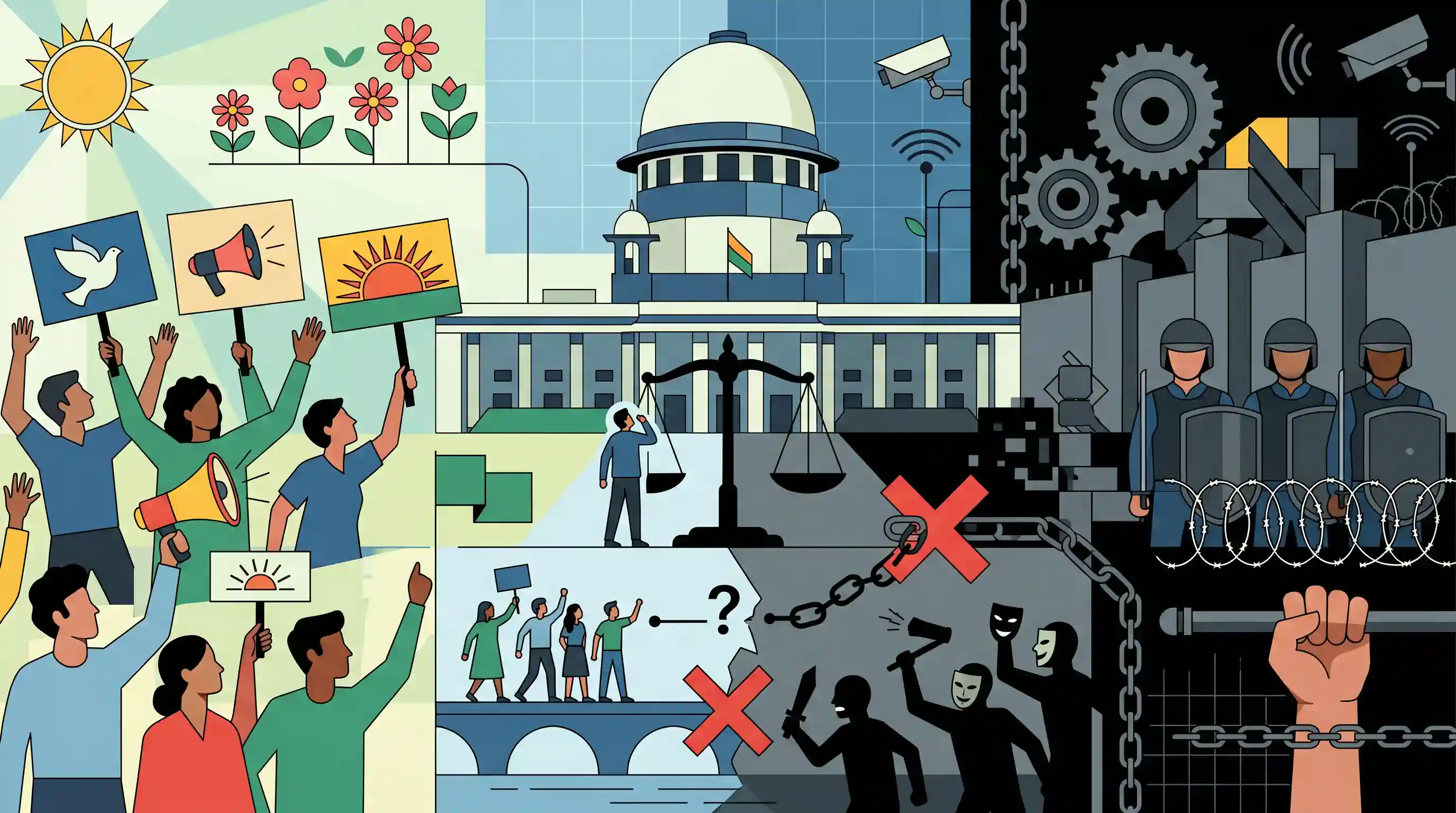
The case serves as a crucial constitutional and legal benchmark regarding the limits of the right to protest in India. It requires balancing democratic dissent against the state's use of stringent anti-terror legislation like the UAPA, especially concerning individuals merely present at protest sites that subsequently escalated into violence.
Summary
An accused in the 2020 Delhi riots case petitioned the Supreme Court, arguing that mere presence at an anti-CAA protest site does not constitute a criminal act under the Unlawful Activities (Prevention) Act (UAPA). The petitioner emphasized that attending a protest should not be conflated with orchestrating a riot or engaging in terrorism. This case brings into focus the ongoing tension between the fundamental right to peaceful protest (Article 19) and the application of stringent anti-terrorism laws, raising critical questions about the protection of civil liberties and the potential criminalization of dissent.
Key Points
- The Supreme Court heard a bail plea from Shadab Ahmed, an accused in the 2020 Delhi riots 'larger conspiracy' case, challenging his prolonged incarceration under the UAPA.
- The petitioner argued that merely being present at the Chand Bagh anti-CAA protest site cannot be construed as a criminal or terrorist act.
- Several other individuals, including student leaders and activists, have been imprisoned without trial for over four years under the UAPA in connection with the same protests.
- The proceedings highlight concerns over the conflation of democratic dissent and peaceful assembly with unlawful, anti-national activities by law enforcement agencies.
Important Terms
Unlawful Activities (Prevention) Act (UAPA)

India’s primary anti-terror legislation enacted in 1967 to prevent activities threatening national sovereignty. It includes stringent bail conditions (Section 43D(5)) that make it difficult for the accused to secure release during trial.
UPSC context
GS Paper III (Internal Security); tests the balance between stringent anti-terror measures and the protection of individual constitutional rights.
Article 19
A fundamental provision of the Indian Constitution guaranteeing six freedoms, including speech and peaceful assembly. These rights are subject to 'reasonable restrictions' like national security and public order.
UPSC context
GS Paper II (Fundamental Rights); tests the understanding of democratic freedoms, dissent, and the state's power to limit them.
Citizenship (Amendment) Act (CAA)
A 2019 law providing an accelerated pathway to Indian citizenship for persecuted non-Muslim minorities (Hindus, Sikhs, Buddhists, Jains, Parsis, Christians) from Afghanistan, Bangladesh, and Pakistan.
UPSC context
GS Paper II (Polity/Citizenship); tests the concepts of secularism, equality under the law, and legislative changes to citizenship norms.
Supreme Court of India
The highest judicial court and final interpreter of the Indian Constitution. It serves as the guardian of fundamental rights and oversees the legality of state actions and legislations.
UPSC context
GS Paper II (Judiciary); tests the court's role in judicial review and its evolution in protecting civil liberties from executive overreach.
Delhi High Court
The high court for the National Capital Territory of Delhi. Its interpretations of UAPA in the context of the 2020 riots are pivotal for setting legal precedents on bail and conspiracy.
UPSC context
GS Paper II (Judiciary); tests the hierarchy of courts and the application of criminal jurisprudence in high-profile internal security cases.
Civil Liberties
Fundamental personal freedoms, such as the right to free speech and assembly, that are protected from government interference and are essential for a functioning democracy.
UPSC context
GS Paper II/IV (Governance/Ethics); tests the ethical and legal limits of state power in managing dissent and public order.
Prelims Trap
Constitutional courts are completely barred from granting bail if UAPA Section 43D(5) applies to the accused.
The SC held in K.A. Najeeb (2021) that statutory bail restrictions under UAPA do not override courts' constitutional powers to protect Article 21 rights.
Static Concepts Connected
What are the constitutional limitations on the Right to Freedom of Assembly?
- Article 19(3): Empowers the State to impose reasonable restrictions in the interests of the sovereignty and integrity of India, or public order.
- Indefinite Occupation: The SC (Shaheen Bagh case) ruled that public spaces and roads cannot be occupied indefinitely during demonstrations.
- Without Arms: Article 19(1)(b) explicitly protects only peaceful assemblies that are conducted without weapons.
How are 'law and order', 'public order', and 'security of state' legally distinguished?
- Concentric Circles: The Ram Manohar Lohia case (1965) established these as three concentric circles. 'Law and order' is the largest, 'security of the state' is the smallest and gravest.
- Threshold of Impact: Routine crime affects 'law and order', widespread community riots affect 'public order', while existential threats to the nation trigger 'security of state' (e.g., UAPA).
Cross-Topic Patterns
UAPA and PMLA Bail Jurisprudence
Both acts feature stringent 'reverse-burden' bail conditions, shifting the onus onto the accused. UPSC consistently tests statutory exceptions to the standard 'bail is the rule' doctrine.
Civil Liberties vs Internal Security
Links GS2 (Article 19 right to protest) directly with GS3 (Internal Security). Expect questions testing the proportionality of anti-terror laws and the state's handling of democratic dissent.

Expect a 2026 Prelims MCQ comparing UAPA bail provisions with standard procedural rules, or a Mains question on Article 21 limits on UAPA.
Linked PYQs · 2
Linked PYQs · 2
- 2019MainsGS3
Indian Government has recently strengthened the anti-terrorism laws by amending the Unlawful Activities (Prevention) Act (UAPA), 1967 and the NIA Act. Analyze the changes in the context of prevailing security environment while discussing the scope and reasons for opposing the UAPA by human rights organizations.
- 2022MainsGS2
“Right of movement and residence throughout the territory of India are freely available to the Indian citizens, but these rights are not absolute.” Comment.
