India macroeconomic growth and structural hurdles in US trade debate
Source:Indian Express ↗
Why It Matters
This issue is highly relevant for GS Paper 3 as it bridges core macroeconomic indicators (GDP growth, employment, capital formation) with international trade dynamics (protectionism, US-India relations). It encourages aspirants to critically analyze whether headline economic growth translates into inclusive development.
Summary
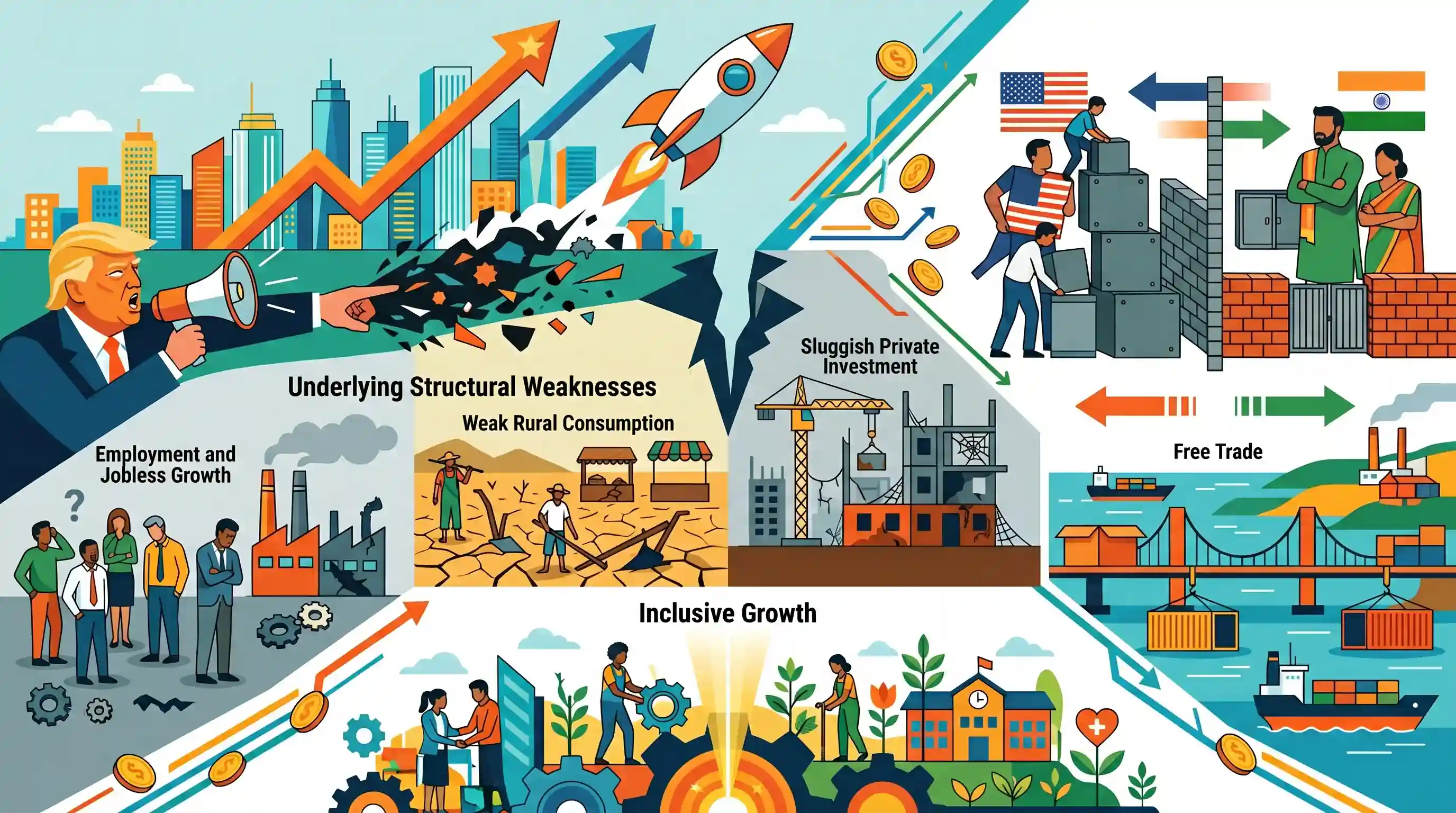
The article evaluates Donald Trump's controversial claim that India's economy is 'dead'. While factually incorrect—given India's status as one of the world's fastest-growing major economies—the assertion brings attention to underlying structural weaknesses in the Indian macroeconomic landscape. The explainer highlights the dichotomy between strong headline GDP growth and grassroots economic realities, such as persistent unemployment, jobless growth, weak rural consumption, and sluggish private investment. Furthermore, the piece contextualizes Trump's criticism within the broader US-India trade friction, where India is often labeled as protectionist. Ultimately, while the economy is far from 'dead', the article underscores the urgent need for structural reforms to transition from top-line expansion to broad-based, inclusive growth.
Key Points
- Donald Trump characterized India's economy as 'dead', a hyperbolic claim likely stemming from his administration's critical stance on India's tariff policies and bilateral trade frictions.
- Despite the claim, India remains one of the fastest-growing major economies globally, with top-line GDP growth figures demonstrating strong overall macroeconomic expansion.
- The article highlights the dichotomy between headline growth and underlying structural vulnerabilities, particularly 'jobless growth' where economic expansion fails to generate adequate employment.
- Other persistent challenges include sluggish private sector capital expenditure (investment) and stagnant private consumption, especially in rural areas, leading to an uneven or K-shaped recovery.
- Trump's rhetoric reflects broader global shifts towards protectionism, emphasizing the need for India to navigate US-India trade ties carefully while implementing domestic structural reforms to ensure inclusive growth.
Important Terms
Jobless Growth

Economic expansion where Gross Domestic Product (GDP) increases without a proportional rise in employment opportunities. In India, this is characterized by a high service-sector contribution but low labor absorption.
UPSC context
GS Paper 3: Employment. Tests understanding of the disconnect between headline growth and labor market realities, critical for the 'Demographic Dividend' debate.
Protectionism
Government policies—including high tariffs, import quotas, and subsidies—designed to shield domestic industries from foreign competition. The US often labels India's trade stance as protectionist.
UPSC context
GS Paper 3: Effects of Liberalization. Relates to 'Atmanirbhar Bharat' vs. Global Trade and GS Paper 2 (International Relations) regarding US-India trade friction.
Inclusive Growth
Economic growth that is broad-based across sectors and ensures equitable distribution of benefits, particularly for marginalized groups. It focuses on reducing inequality and improving access to essential services.
UPSC context
GS Paper 3: Inclusive Growth. A specific syllabus topic testing the transition from 'growth' to 'development' and social justice.
Structural Reforms
Long-term policy changes aimed at improving economic efficiency by removing bottlenecks in markets, such as labor laws, land acquisition, and tax systems (e.g., GST or 1991 LPG reforms).
UPSC context
GS Paper 3: Indian Economy and planning. Tests knowledge of the 1991 reforms and necessary second-generation reforms for sustained 8%+ growth.
Gross Domestic Product (GDP)
The total market value of all finished goods and services produced within a country's borders in a specific period. It is the primary indicator of economic health.
UPSC context
GS Paper 3: National Income. Essential for interpreting India's status as the 'fastest-growing major economy' versus grassroots economic distress.
World Trade Organization (WTO)
A global body regulating international trade. It provides a framework for trade agreements and dispute resolution; India frequently defends its 'Special and Differential Treatment' status here.
UPSC context
GS Paper 2: International Institutions. Tests understanding of multilateral trade rules and India's compliance or friction with 'Reciprocal Tariff' demands.
Demographic Dividend
The economic growth potential resulting from a shift in a population's age structure, specifically when the working-age population is larger than the non-working-age share.
UPSC context
GS Paper 1 & 3: Population and Employment. A recurring theme on whether India can utilize its youth bulge before it ages.
Private Investment
Capital expenditure by private businesses into productive assets like machinery or factories. India currently faces a 'twin balance sheet' recovery or 'sluggish' investment despite high GDP.
UPSC context
GS Paper 3: Investment Models. Tests understanding of the 'Crowding-in' effect and why corporate profits aren't always translating into new jobs.
Prelims Trap
India runs a persistent trade deficit with the US, prompting retaliatory tariffs.
India actually enjoys a significant merchandise trade surplus with the US. Trump's tariff threats and "protectionist" labels stem from specific Indian import duties (like on Harley Davidson motorcycles) and non-tariff barriers, not a US trade surplus.
Static Concepts Connected
What is the 'Employment Elasticity of Growth'?
- Definition: The percentage change in employment associated with a 1% change in economic growth (GDP).
- Jobless Growth: A situation where employment elasticity approaches zero, meaning economic expansion fails to create proportionate job opportunities.
- India's Trend: Historically declining in India since the 1990s, highlighting a structural shift toward capital-intensive or skill-intensive sectors (like IT) over labor-intensive manufacturing.
What is the Generalized System of Preferences (GSP)?
- Origin & Purpose: Instituted under UNCTAD (1971), allowing developed countries to grant preferential, non-reciprocal tariff reductions to developing nations.
- US-India Context: The US revoked India's GSP status in 2019, citing lack of equitable and reasonable access to Indian markets.
- WTO Compatibility: It operates legally under the WTO's "Enabling Clause," functioning as an accepted exception to the Most-Favored-Nation (MFN) principle.
Cross-Topic Patterns
K-shaped recovery and structural inequality
Links high GDP growth driven by capital-intensive sectors with lagging rural consumption and stagnant real wages. This paradox is frequently tested under 'Inclusive Growth' in GS Paper 3.
Public Capex vs Sluggish Private Investment
Connects the current reliance on government capital expenditure to the concept of 'crowding in' private investment, a recurring macroeconomic theme in recent Economic Surveys and UPSC Mains.

Mains 2026 will likely test the paradox of India's macroeconomic resilience against structural flaws like low employment elasticity.
Linked PYQs · 5
Linked PYQs · 5
- 2025MainsGS3
What are the challenges before the Indian economy when the world is moving away from free trade and multilateralism to protectionism and bilateralism? How can these challenges be met?
- 2022MainsGS3
Economic growth in the recent past has been led by increase in labour productivity." Explain this statement. Suggest the growth pattern that will lead to creation of more jobs without compromising labour productivity.
- 2019MainsGS2
‘What introduces friction into the ties between India and the United States is that Washington is still unable to find for India a position in its global strategy, which would satisfy India's national self-esteem and ambitions.’ Explain with suitable examples.
- 2017MainsGS3
What are the salient features of 'inclusive growth'? Has India been experiencing such a growth process? Analyse and suggest measures for inclusive growth.
- 2023MainsGS3
Faster economic growth requires increased share of the manufacturing sector in GDP, particularly of MSMEs. Comment on the present policies of the Government in this regard.
