Economic Burden of Invasive Alien Species in India
Source:The Hindu ↗
Why It Matters
Invasive alien species are a leading driver of global biodiversity loss. For UPSC aspirants, understanding the intersection of ecology and economy—specifically how environmental degradation translates into livelihood loss and economic costs—is crucial for GS3 Environment and Economy answers, as well as Prelims questions on species conservation and threats to biodiversity.
Summary
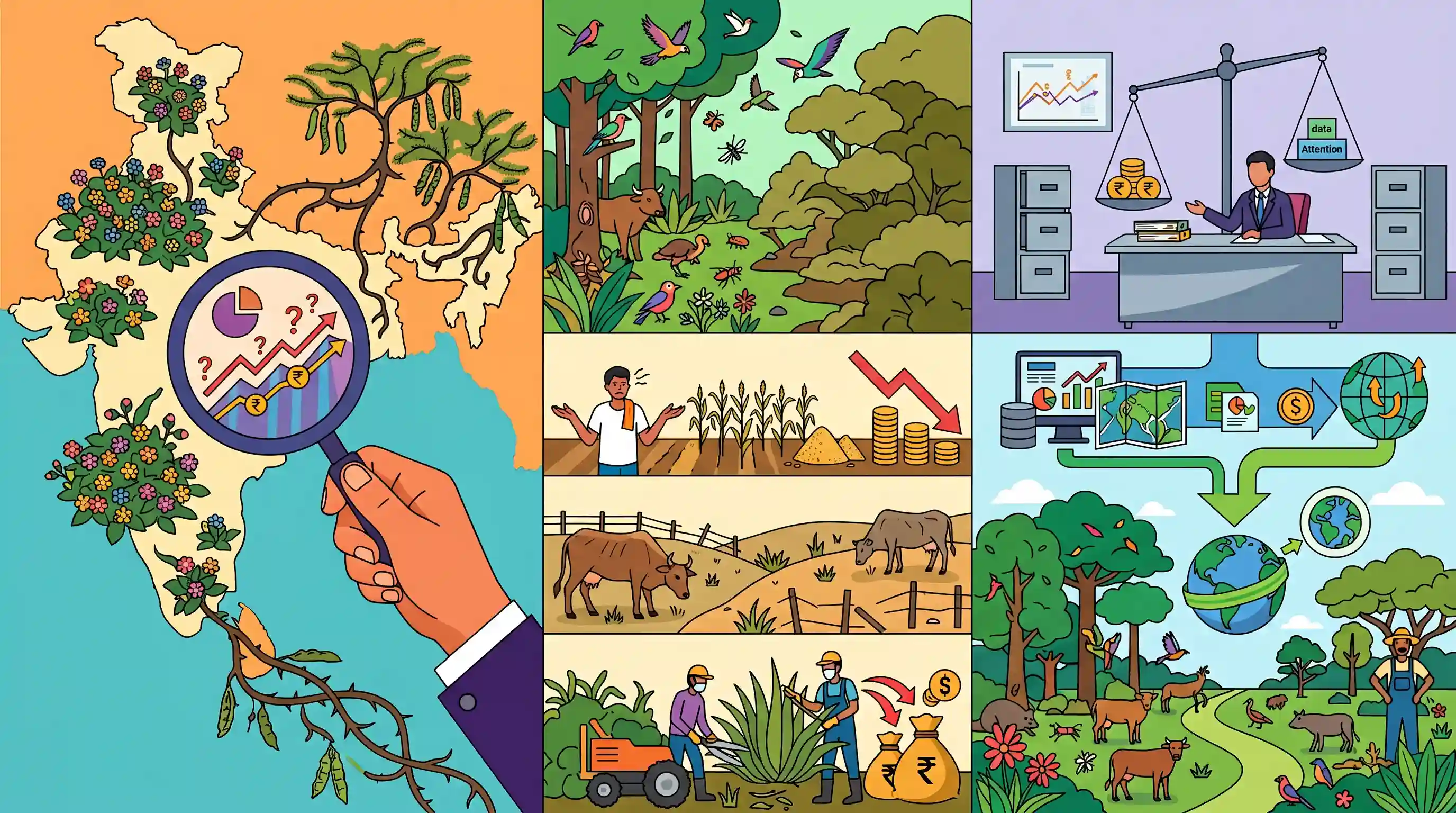
The article highlights the growing concern that India is significantly underestimating the ecological and economic costs of invasive alien species. Beyond devastating native biodiversity, invasive species such as Lantana camara and Prosopis juliflora impose substantial financial burdens by reducing agricultural productivity, degrading grazing lands, and increasing management costs. The lack of comprehensive national accounting for the loss of ecosystem services and rural livelihood impacts means that biological invasions receive inadequate policy attention and funding. Recognizing the true cost is essential for effective environmental management and achieving global biodiversity conservation goals.
Key Points
- Invasive alien species (IAS) cause extensive ecological damage by outcompeting native flora and fauna, leading to significant biodiversity loss.
- Common invasive species in India, such as Lantana camara and Prosopis juliflora, severely degrade forests and grazing lands, directly impacting pastoral and forest-dependent communities.
- The true economic cost of dealing with invasive species in India is likely underestimated because non-market values, loss of ecosystem services, and indirect socio-economic impacts are often ignored in official calculations.
- A comprehensive national accounting of the economic burden imposed by biological invasions is necessary to guide proactive policy-making, allocate sufficient restoration funds, and align with global biodiversity targets.
Important Terms
Invasive Alien Species (IAS)

Non-native organisms whose introduction and spread threaten ecosystems, agricultural productivity, and human health, often outcompeting native flora and fauna.
UPSC context
GS Paper III (Environment); tested as a major driver of biodiversity loss and economic impact.
Kunming-Montreal Global Biodiversity Framework (GBF)
Adopted in 2022, this global agreement includes Target 6, which specifically aims to reduce the rate of invasive species introduction and establishment by at least 50% by 2030.
UPSC context
GS Paper III (International Treaties); critical for questions on global biodiversity targets and India's commitments.
IPBES
An independent intergovernmental body that provides scientific assessments on biodiversity; its 2023 report highlighted that invasive species contribute to 60% of global extinctions.
UPSC context
GS Paper III (International Institutions); tests knowledge of global reports and evidence-based policy making.
Convention on Biological Diversity (CBD)
The 1992 treaty for biodiversity conservation; Article 8(h) requires parties to prevent the introduction of, control, or eradicate alien species that threaten ecosystems.
UPSC context
GS Paper III (Environment); the primary legal framework for India's National Biodiversity Action Plan.
Lantana camara
A South American shrub that is one of India's most invasive plants, infesting over 40% of forest areas and impacting tiger reserves like the Nilgiris.
UPSC context
GS Paper III (Biodiversity); a recurring example of ecological degradation and allelopathy in India.
Invasive Species Specialist Group (ISSG)
A global network of experts under the IUCN Species Survival Commission that provides technical advice and maintains the Global Invasive Species Database (GISD).
UPSC context
GS Paper III (Environmental Governance); relevant for technical monitoring and scientific advisory mechanisms.
Prelims Trap
"The Global Invasive Species Database is maintained by the Convention on Biological Diversity (CBD)."
The GISD is developed and managed by the Invasive Species Specialist Group (ISSG), which operates under the IUCN, not the CBD or UNEP.
Static Concepts Connected
What ecological mechanisms make invasive species highly successful?
- Phenotypic plasticity: Ability to alter growth and form to survive in vastly different environmental conditions.
- Allelopathy: Releasing biochemicals into the soil that inhibit the germination or growth of native flora (e.g., Prosopis juliflora).
- Enemy release hypothesis: They often arrive in environments lacking their natural pests, diseases, or predators, allowing unchecked population expansion.
How does the Kunming-Montreal Framework target invasive species?
- Target 6: Target 6 specifically mandates reducing the rates of introduction and establishment of known or potential IAS by at least 50% by 2030.
- Priority eradication: Focuses on controlling or eradicating IAS in priority sites, particularly islands and highly vulnerable ecosystems, to protect native biodiversity.
Cross-Topic Patterns
NTFP economy and biological invasions
Forest degradation by species like Lantana camara reduces Non-Timber Forest Produce (NTFP) yields, directly threatening tribal livelihoods and undermining poverty alleviation schemes in central and southern India.
Invasives exacerbating arid water stress
In arid regions, Prosopis juliflora acts as a threat multiplier by deep-rooting to deplete critical groundwater tables while actively suppressing native fodder grasses, worsening agricultural distress.

Expect a multi-statement prelims question linking specific IAS (Lantana, Prosopis) to their ecological mechanisms (allelopathy) and IUCN.
Linked PYQs · 2
Linked PYQs · 2
- 2023PrelimsGS1
'Invasive Species Specialist Group' (that develops Global Invasive Species Database) belongs to which one of the following organizations?
- 2012PrelimsGS1
Which of the following can be threats to the biodiversity of a geographical area? 1. Global warming 2. Fragmentation of habitat 3. Invasion of alien species 4. Promotion of vegetarianism Select the correct answer using the codes given below:
