Gross Domestic Product Metrics and Per Capita Income Realities
Source:The Hindu ↗
Why It Matters
Provides critical insights into the limitations of GDP as a metric for economic success, a fundamental concept for both Prelims (PPP vs. Nominal exchange rates) and Mains (differentiating economic growth from economic development and inclusive growth).
Summary
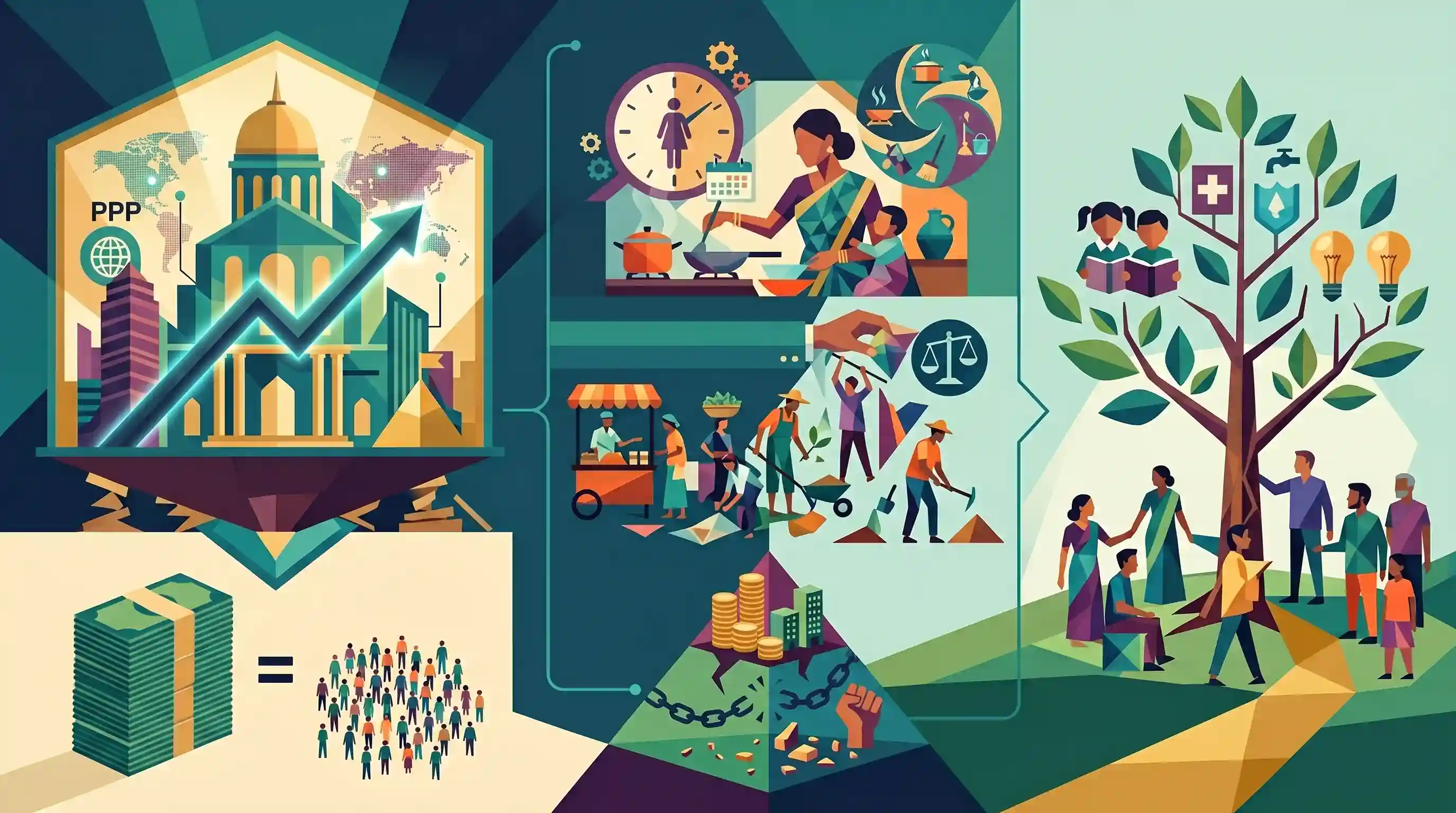
The article critically examines India's projected rise to become the world's fourth-largest economy by 2025, according to IMF forecasts based on market exchange rates. It differentiates this from Purchasing Power Parity (PPP) metrics, where India has ranked third since 2009. The piece cautions against celebrating aggregate GDP figures, highlighting the 'big economy illusion.' It emphasizes that despite a large overall GDP, India's per capita income remains low, and GDP fails to reflect critical socio-economic realities such as unpaid female labor, massive informal sector underemployment, and widespread wealth inequality. Ultimately, social progress indicators provide a far more accurate picture of development than raw economic output.
Key Points
- The IMF projects India's GDP to reach $4,187 billion in 2025, surpassing Japan to become the world's fourth-largest economy at market exchange rates.
- When evaluated using Purchasing Power Parity (PPP), India has consistently been the world's third-largest economy since 2009.
- The PPP method accounts for lower prices of non-traded goods and labor in developing countries, offering a more realistic comparison of living standards than volatile market exchange rates.
- Despite the massive aggregate size, India's per capita GDP remains low at $2,711 in 2024, ranking 144th globally in nominal terms and 127th in PPP terms.
- The author critiques the 'big economy illusion,' stressing that aggregate GDP ignores significant underlying issues like the informal sector, unpaid female labor, inequality, and lack of minimum wages.
Important Terms
Gross Domestic Product (GDP)

The total market value of all final goods and services produced within a country's borders during a specific period. It is a standard indicator of a nation's overall economic size and health.
UPSC context
GS Paper 3: Tests understanding of national income accounting, economic growth trajectories, and the limitations of aggregate growth metrics.
Purchasing Power Parity (PPP)
An economic metric used to compare different countries' currencies by equalizing the price of a common basket of goods. It reflects the real buying power of a currency within its domestic market.
UPSC context
GS Paper 3: Crucial for comparing economic size, standard of living, and poverty levels across nations, moving beyond volatile market exchange rates.
Per Capita Income
A measure of the average income earned per person in a given area (country or city) in a specified year. It is calculated by dividing the total national income by the population.
UPSC context
GS Paper 3: A key indicator for measuring individual economic well-being and the disparity between national wealth and citizens' living standards.
Informal Sector
The part of an economy that is neither taxed nor monitored by any form of government. In India, it employs the vast majority of the workforce, often lacking social security.
UPSC context
GS Paper 3: Central to discussions on inclusive growth, employment challenges, and the 'dualistic' nature of India's economy.
International Monetary Fund (IMF)
A global financial institution established in 1944 to promote international monetary cooperation, ensure financial stability, and provide temporary assistance to member countries facing balance-of-payments crises.
UPSC context
GS Papers 2 & 3: Tests knowledge of international financial institutions, global economic governance, and India's role in the global monetary system.
NITI Aayog
India's premier policy think tank that replaced the Planning Commission in 2015. It aims to foster cooperative federalism and design long-term strategic policies using a bottom-up approach.
UPSC context
GS Papers 2 & 3: Evaluates understanding of federalism, planning architecture, and the shift from centralized planning to cooperative policy formulation.
International Labour Organization (ILO)
A United Nations agency that sets international labor standards and promotes social justice and decent work. It features a unique tripartite structure involving governments, employers, and workers.
UPSC context
GS Papers 2 & 3: Examines international organizations, labor laws, social security, and India’s commitment to global employment standards.
Prelims Trap
"India recently became the world's third-largest economy when measured by Purchasing Power Parity (PPP)."
A classic trap. India has been 3rd in PPP since 2009. The 2025 projection of surpassing Japan is for the 4th position in nominal (market exchange rate) GDP.
Static Concepts Connected
How does Purchasing Power Parity (PPP) differ from Market Exchange Rate GDP?
- Basket of Goods: Compares currencies by determining the cost of a standard basket of goods, reflecting domestic living standards rather than international trade valuation.
- Non-Traded Goods: PPP accounts for cheaper local services and labor in developing nations, usually making their PPP GDP significantly higher than their nominal GDP.
- Volatility: Market exchange rates fluctuate wildly with global financial flows, whereas PPP exchange rates remain relatively stable over time.
What are the primary limitations of using aggregate GDP as a measure of economic welfare?
- Unpaid Labor: It excludes non-monetized transactions, entirely ignoring the massive economic contribution of women's unpaid domestic and care work.
- Inequality Blindness: Aggregate GDP and per capita averages hide wealth concentration; extreme inequality means rapid growth does not necessarily translate to broad-based societal welfare.
- Ecological Externalities: Standard GDP calculations fail to account for the environmental degradation, pollution, and resource depletion associated with rapid economic expansion.
Cross-Topic Patterns
Unpaid female labor & GDP accounting
GS-1 society themes on women's roles heavily overlap with GS-3 economic debates on how monetizing female domestic labor could drastically alter national income statistics.
Macro aggregates vs. micro-level reality
UPSC frequently tests the paradox of India's rising aggregate GDP alongside its persistently low HDI and high Gini coefficient to evaluate the concept of 'inclusive growth'.

Expect a Prelims trap confusing India's long-standing 3rd rank in PPP with its newly projected 4th rank in nominal GDP for 2025.
Linked PYQs · 3
Linked PYQs · 3
- 2019PrelimsGS1
Consider the following statements: 1. Purchasing Power Parity (PPP) exchange rates are calculated by comparing the prices of the same basket of goods and services in different countries. 2. In terms of PPP dollars, India is the sixth largest economy in the world. Which of the statements given above is/are correct?
- 2018PrelimsGS1
Increase in absolute and per capita real GNP do not connote a higher level of economic development, if
- 2025MainsGS3
Distinguish between the Human Development Index (HDI) and the Inequality-adjusted Human Development Index (IHDI) with special reference to India. Why is the IHDI considered a better indicator of inclusive growth?
