Diplomacy and Commercial Lobbying Firms in International Relations
Source:The Hindu ↗
Why It Matters
Evaluates an informal but highly impactful tool of modern diplomacy (lobbying) and how it shapes India's bilateral relations, providing a nuanced view of international relations beyond formal state mechanisms.
Summary
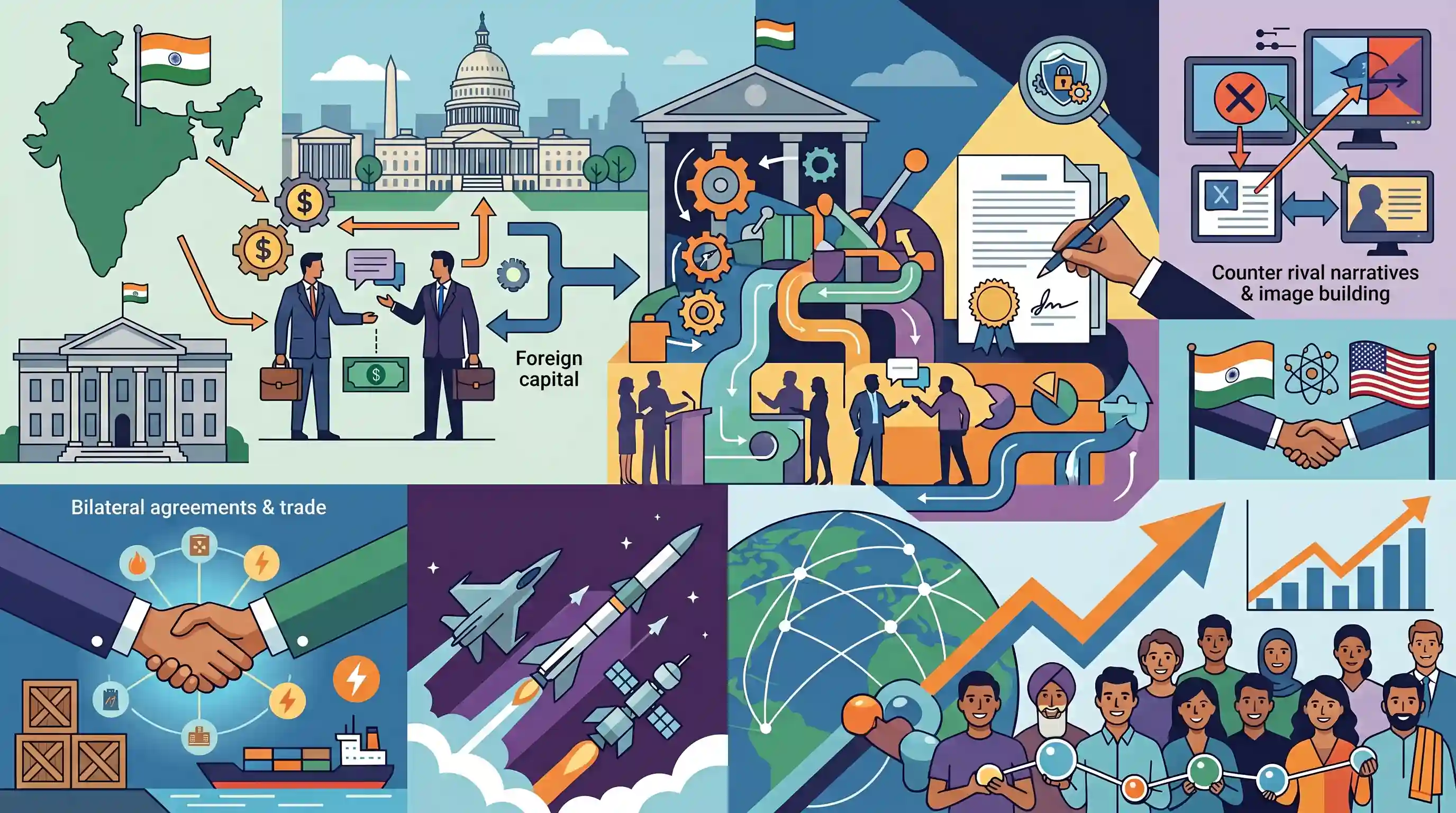
The article examines the prevalent practice of sovereign states hiring private lobbying and public relations firms in foreign capitals—most notably Washington, D.C.—to advance their diplomatic objectives. While traditional diplomacy relies on state-to-state interaction via embassies, modern statecraft increasingly utilizes commercial lobbyists to navigate complex legislative environments, secure favorable trade or defense deals, and counter rival narratives. The US mandates transparency for such activities through the Foreign Agents Registration Act (FARA). India, like many other nations, has actively utilized lobbying firms to supplement its diplomatic efforts and diaspora outreach, a practice historically instrumental in securing milestones like the Indo-US civil nuclear agreement.
Key Points
- Commercialization of Diplomacy: Foreign governments frequently employ private lobby groups to supplement official embassy work, seeking access to influential lawmakers, think tanks, and media networks.
- Regulatory Framework: In the US, the Foreign Agents Registration Act (FARA) requires individuals and organizations representing foreign interests to publicly disclose their relationship, activities, and financial compensation.
- Strategic Objectives: Lobbying is used to shape foreign policy, secure military/economic assistance, mitigate diplomatic crises, and neutralize lobbying by adversarial states.
- India's Experience: India has consistently engaged lobbying firms in Washington D.C. to promote bilateral ties and safeguard its strategic interests, often working in tandem with the politically active Indian diaspora.
- Ethics and Transparency: While legal and widespread, the practice raises concerns regarding the influx of foreign money into domestic politics and the accountability of private actors shaping public policy.
Important Terms
Foreign Agents Registration Act (FARA)

A 1938 US law requiring individuals or entities representing foreign interests to register with the Department of Justice and disclose their activities, finances, and relationships to ensure transparency.
UPSC context
GS Paper II (International Relations); tests understanding of legal transparency frameworks governing foreign influence and diplomatic outreach in developed countries.
Indo-US Civil Nuclear Agreement
A landmark 2008 bilateral pact (the "123 Agreement") that ended India’s global nuclear isolation, allowing civil nuclear trade despite India not signing the Non-Proliferation Treaty (NPT).
UPSC context
GS Paper II (Bilateral Groupings/Agreements); crucial for India-US strategic ties, energy security, and India's recognition as a responsible nuclear power.
Lobbying
The practice of individuals or interest groups (pressure groups) attempting to influence government decisions, legislation, or policy through strategic communication and advocacy, often via specialized private firms.
UPSC context
GS Paper II (Pressure Groups and Formal/Informal Associations); essential for understanding policy influence mechanisms and participatory democracy in a globalized context.
Public Diplomacy
Diplomatic outreach by a state to influence the public and opinion-makers of another country, often using PR firms and media to build a favorable national image.
UPSC context
GS Paper II (International Relations); tests understanding of non-traditional tools of influence and "soft power" used to achieve strategic foreign policy objectives.
BGR Group
A prominent US-based bipartisan lobbying firm frequently retained by the Indian government to manage strategic outreach, particularly with Republican Party lawmakers, to advance India’s national interests in Washington.
UPSC context
GS Paper II (International Relations/Diplomacy); serves as a case study for "commercial diplomacy" and the use of private actors to supplement state-to-state relations.
Cornerstone Government Affairs
A leading American lobbying firm with strong Democratic Party ties, contracted by the Indian Embassy to enhance legislative outreach and manage political narratives within the US Congress and administration.
UPSC context
GS Paper II (Effect of Politics of Developed Countries); illustrates targeted diplomatic strategies used to navigate partisan environments and mitigate criticism on sensitive policy issues.
Prelims Trap
Under the US Foreign Agents Registration Act (FARA), lobbying by foreign governments is strictly prohibited.
FARA does not ban lobbying by foreign entities; it only requires them to register and publicly disclose their activities, relationships, and financial compensation to ensure transparency.
Static Concepts Connected
How do pressure groups influence a nation's foreign policy?
- Diaspora mobilization: Groups like the Indian-American community actively lobby host-country lawmakers to align foreign policy with their home country's interests.
- Corporate lobbying: Private businesses and defense contractors push for favorable bilateral trade agreements, tariff reductions, and arms sales.
- Think tanks: Academic and research institutions shape public opinion and policy narratives by providing expert testimonies and policy papers.
How does the legal status of lobbying differ between India and the USA?
- USA framework: Lobbying is a constitutionally protected, legally regulated industry governed by transparency laws like the Lobbying Disclosure Act and FARA.
- Indian context: India has no specific statute regulating or legalizing lobbying; it largely operates informally, often blurring the lines with corruption under the Prevention of Corruption Act.
Cross-Topic Patterns
FARA (US) vs. FCRA (India)
Both laws address foreign influence, but while the US FARA demands transparency from foreign lobbyists, India's FCRA restricts foreign funding to NGOs to prevent interference in domestic affairs.
Diaspora in India's Foreign Policy
The 2008 Indo-US Civil Nuclear Agreement demonstrated how official statecraft, combined with commercial lobbying and grassroots diaspora mobilization, successfully navigates complex foreign legislative environments.

The synergy of diaspora mobilization, commercial lobbying, and pressure groups in shaping bilateral ties is a prime GS2 Mains question focus.
Linked PYQs · 4
Linked PYQs · 4
- 2021MainsGS2
“Pressure groups play a vital role in influencing public policy making in India.” Explain how the business associations contribute to public policies.
- 2020MainsGS2
Indian diaspora has a decisive role to play in the politics and economy of America and European Countries'. Comment with examples.
- 2015MainsGS2
Terrorist activities and mutual distrust have clouded India-Pakistan relations. To what extent the use of soft power like sports and cultural exchanges could help generate goodwill between the two countries? Discuss with suitable examples.
- 2017MainsGS2
How do pressure groups influence Indian political process? Do you agree with this view that informal pressure groups have emerged as more powerful than formal pressure groups in recent years?
