Climate Adaptation Over Global Warming Targets
Source:The Hindu ↗
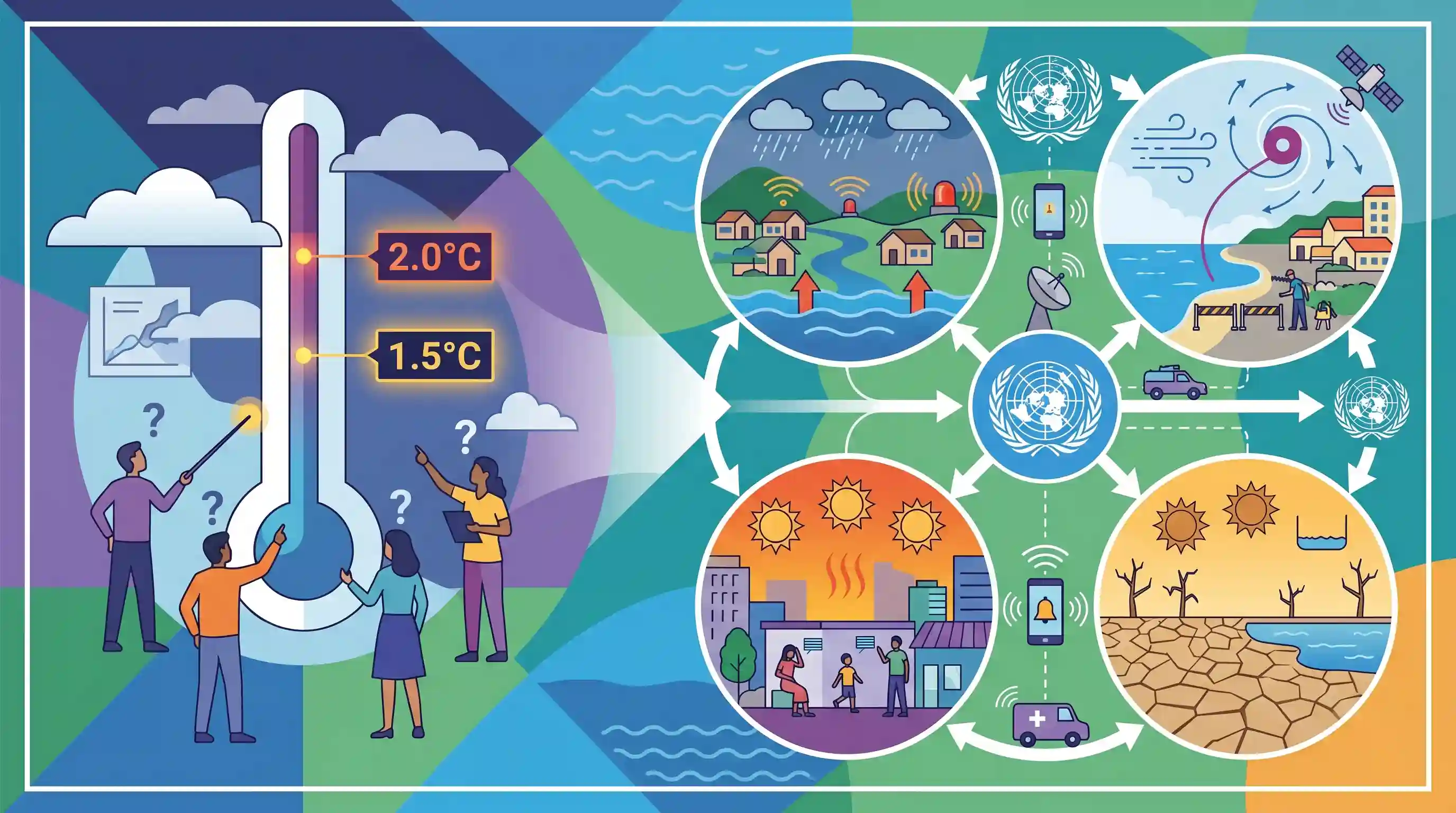
Why It Matters
Provides a critical analytical perspective for GS3 Disaster Management and Environment, emphasizing the shift from global emission target debates to practical, localized adaptation and early warning systems.
Summary
The article critiques the intense focus on global mean warming thresholds (such as 1.5°C and 2°C) established under the Paris Agreement, arguing that it can distract from critical local disaster preparedness. It highlights that the 2°C limit originated in economics rather than strict climate physics and notes the limitations of climate models in predicting decadal shifts. Instead of debating exact global temperature breaches, the author stresses that policymakers must prioritize hyper-local, actionable early-warning systems—aligned with the UN 'Early Warnings for All' initiative—to effectively mitigate the real-world impacts of extreme weather events.
Key Points
- The 2°C warming limit originated from economist William Nordhaus based on historical bounds, rather than a strict physical tipping point in climate science.
- Climate models, while robust for long-term trends, struggle with precise decadal predictability due to uncertainties in socio-economic pathways and non-linear factors like ocean dynamics.
- Debates over whether the 1.5°C global mean threshold has been breached can distract from the immediate, localized impacts of climate change that require urgent adaptation.
- Hyper-local, actionable early warning systems (championed by the UN 'Early Warnings for All' initiative) are critical to mitigating disaster risks, such as extreme flooding, regardless of fractional degrees of global mean warming.
Important Terms
Paris Agreement

A 2015 legally binding international treaty aiming to limit global temperature rise to well below 2°C, preferably 1.5°C, compared to pre-industrial levels.
UPSC context
GS III: Environment. Tests international climate governance, India's commitments (NDCs), and the 1.5°C/2°C warming thresholds.
UN Early Warnings for All
A 2022 UN initiative aiming to ensure every person on Earth is protected by life-saving early warning systems by the end of 2027.
UPSC context
GS III: Disaster Management. Tests global strategies for climate adaptation and mitigating the impact of extreme weather events.
World Meteorological Organization (WMO)
A specialized UN agency established in 1950 to facilitate international cooperation on meteorology, climatology, and hydrology.
UPSC context
GS II: International Relations/GS III. Tests the role of global institutions in weather forecasting and climate risk reduction.
Intergovernmental Panel on Climate Change (IPCC)
The UN body established in 1988 to provide regular scientific assessments on climate change, its implications, and future risks.
UPSC context
GS III: Environment. Tests scientific consensus on global warming and key reports like the Sixth Assessment Report (AR6).
Multi-Hazard Early Warning System (MHEWS)
Integrated systems providing timely alerts for multiple hazards (floods, cyclones, etc.) to empower individuals and communities to act.
UPSC context
GS III: Disaster Management. Aligns with Sendai Framework Target G; tests technological interventions in disaster risk reduction.
Nationally Determined Contributions (NDCs)
Self-determined climate targets set by individual countries under the Paris Agreement to reduce greenhouse gas emissions and adapt to climate change.
UPSC context
GS III: Environment. Tests India's specific pledges and the "bottom-up" approach of the Paris framework.
Prelims Trap
"The 2°C warming limit was derived exclusively from IPCC physical climate tipping point models."
The 2°C limit originated in the 1970s from economic models by William Nordhaus based on historical temperature bounds, not a strict physical tipping point.
Static Concepts Connected
What are the 4 key elements of a Multi-Hazard Early Warning System (MHEWS)?
- Risk Knowledge: Systematically collecting data and assessing hazards, exposures, and underlying vulnerabilities in a region.
- Monitoring & Forecasting: Continuous observation, modeling, and prediction of impending extreme events by scientific agencies (e.g., IMD, INCOIS).
- Warning Dissemination: Communicating reliable, actionable, and timely warnings to authorities and vulnerable populations at risk.
- Response Capability: Ensuring local communities and disaster management authorities are prepared and educated to act on alerts.
What are the core operational mechanisms of the 2015 Paris Agreement?
- Temperature Goal: Holding global average temperature increase to well below 2°C above pre-industrial levels, pursuing 1.5°C.
- NDCs: Climate action plans submitted by countries. They are legally binding to report, but targets themselves are not punitive if missed.
- Global Stocktake: A mandatory five-year review mechanism to assess the world's collective progress towards the agreement's long-term climate goals.
Cross-Topic Patterns
Climate Economics & Tipping Points
The intersection of climate science and macroeconomics (e.g., Nordhaus's models) is increasingly relevant for Mains GS3, connecting mitigation targets directly to adaptation financing and loss/damage debates.
Global Targets vs Local Resilience
While GS2 emphasizes international treaties like the Paris Agreement, GS3 demands a shift to decentralized disaster management and the Sendai Framework to address highly localized regional vulnerabilities.

Expect a Prelims question on the UN 'Early Warnings for All' initiative, specifically testing its 2027 target year and WMO/UNDRR co-leads.
Linked PYQs · 5
Linked PYQs · 5
- 2025MainsGS3
Write a review on India's climate commitments under the Paris Agreement (2015) and mention how these have been further strengthened in COP26 (2021). In this direction, how has the first Nationally Determined Contribution intended by India been updated in 2022?
- 2022MainsGS3
Discuss global warming and mention its effects on the global climate. Explain the control measures to bring down the level of greenhouse gases which cause global warming, in the light of the Kyoto Protocol, 1997.
- 2024MainsGS3
Flooding in urban areas is an emerging climate-induced disaster. Discuss the causes of this disaster. Mention the features of two such major floods in the last two decades in India. Describe the policies and frameworks in India that aim at tackling such floods.
- 2024MainsGS3
What is disaster resilience? How is it determined? Describe various elements of a resilience framework. Also mention the global targets of Sendai Framework for Disaster Risk Reduction (2015–2030).
- 2016PrelimsGS1
With reference to the Agreement at the UNFCCC Meeting in Paris in 2015, which of the following statements is/are correct? 1. The Agreement was signed by all the member countries of the UN and it will go into effect in 2017. 2. The Agreement aims to limit the greenhouse gas emissions so that the rise in average global temperature by the end of this century does not exceed 2°C or even 1.5°C above pre-industrial levels. 3. Developed countries acknowledged their historical responsibility in global warming and committed to donate $ 1000 billion a year from 2020 to help developing countries to cope with climate change. Select the correct answer using the code given below.
