Pune District Bridge Collapse: Disaster Management and NDRF Ops
Source:The Hindu ↗
Why It Matters
The incident provides a stark case study for GS-3 Disaster Management on the critical need for pre-disaster vulnerability assessment, proactive risk mitigation, and strict enforcement of public safety guidelines around ageing infrastructure. It also illustrates the challenges of crowd management during monsoon tourism and citizen apathy towards safety warnings.
Summary
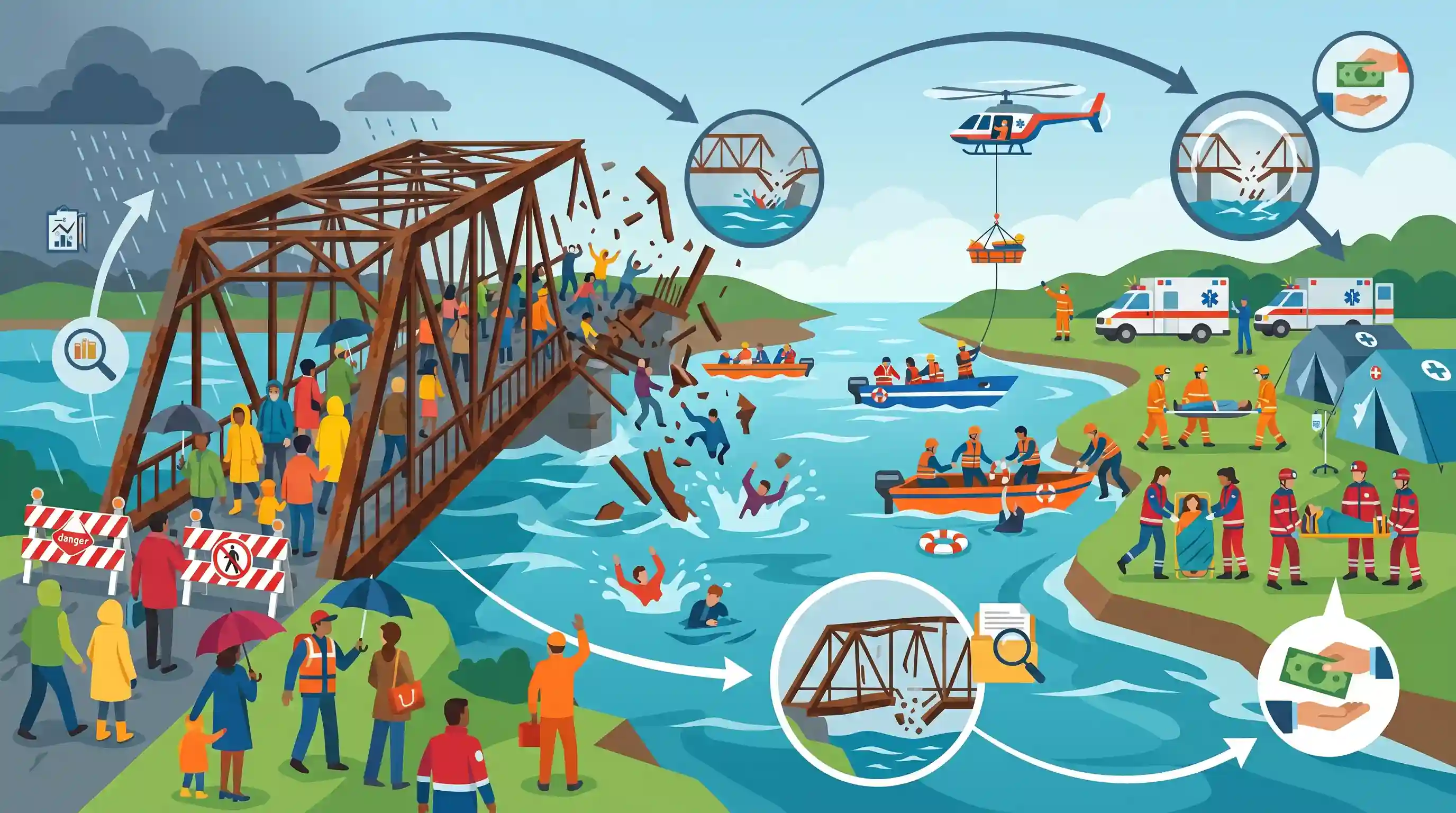
A century-old iron bridge over the Indrayani river in Pune collapsed under the weight of tourists, leaving four dead and over 40 injured. Despite warning signs and barricades placed by authorities indicating the structure was unsafe, crowds bypassed them. The incident highlights critical gaps in public safety enforcement and disaster vulnerability, especially concerning ageing colonial-era infrastructure and unmanaged monsoon tourism. Rescue operations by the NDRF and SDRF are underway, and the state government has ordered a probe into administrative lapses while announcing ex-gratia relief.
Key Points
- A century-old, British-era iron bridge over the Indrayani river collapsed in Pune district, resulting in 4 deaths and over 40 injuries.
- The collapse occurred due to overcrowding by tourists who ignored police and MIDC barricades and warning boards indicating the bridge's weakened state.
- Rescue operations were launched by the NDRF, SDRF, and local fire brigade, though high water currents hampered initial efforts.
- Maharashtra Chief Minister Devendra Fadnavis announced a solatium of ₹5 lakh to the families of the deceased and free medical treatment for the injured.
- A high-level committee has been directed to probe potential administrative lapses, raising questions about the enforcement of recently issued state guidelines for monsoon tourism safety.
Important Terms
National Disaster Response Force (NDRF)

India's specialized multi-disciplinary force for responding to natural and man-made disasters, established under the Disaster Management Act, 2005. It operates under the Ministry of Home Affairs with technical rescue expertise.
UPSC context
GS Paper III (Disaster Management). Tests institutional frameworks for emergency response and specialized rescue operations during national calamities.
State Disaster Response Force (SDRF)
The state-level specialized response force and primary fund for disaster relief. It serves as the first responder, supported by central funding (75% for general states, 90% for special category).
UPSC context
GS Paper III. Concerns federal disaster architecture and the role of state-level institutions in managing local and notified calamities.
Disaster Management Act, 2005
The legislative framework governing India's disaster management. It established the NDMA, SDMA, and DDMA, shifting the national approach from post-disaster relief to proactive mitigation, preparedness, and legal accountability.
UPSC context
GS Paper III. Essential statutory topic; covers executive powers, institutional hierarchy, and legal penalties for administrative non-compliance during crises.
National Disaster Management Authority (NDMA)
The apex statutory body for disaster management in India, chaired by the Prime Minister. It formulates policies and guidelines to ensure timely, effective response and multi-agency coordination.
UPSC context
GS Paper III. Core body for disaster policy-making; tests understanding of high-level coordination and guidelines for safety and risk reduction.
Crowd Management
Systematic planning and control of mass gatherings to ensure public safety and prevent stampedes or structural failures. It involves capacity assessment, monitoring crowd behavior, and effective communication strategies.
UPSC context
GS Paper III & Paper II. Crucial for public safety topics; tests administrative strategies for managing high-density tourist, religious, or political gatherings.
Vulnerability and Risk Assessment
The process of identifying physical or social factors that increase a structure's susceptibility to damage from hazards. It is a critical component of pre-disaster planning and maintenance.
UPSC context
GS Paper III. Fundamental disaster management concept; tests the ability to evaluate risks in infrastructure and community settings before disasters occur.
Prelims Trap
"The Indrayani River is a direct tributary of the Krishna River."
Indrayani is a tributary of the Bhima River, which subsequently joins the Krishna River. It does not directly empty into the Krishna.
Static Concepts Connected
What is the geographical and cultural significance of the Indrayani River?
- Origin: Originates in the Western Ghats near Lonavala, flowing eastwards through the Pune district of Maharashtra.
- River system: It is a key tributary of the Bhima River, which forms a major part of the Krishna River basin.
- Cultural significance: Its banks host the sacred Varkari pilgrimage towns of Alandi (Sant Dnyaneshwar) and Dehu (Sant Tukaram).
What is the mandate and composition of the NDRF?
- Statutory backing: Constituted under Section 44 of the Disaster Management Act, 2005 for a specialized response to threatening disaster situations.
- Apex control: Functions under the general superintendence, direction, and control of the National Disaster Management Authority (NDMA).
- Composition: Battalions are deputed from Central Armed Police Forces (BSF, CRPF, CISF, ITBP, SSB).
Cross-Topic Patterns
Colonial infra & urban governance
Similar to the 2022 Morbi collapse, this highlights the governance gap between passive safety warnings and enforcing mandatory structural audits for ageing colonial-era public assets.
Monsoon tourism vs. NDMA crowd guidelines
Unregulated seasonal monsoon tourism frequently turns physical hazards into disasters, testing NDMA's strict mandates for active physical barricading and proactive on-ground personnel deployment.

Geography mapping of Bhima tributaries (Indrayani, Mula-Mutha) is highly probable, as is a Mains question on NDMA crowd management.
Linked PYQs · 4
Linked PYQs · 4
- 2013MainsGS3
How important are vulnerability and risk assessment for pre-disaster management ? As an administrator, what are key areas that you would focus on in a Disaster Management System.
- 2019MainsGS3
Vulnerability is an essential element for defining disaster impacts and its threat to people. How and in what ways can vulnerability to disasters be characterized? Discuss different types of vulnerability with reference to disasters.
- 2023MainsGS3
Dam failures are always catastrophic, especially on the downstream side, resulting in a colossal loss of life and property. Analyze the various causes of dam failures. Give two examples of large dam failures.
- 2024MainsGS3
What is disaster resilience? How is it determined? Describe various elements of a resilience framework. Also mention the global targets of Sendai Framework for Disaster Risk Reduction (2015–2030).
