Persian Gulf Military Escalation and Air Defense Interceptions
Source:Indian Express ↗
Why It Matters
Direct military engagement between the US and Iran in the Persian Gulf threatens regional stability, global energy supply chains, and maritime security. It is critical for UPSC aspirants studying International Relations (GS2) and Defense Technologies (GS3).
Summary
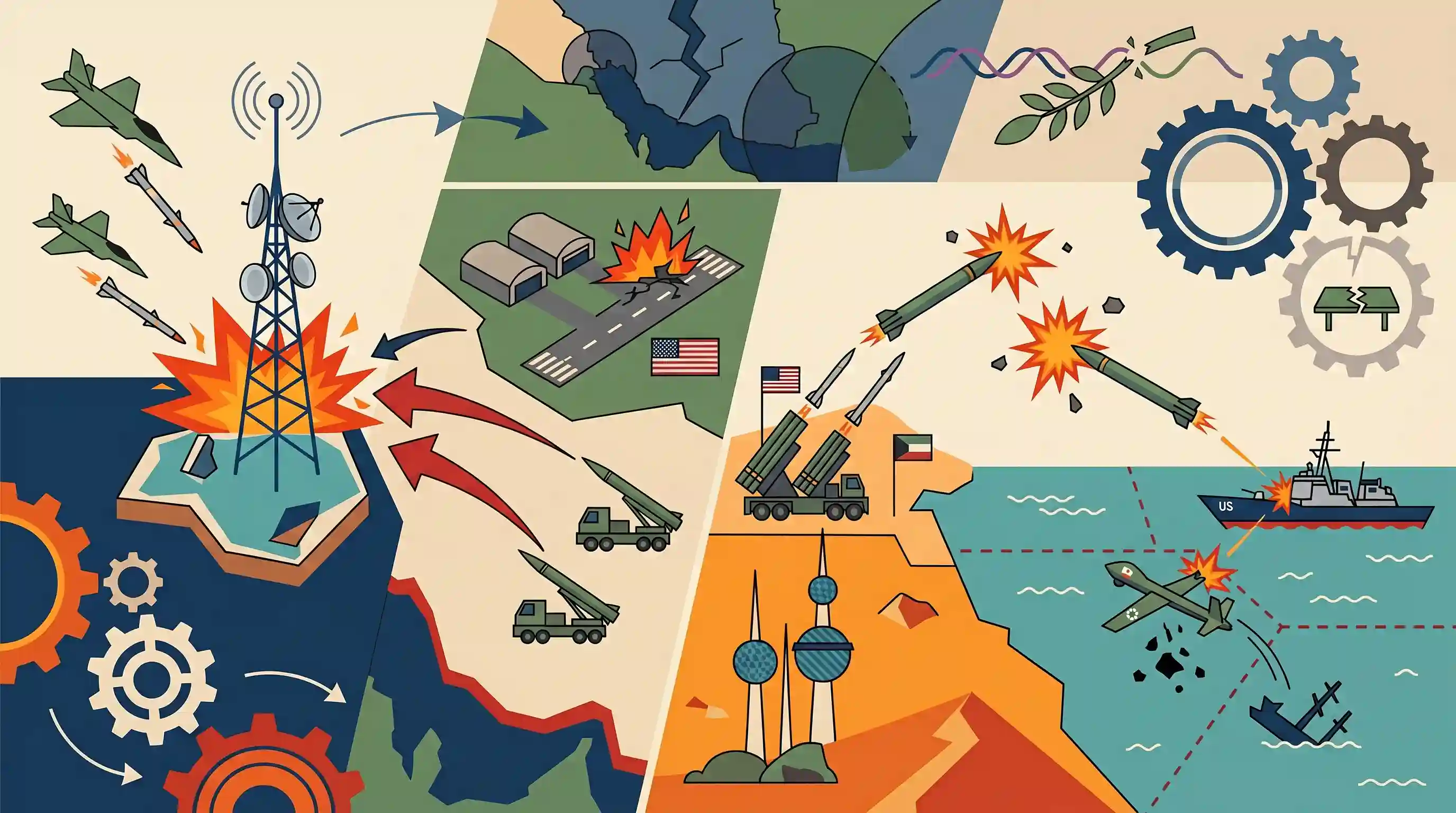
The article reports on escalating military confrontations between the United States and Iran in West Asia. Following a US strike on an Iranian communications tower on Sirik Island, Iran's Islamic Revolutionary Guard Corps (IRGC) launched retaliatory attacks on a US-used airbase. Concurrently, US forces in Kuwait intercepted Iranian ballistic missiles, and an Iranian drone was shot down over international waters. These direct clashes heighten geopolitical instability in the Persian Gulf amid fragile ceasefire negotiations.
Key Points
- The IRGC launched retaliatory strikes against an airbase used by US forces following an earlier American attack on an Iranian communications tower in Sirik Island, Hormozgan Province.
- US forces deployed in Kuwait successfully intercepted two Iranian ballistic missiles.
- An Iranian MQ-1 drone was shot down by US forces over international waters.
- The direct military confrontation escalates tensions in the volatile West Asian region, raising concerns over maritime security and regional stability despite ongoing ceasefire talks.
Important Terms
Islamic Revolutionary Guard Corps (IRGC)

An elite branch of the Iranian Armed Forces reporting to the Supreme Leader. It protects the Islamic system, manages regional proxy networks (Quds Force), and controls major economic and missile programs.
UPSC context
GS II/III (IR & Security). Relevant for understanding West Asian power dynamics, proxy warfare, and threats to India’s regional energy interests.
Strait of Hormuz
A vital narrow waterway connecting the Persian Gulf to the Arabian Sea. It is the world’s most important oil transit chokepoint, handling approximately 20% of global oil consumption.
UPSC context
GS I/II (Geography & IR). Tests knowledge of maritime "choke points," global trade vulnerabilities, and Indian maritime security.
Persian Gulf
A strategic marginal sea in West Asia containing 60% of world oil reserves. It is a central corridor for global energy trade and a focal point of US-Iran geopolitical tensions.
UPSC context
GS I/II (Geography & IR). Critical for mapping strategic waterways and analyzing India's "Look West" policy and energy security.
UNCLOS (United Nations Convention on the Law of the Sea)
International treaty establishing the legal framework for marine activities. It defines "International Waters" and freedom of navigation, serving as the legal basis for assessing military actions on high seas.
UPSC context
GS II (IR/Global Groupings). Tests knowledge of international maritime law, territorial sovereignty, and rules of engagement in international waters.
CENTCOM (United States Central Command)
A US unified combatant command responsible for military operations in 21 nations across West Asia, Central Asia, and South Asia, including managing responses to Iranian military activity.
UPSC context
GS II (IR). Relevant for understanding US strategic presence in India's extended neighborhood and its role in regional stability.
Ballistic Missiles
Missiles following a sub-orbital parabolic trajectory to deliver warheads. They are powered during the initial phase and represent a primary long-range strike capability for regional actors like Iran.
UPSC context
GS III (S&T & Security). Important for distinguishing between missile technologies (vs. cruise) and understanding regional arms races.
Sirik Island
A strategic Iranian location near the Strait of Hormuz. It serves as a communications and military hub within Iran's "Arch of Defence" to monitor maritime traffic in the region.
UPSC context
GS I/II (Geography & IR). A context-specific term testing awareness of current strategic flashpoints and Iranian maritime defensive networks.
Prelims Trap
"The Strait of Hormuz is a critical chokepoint connecting the Persian Gulf directly to the Red Sea."
The Strait of Hormuz connects the Persian Gulf to the Gulf of Oman/Arabian Sea. UPSC routinely swaps this with Bab-el-Mandeb (Red Sea to Gulf of Aden) to confuse aspirants.
Static Concepts Connected
What are the key maritime chokepoints critical to West Asian oil transit?
- Strait of Hormuz: Connects the Persian Gulf to the Gulf of Oman and the Arabian Sea. It is bordered by Iran, Oman, and the UAE, handling ~20% of global oil.
- Bab el-Mandeb: Connects the Red Sea to the Gulf of Aden and the Indian Ocean. It separates the Arabian Peninsula (Yemen) from the Horn of Africa (Djibouti, Eritrea).
How does India physically shield its economy from sudden West Asian oil supply disruptions?
- Strategic Petroleum Reserves: India maintains crude oil reserves in underground rock caverns at Visakhapatnam, Mangaluru, and Padur under phase I of the ISPRL to provide emergency energy security.
- SPR Phase II: Chandikhol (Odisha) and Padur (Karnataka) have been approved for commercial-cum-strategic reserves under a Public-Private Partnership model.
Cross-Topic Patterns
Geopolitics + Macroeconomic Stability
Conflict near the Strait of Hormuz directly impacts Brent crude prices, risking a widened Current Account Deficit (CAD), depreciating rupee, and imported inflation for India.
Drone Warfare + Defence Tech
Escalating asymmetric drone usage mirrors threats India faces on its western borders, elevating the exam relevance of C-UAS (Counter-Unmanned Aircraft Systems) and indigenous anti-drone domes like 'Indrajaal'.

Expect a map-matching question pairing West Asian chokepoints (Hormuz, Bab-el-Mandeb) with recent conflict zones (Sirik Island, Kuwait).
Linked PYQs · 4
Linked PYQs · 4
- 2016PrelimsGS1
Which of the following is not a member of 'Gulf Cooperation Council'?
- 2023MainsGS3
The use of unmanned aerial vehicles (UAVs) by our adversaries across the borders to ferry arms/ammunitions, drugs, etc., is a serious threat to the internal security. Comment on the measures being taken to tackle this threat.
- 2021MainsGS3
How is S-400 air defence system technically superior to any other system presently available in the world?
- 2017MainsGS2
The question of India's Energy Security constitutes the most important part of India's economic progress. Analyze India's energy policy cooperation with West Asian countries.
