IRDAI Permits Insurers Investment in New Development Bank Rupee Bonds
Source:The Hindu ↗
આ શા માટે મહત્વનું છે
Highlights evolving financial instruments (Maharajah Bonds) and regulatory reforms to channel domestic long-term capital (insurance funds) toward infrastructure and sustainable development, while showcasing the operational role of multilateral development banks (like NDB) in India's growth.
સારાંશ
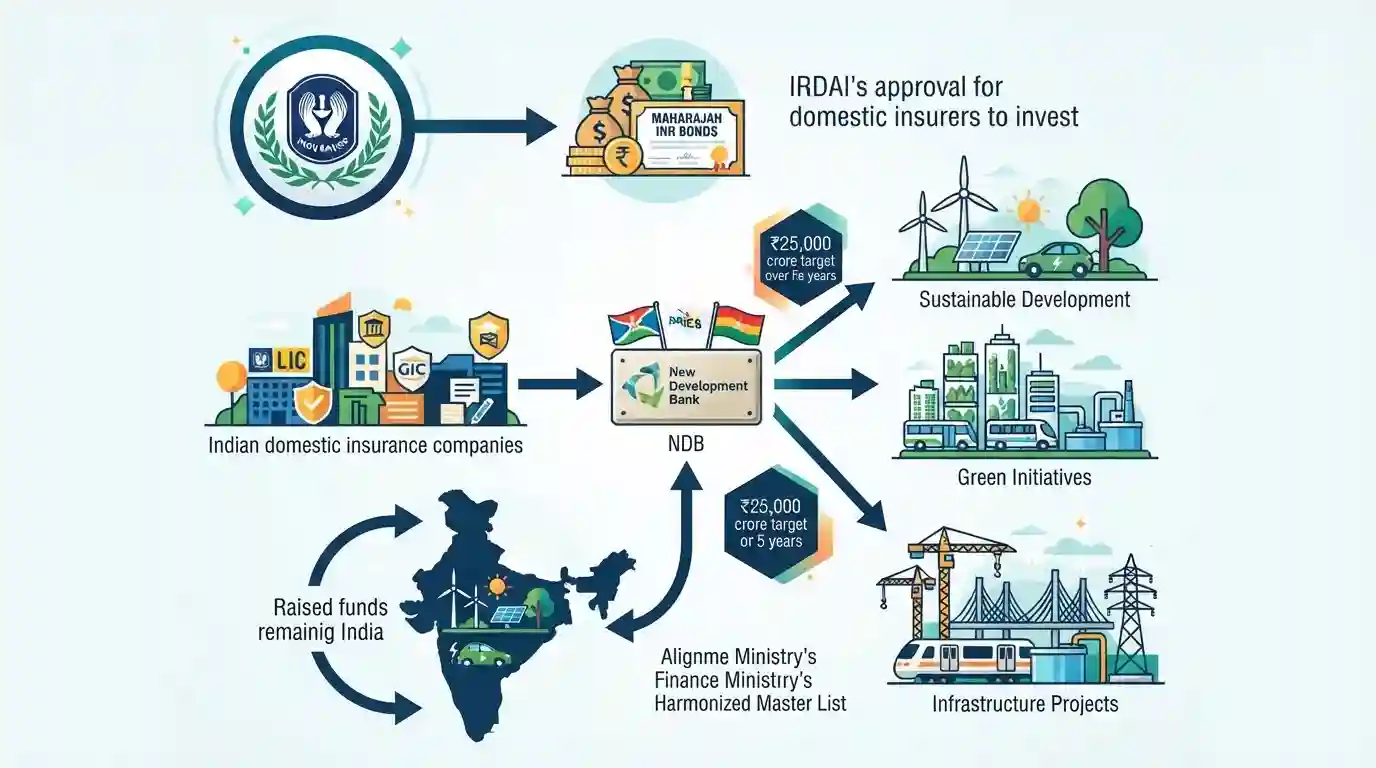
The Insurance Regulatory and Development Authority of India (IRDAI) has permitted domestic insurers to invest in the New Development Bank's (NDB) onshore rupee bonds, also known as Maharajah INR Bonds. The BRICS-established NDB intends to raise ₹25,000 crore over five years to fund sustainable development, green initiatives, and infrastructure projects across India. These investments will be treated as infrastructure investments if they align with the Finance Ministry's Harmonized Master List. The regulatory approval ensures compliance with the Insurance Act, mandating that the raised funds remain deployed within India.
મુખ્ય મુદ્દા
- IRDAI has allowed insurance companies to invest in the New Development Bank's onshore rupee bonds, known as Maharajah INR Bonds.
- The NDB aims to raise ₹25,000 crore over five years to finance sustainable development, infrastructure, and green projects within India.
- Investments will classify as infrastructure investments if the proceeds are directed toward subsectors identified in the Ministry of Finance's Harmonized Master List.
- Insurers must ensure compliance with Section 27E of the Insurance Act, 1938, which prevents investing policyholders' funds outside India, guaranteeing domestic utilization of the bond proceeds.
મહત્વપૂર્ણ શબ્દો
New Development Bank (NDB)

A multilateral development bank established by BRICS nations in 2014, headquartered in Shanghai. It mobilizes resources for infrastructure and sustainable development projects in emerging economies.
UPSC context
Tested in GS-3 Economy and GS-2 International Institutions. Focuses on its BRICS origins, governance structure, and role as an alternative to Western institutions.
Insurance Regulatory and Development Authority of India (IRDAI)
A statutory body established in 1999 to regulate, promote, and ensure the orderly growth of India's insurance and reinsurance sector while protecting policyholder interests.
UPSC context
Relevant for GS-3 Economy and GS-2 Statutory Bodies. Tests focus on its financial regulatory role, market oversight, and insurance penetration initiatives.
Harmonized Master List of Infrastructure sub-sectors
A standardized government classification listing sub-sectors eligible for infrastructure status. Maintained by the Finance Ministry, it guides institutional financing, regulatory concessions, and preferential investments.
UPSC context
Vital for GS-3 Infrastructure and Investment Models. Crucial for understanding which sectors qualify for targeted funding, tax benefits, and specific investment mechanisms.
Insurance Act, 1938
India's foundational legislation providing the legal framework for the life, health, and general insurance businesses. It establishes rules for registration, capital requirements, and investment norms.
UPSC context
Foundational for GS-3 Economy. Important for understanding historical financial regulation, statutory obligations of insurers, and legislative amendments allowing higher FDI.
BRICS
An intergovernmental grouping originally comprising Brazil, Russia, India, China, and South Africa. It represents major emerging economies collaborating to reshape global political and economic governance.
UPSC context
High priority for GS-2 International Relations. Questions focus on its role in multipolarity, recent expansions, and initiatives like the New Development Bank.
પ્રિલિમ્સ ટ્રેપ
"Maharajah bonds are offshore rupee-denominated bonds issued by multilateral banks to foreign investors."
Aspirants confuse them with Masala bonds. Maharajah bonds are *onshore* rupee bonds issued in India to domestic investors, while Masala bonds are *offshore* rupee bonds issued abroad.
સંલગ્ન સ્થિર ખ્યાલો
What is the structural difference between Masala and Maharajah bonds?
- Masala Bonds: Offshore rupee-denominated bonds issued in foreign markets to international investors. The currency fluctuation risk is borne by the investor, not the issuer.
- Maharajah Bonds: Onshore rupee-denominated bonds issued within India's domestic market specifically to domestic institutional investors, keeping capital mobilized within the local economy.
What are the core governance features of the New Development Bank (NDB)?
- Origin & HQ: Established by BRICS nations during the 6th BRICS Summit in Fortaleza (2014). It is headquartered in Shanghai, China.
- Voting Structure: Unlike the World Bank or IMF, founding members hold an equal number of shares and equal voting rights. No single member possesses veto power.
- Expanded Membership: Open to all UN members. Recent additions beyond the original BRICS countries include Bangladesh, Egypt, the United Arab Emirates, and Uruguay.
આંતર-વિષય પેટર્ન
Multilateral Banks and GIFT City integration
NDB issuing domestic bonds complements its 2022 regional office launch in GIFT City, shifting multilateral financing from offshore foreign borrowing to mobilizing domestic institutional capital for green infrastructure.
Harmonized Master List as a policy anchor
The Finance Ministry's Harmonized Master List of Infrastructure acts as the universal standard across regulators (IRDAI, RBI, SEBI) to dictate exactly where prioritized institutional capital can legally flow.

Multi-statement Q likely comparing Masala vs Maharajah bonds alongside NDB's expanded non-BRICS membership and equal voting structure.
સંલગ્ન PYQ · 4
સંલગ્ન PYQ · 4
- 2025PrelimsGS1
Which one of the following launched the 'Nature Solutions Finance Hub for Asia and the Pacific?
- 2016PrelimsGS1
With reference to 'IFC Masala Bonds', sometimes seen in the news, which of the statements given below is/are correct? 1. The International Finance Corporation, which offers these bonds, is an arm of the World Bank. 2. They are the rupee-denominated bonds and are a source of debt financing for the public and private sector. Select the correct answer using the code given below.
- 2019PrelimsGS1
Which one of the following is not the most likely measure the Government/RBI takes to stop the slide of Indian rupee?
- 2025PrelimsGS1
Consider the following statements with regard to BRICS : I. 16th BRICS Summit was held under the Chairship of Russia in Kazan. II. Indonesia has become a full member of BRICS. III. The theme of the 16th BRICS Summit was Strengthening Multiculturalism for Just Global Development and Security. Which of the statements given above is/are correct?
