IRDAI Committee Recommends Simplified and Transparent Health Insurance
Source:The Hindu ↗
हे का महत्त्वाचे आहे
With high out-of-pocket expenditure (OOPE) driving millions into poverty in India, streamlining health insurance is critical to achieving Universal Health Coverage (UHC). The proposed regulatory interventions by IRDAI and the integration with digital public infrastructure like the National Health Claims Exchange (NHCX) demonstrate how the state can regulate private players, contain the adverse impacts of marketisation, and protect consumer rights.
सारांश
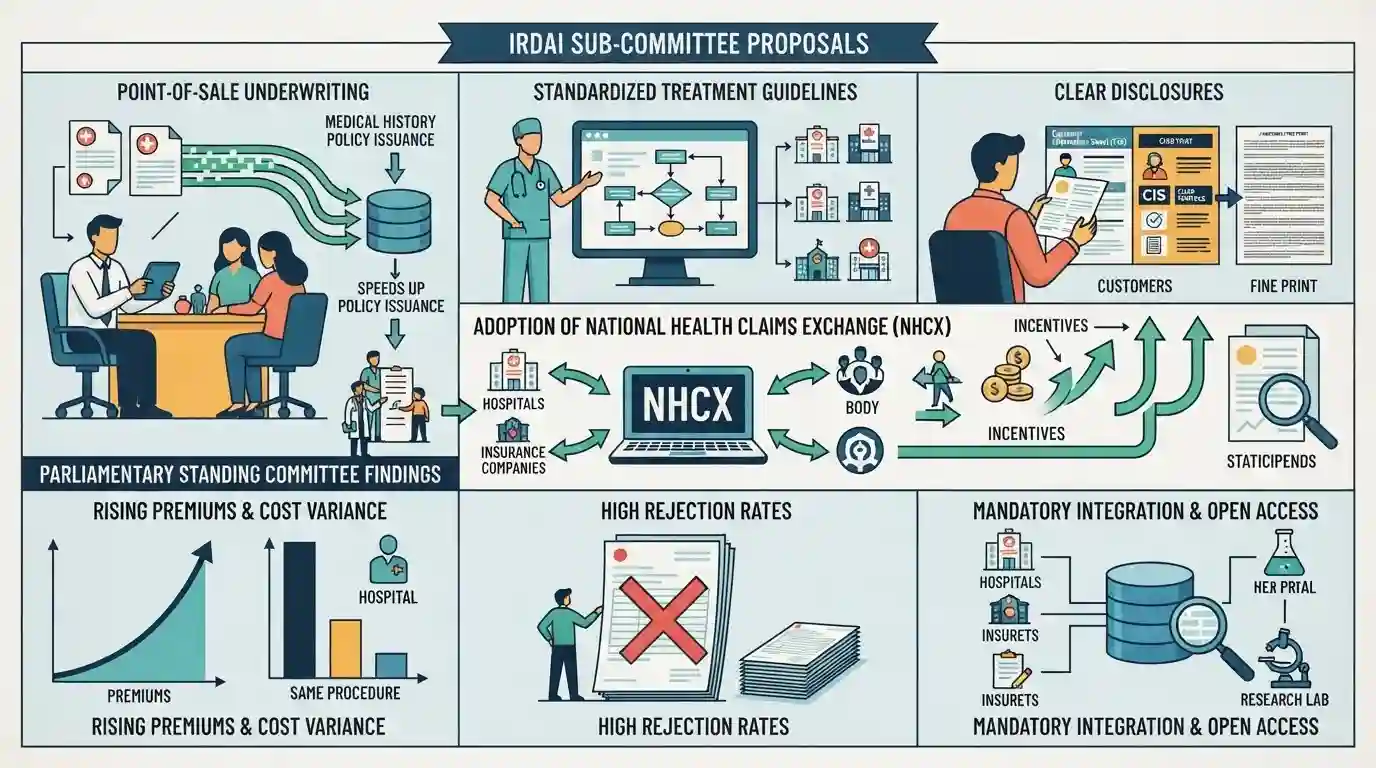
An Insurance Regulatory and Development Authority of India (IRDAI) sub-committee has called for sweeping reforms to make health insurance policies simpler, more transparent, and easier to settle. The sub-committee recommended point-of-sale underwriting, standardized treatment guidelines, and clear disclosures in the Customer Information Sheet. Importantly, it urged broader adoption of the National Health Claims Exchange (NHCX) using incentives for stakeholders. These proposals align with a recent report by the Parliamentary Standing Committee on Health and Family Welfare, which highlighted rising premiums, steep variance in procedure costs, and high rejection rates, and advocated for mandatory integration of hospitals and insurers with the NHCX and an open-access claims database.
मुख्य मुद्दे
- An IRDAI sub-committee on health insurance (headed by Ajay Seth) recommended simplifying policy language, strengthening underwriting at the point of sale, and streamlining claim settlement processes to minimize disputes over inadequate disclosures.
- The panel advocated for measures to incentivize insurers, third-party administrators (TPAs), and hospitals to join the National Health Claims Exchange (NHCX) via faster payments, onboarding incentives, and streamlined settlements.
- The sub-committee suggested promoting preventive healthcare by offering incentives to policyholders who undergo periodic health check-ups and adopt healthy lifestyles.
- To improve transparency and patient choice, the panel proposed that insurers publish standard treatment guidelines (STGs) and treatment package rates, alongside a review of exclusions listed in the Customer Information Sheet.
- The meeting was held against the backdrop of a Parliamentary Standing Committee report on the 'Affordability and accessibility of healthcare facilities in public and private sector' led by Ram Gopal Yadav.
- The Parliamentary Committee raised alarms over rising premiums, arbitrary claim rejections, and wide cost disparities for identical medical procedures across different private hospitals.
- The Parliamentary Committee strongly recommended mandatory integration of all health sector stakeholders with the NHCX, creating an open-access public portal for claims settlement data, and enforcing stringent penalties for arbitrary pricing.
महत्त्वाच्या संज्ञा
National Health Claims Exchange (NHCX)

A digital gateway developed under Ayushman Bharat Digital Mission to standardize, secure, and streamline health insurance claims processing between hospitals, insurers, and policyholders.
UPSC context
GS Paper II & III: E-governance applications, health infrastructure, and social sector services.
Insurance Regulatory and Development Authority of India (IRDAI)
A statutory body established under the IRDA Act, 1999, responsible for regulating, promoting, and ensuring orderly growth of the insurance and reinsurance industries in India while protecting policyholder interests.
UPSC context
GS Paper II & III: Statutory regulatory bodies, economic growth, and governance.
Insurance Advisory Committee (IAC)
A statutory consultative committee constituted under Section 25 of the IRDA Act, 1999, that advises IRDAI on making regulations, sector development, and protecting policyholders' interests.
UPSC context
GS Paper II: Statutory bodies, regulatory accountability, and stakeholder consultation.
Parliamentary Standing Committee on Health and Family Welfare
A department-related parliamentary standing committee comprising 31 members that provides legislative oversight, scrutinizes policy implementation, bills, and demands for grants of the Ministry of Health and Family Welfare.
UPSC context
GS Paper II: Parliament, legislative oversight, and healthcare accountability.
पूर्वपरीक्षा सापळा
The National Health Claims Exchange (NHCX) is built and maintained solely by the IRDAI.
NHCX is developed by the National Health Authority (NHA) under the Ayushman Bharat Digital Mission (Ministry of Health), not by the insurance regulator IRDAI.
संबंधित स्थिर संकल्पना
What is the statutory mandate and structure of IRDAI?
- Statutory Origin: Established under the IRDAI Act, 1999, following the recommendations of the Malhotra Committee.
- Composition: A 10-member body appointed by the central government, comprising a Chairman, five whole-time, and four part-time members.
- Key Mandate: Regulates, promotes, and ensures the orderly growth of insurance and reinsurance industries while protecting policyholders' interests.
What is the National Health Authority (NHA) and its role?
- PM-JAY Implementation: The apex body responsible for implementing India's flagship public health insurance scheme, Ayushman Bharat PM-JAY.
- ABDM Architecture: NHA is mandated to design and build the digital backbone for the Ayushman Bharat Digital Mission (ABDM).
आंतर-विषय नमुने
DPI as a catalyst for UHC
Using NHCX mirrors UPI's digital public infrastructure success, demonstrating how open-source protocols can drive down transaction costs and accelerate universal health coverage.
Regulatory confluence in health governance
Placing NHCX under dual MoHFW and MoF/IRDAI supervision highlights the growing need for inter-ministerial synergy to tackle rising medical inflation and hospital overcharging.

NHCX as health DPI and IRDAI’s regulatory measures to curb out-of-pocket costs are prime targets for GS-2/3 mains questions.
संबंधित PYQ · 2
संबंधित PYQ · 2
- 2024MainsGS2
In a crucial domain like the public healthcare system the Indian State should play a vital role to contain the adverse impact of marketisation of the system. Suggest some measures through which the State can enhance the reach of public healthcare at the grassroots level.
- 2020MainsGS2
In order to enhance the prospects of social development, sound and adequate health care policies are needed particularly in the fields of geriatric and maternal health care. Discuss.
