Iran Appeal to BRICS and Maritime Security in the Gulf
Source:The Hindu ↗
Why It Matters
The developments highlight India's delicate diplomatic balancing act in West Asia—navigating its strong ties with both Israel and Iran, its leadership role in BRICS, and its critical national interests in energy security and uninterrupted maritime trade through the Gulf.
Summary
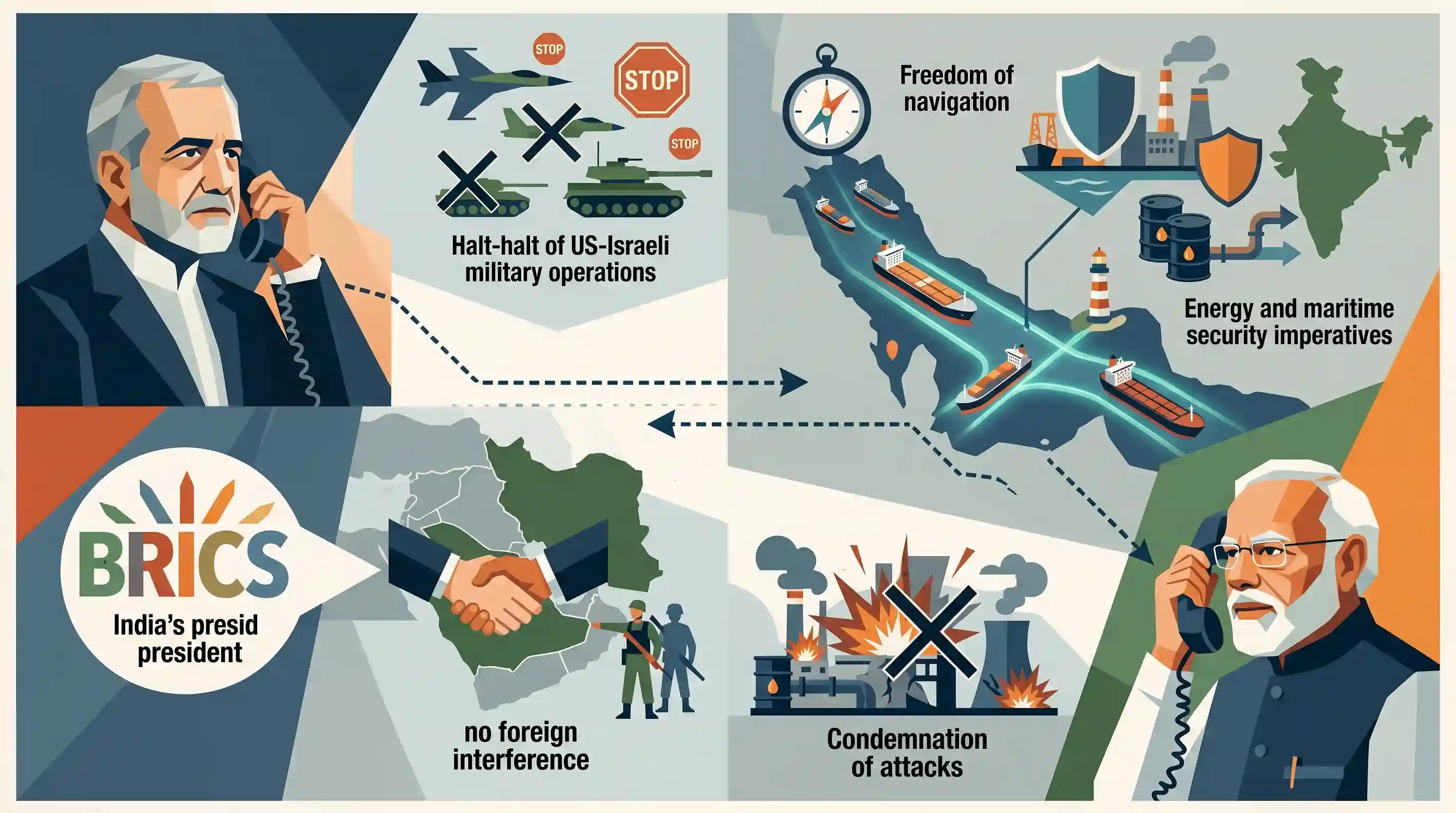
In a strategic telephone conversation, Iranian President Masoud Pezeshkian urged PM Narendra Modi to leverage India's BRICS presidency to help halt US-Israeli military operations and proposed a West Asian security framework devoid of foreign interference. In response, PM Modi articulated India's primary concerns by condemning attacks on critical infrastructure and emphasizing the absolute necessity of safeguarding freedom of navigation and secure shipping lanes in the Gulf, reflecting India's energy and maritime security imperatives.
Key Points
- Iranian President Masoud Pezeshkian urged PM Modi to support an immediate end to US-Israeli military actions to prevent wider conflict in West Asia.
- Iran proposed a West Asian regional security framework aimed at ensuring peace and stability without foreign interference.
- Pezeshkian appealed to BRICS, under India's presidency, to take an independent role in halting regional aggression and maintaining stability.
- PM Modi condemned attacks on critical infrastructure and emphasized the vital importance of safeguarding freedom of navigation and secure shipping lanes in the Gulf.
- External Affairs Minister S. Jaishankar held parallel discussions with his Iranian counterpart Seyed Abbas Araghchi on the conflict's regional implications.
Important Terms
BRICS

A grouping of major emerging economies—Brazil, Russia, India, China, and South Africa—recently expanded to include Iran, Egypt, Ethiopia, and the UAE.
UPSC context
GS Paper 2: International Relations. Important for topics on multilateral groupings, Global South leadership, and India's role in a multipolar world.
West Asian security framework (proposed)
A proposed regional architecture intended to manage peace and stability within West Asia exclusively by regional states, specifically excluding foreign or external military interference.
UPSC context
GS Paper 2: International Relations. Relevant to regional security, India-West Asia relations, and the concept of 'Asian solutions to Asian problems.'
Freedom of Navigation (FoN)
A principle of international law, codified in UNCLOS, ensuring that ships from any state can navigate international waters without interference from other states.
UPSC context
GS Paper 2 & 3: IR and Security. Tests knowledge of UNCLOS, maritime chokepoints like the Strait of Hormuz, and global trade security.
Maritime Security
The protection of maritime domains against threats such as piracy, terrorism, and military aggression to ensure secure trade routes and energy supply chains.
UPSC context
GS Paper 3: Internal Security/Energy Security. Crucial for India's energy imports from the Gulf and the 'Security and Growth for All in the Region' (SAGAR) vision.
Strategic Autonomy
A core tenet of India’s foreign policy, emphasizing the ability to make independent decisions based on national interest without being coerced by external powers or alliances.
UPSC context
GS Paper 2: International Relations. Frequently tested as India's balancing act between the West (USA) and partners like Iran/Russia.
Strait of Hormuz
A vital maritime chokepoint between the Persian Gulf and the Gulf of Oman through which approximately one-fifth of the world's oil consumption passes daily.
UPSC context
GS Paper 1 & 2: Geography and IR. Key strategic location impacting India’s energy security and regional stability.
Prelims Trap
"Coastal states hold the right to suspend transit passage in international straits for essential security reasons."
Under UNCLOS, coastal states cannot suspend 'transit passage' in international straits (like Hormuz), unlike 'innocent passage' in territorial waters which can be temporarily suspended.
Static Concepts Connected
What are the rules governing international straits under UNCLOS?
- Transit Passage: Applies to straits used for international navigation (e.g., Strait of Hormuz). All ships and aircraft enjoy freedom of navigation solely for continuous and expeditious transit.
- No Suspension: Unlike innocent passage in standard territorial seas, coastal states cannot suspend transit passage for security reasons, ensuring unimpeded global supply chain stability.
How does the expanded BRICS+ framework operate?
- New Members: The bloc expanded in 2024 beyond the original five to officially include prominent Middle Eastern and African nations like Iran, the UAE, Egypt, and Ethiopia.
- Consensus Mechanism: Decisions, including issuing joint statements on conflict mediation or adopting regional security frameworks, require absolute consensus among all members.
Cross-Topic Patterns
Chabahar connectivity vs. Gulf energy security
India balances its INSTC and Chabahar transit investments in Iran against its heavy reliance on Arab Gulf states for crude oil and LNG imports, requiring delicate maritime diplomacy.
BRICS as a Global South mediator
Iran’s appeal highlights BRICS’s transition from an economic bloc to a geopolitical platform attempting to counter Western unipolarity and offer alternative, non-Western regional security frameworks.

BRICS+ consensus mechanisms paired with UNCLOS transit passage rules in West Asian chokepoints are highly probable for a 2026 Prelims MCQ.
Linked PYQs · 4
Linked PYQs · 4
- 2025MainsGS2
"Energy security constitutes the dominant kingpin of India's foreign policy, and is linked with India's overarching influence in Middle Eastern countries.” How would you integrate energy security with India's foreign policy trajectories in the coming years?
- 2018MainsGS2
“India’s relations with Israel have, of late, acquired a depth and diversity, which cannot be rolled back.” Discuss.
- 2012MainsGS2
Compare the significance of IBSA and BRICS in the context of India's multilateral diplomacy.
- 2017MainsGS2
The question of India's Energy Security constitutes the most important part of India's economic progress. Analyze India's energy policy cooperation with West Asian countries.
