Iran nuclear programme and global non-proliferation security
Source:The Hindu ↗
Why It Matters
The Iran nuclear crisis is a critical issue for UPSC aspirants as it intersects International Relations (GS2) with global security (GS3). Understanding the JCPOA, the IAEA's mandate, and the resulting geopolitical ripple effects in West Asia is essential for analyzing impacts on India's energy security and its balancing act between strategic partners like the US, Israel, and Iran.
Summary
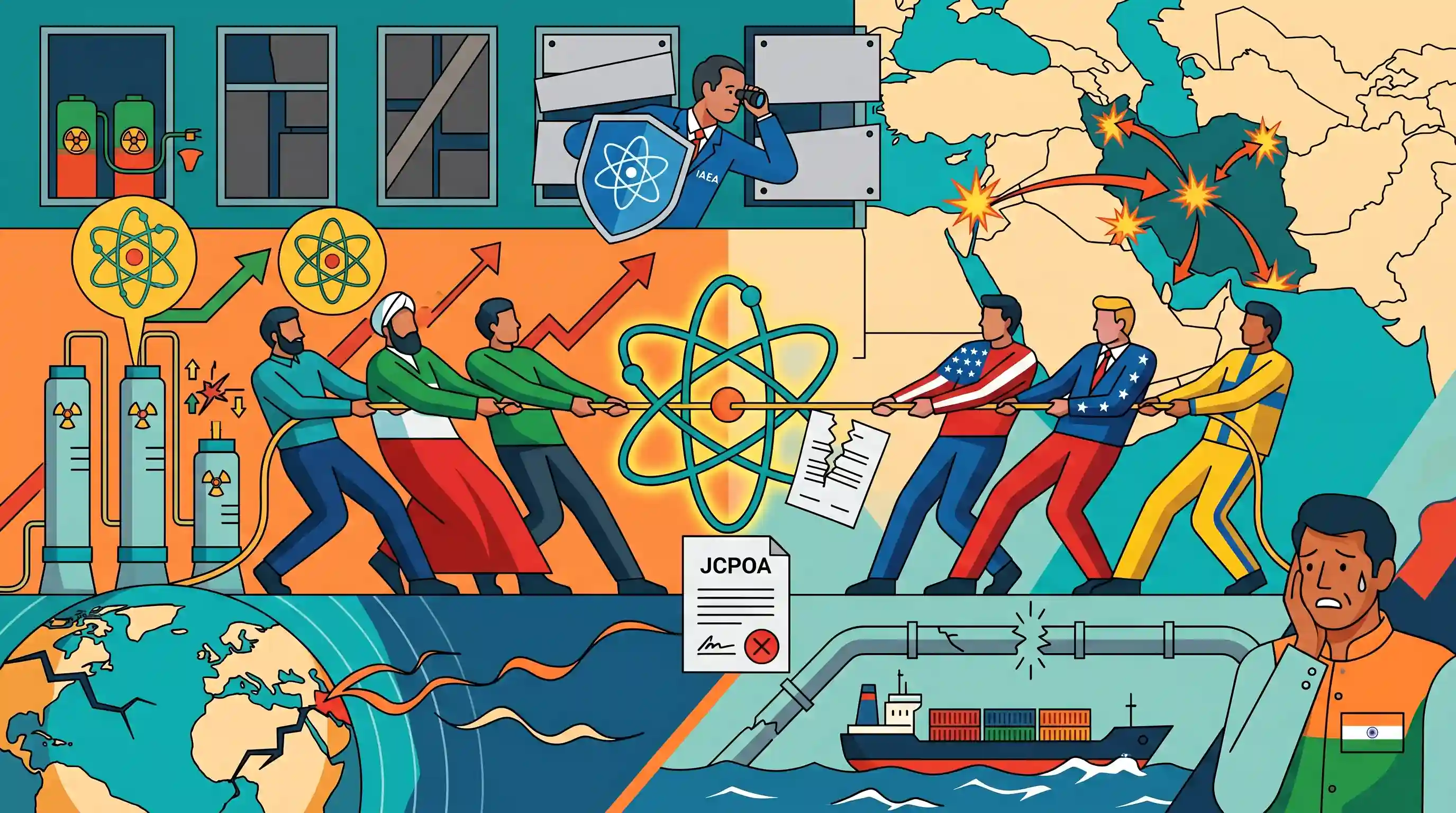
The article examines the escalating tensions surrounding Iran's nuclear program following the collapse of the 2015 Joint Comprehensive Plan of Action (JCPOA). With Iran steadily increasing its uranium enrichment levels, the International Atomic Energy Agency (IAEA) faces significant hurdles in maintaining oversight and verifying that the program remains strictly peaceful. The "atomic tug of war" not only tests the resilience of the Non-Proliferation Treaty (NPT) but also acts as a major flashpoint in Middle Eastern geopolitics, exacerbating hostilities between Iran, Israel, and the United States. This ongoing crisis has profound implications for global security and India's strategic interests in West Asia, notably regarding energy stability.
Key Points
- The breakdown of the Joint Comprehensive Plan of Action (JCPOA) following the US withdrawal in 2018 has led to Iran accelerating its uranium enrichment closer to weapons-grade purity.
- The International Atomic Energy Agency (IAEA) struggles to fully monitor Iran's nuclear facilities due to restricted access, undermining global nuclear verification mechanisms.
- The escalating "tug of war" over Iran's nuclear capabilities heightens the risks of military confrontation in the Middle East, primarily involving Israel and the United States.
- These developments pose a severe challenge to the global non-proliferation framework under the NPT and have cascading effects on regional stability and energy markets.
- For India, instability in West Asia directly threatens energy security, diaspora welfare, and strategic ties with key regional partners.
Important Terms
Joint Comprehensive Plan of Action (JCPOA)

A 2015 multilateral agreement between Iran and the P5+1 (UN Security Council permanent members plus Germany) designed to limit Iran's nuclear program in exchange for the lifting of international economic sanctions.
UPSC context
GS Paper II: International Relations. Significant for West Asia geopolitics, India's energy security (oil imports), and strategic projects like Chabahar Port.
Treaty on the Non-Proliferation of Nuclear Weapons (NPT)
A landmark 1968 international treaty aimed at preventing the spread of nuclear weapons, promoting peaceful nuclear energy use, and advancing disarmament; it distinguishes between nuclear-weapon and non-nuclear-weapon states.
UPSC context
GS Paper II: International Agreements. Tests knowledge of the global non-proliferation regime and India's traditional refusal to sign based on its 'discriminatory' nature.
International Atomic Energy Agency (IAEA)
The Vienna-based 'Atoms for Peace' organization within the UN family (est. 1957) that promotes safe, secure, and peaceful nuclear technology while verifying that states do not divert nuclear materials to weapons.
UPSC context
GS Paper II: Important International Institutions. Focuses on its mandate, structure, and India's role as a founding member and its safeguards agreements.
IAEA Safeguards
Technical measures applied by the IAEA to verify that nuclear material and facilities are used only for peaceful purposes and not diverted toward military or undeclared nuclear activities.
UPSC context
GS Paper II & III: International Relations/Nuclear Security. Essential for understanding the India-US Civil Nuclear Deal and the monitoring of India's civilian reactors.
Additional Protocol (AP)
A legal document providing the IAEA with expanded rights of access to information and locations in a state to verify the absence of undeclared nuclear material and activities.
UPSC context
GS Paper II: International Relations. Specifically tested in Prelims (2018) regarding India's ratification and its implications for civilian nuclear monitoring.
Prelims Trap
Iran withdrew from the Non-Proliferation Treaty (NPT) after the collapse of the JCPOA.
Iran remains an NPT signatory as a non-nuclear-weapon state, despite violating JCPOA limits. Unlike India, Israel, and Pakistan, Iran never exited or abstained from the NPT.
Static Concepts Connected
What are the varying levels of Uranium enrichment?
- Natural Uranium: Contains about 0.7% of the fissile U-235 isotope in its naturally mined state.
- Low-Enriched (LEU): Enriched to 3-5% U-235, which is the standard for civilian commercial nuclear power reactors.
- Highly-Enriched (HEU): Enriched to 20% or above, primarily used in medical research reactors and naval propulsion systems.
- Weapons-grade: Requires around 90% U-235 concentration to create a viable nuclear warhead.
What is the IAEA Additional Protocol?
- Core mandate: Grants the IAEA expanded rights to access information and sites to verify the absence of undeclared nuclear material.
- India's status: India signed a customized Additional Protocol in 2014, applying safeguards only to its declared civilian nuclear facilities, not military ones.
Cross-Topic Patterns
Chabahar Port & INSTC linkages
Sanctions on Iran directly impact India's strategic connectivity projects like Chabahar Port and the INSTC, which are critical for accessing Central Asia while bypassing Pakistan.
I2U2 balancing act
Escalating Iran-Israel tensions force India to carefully balance its strategic investments in the I2U2 grouping with its traditional bilateral energy and connectivity ties with Tehran.

Expect a multi-statement question mixing IAEA Additional Protocol provisions with India's specific safeguard exemptions in 2026.
Linked PYQs · 5
Linked PYQs · 5
- 2018PrelimsGS1
In the Indian context, what is the implication of ratifying the 'Additional Protocol' with the 'International Atomic Energy Agency (IAEA)'?
- 2020PrelimsGS1
In India, why are some nuclear reactors kept under "IAEA Safeguards" while others are not?
- 2015PrelimsGS1
Consider the following countries: 1. China 2. France 3. India 4. Israel 5. Pakistan Which among the above are Nuclear Weapons States as recognized by the Treaty on the Non-Proliferation of Nuclear Weapons, commonly known as Nuclear Non-Proliferation Treaty (NPT)?
- 2017MainsGS2
The question of India's Energy Security constitutes the most important part of India's economic progress. Analyze India's energy policy cooperation with West Asian countries.
- 2018MainsGS2
“India’s relations with Israel have, of late, acquired a depth and diversity, which cannot be rolled back.” Discuss.
