Iran Leadership Faces Severe Protests and Economic Sanctions
Source:The Hindu ↗
Why It Matters
Regime instability in Iran and aggressive US sanctions reshape Middle East geopolitics, impacting global trade, energy security, and bilateral relations for key players like India and European nations.
Summary
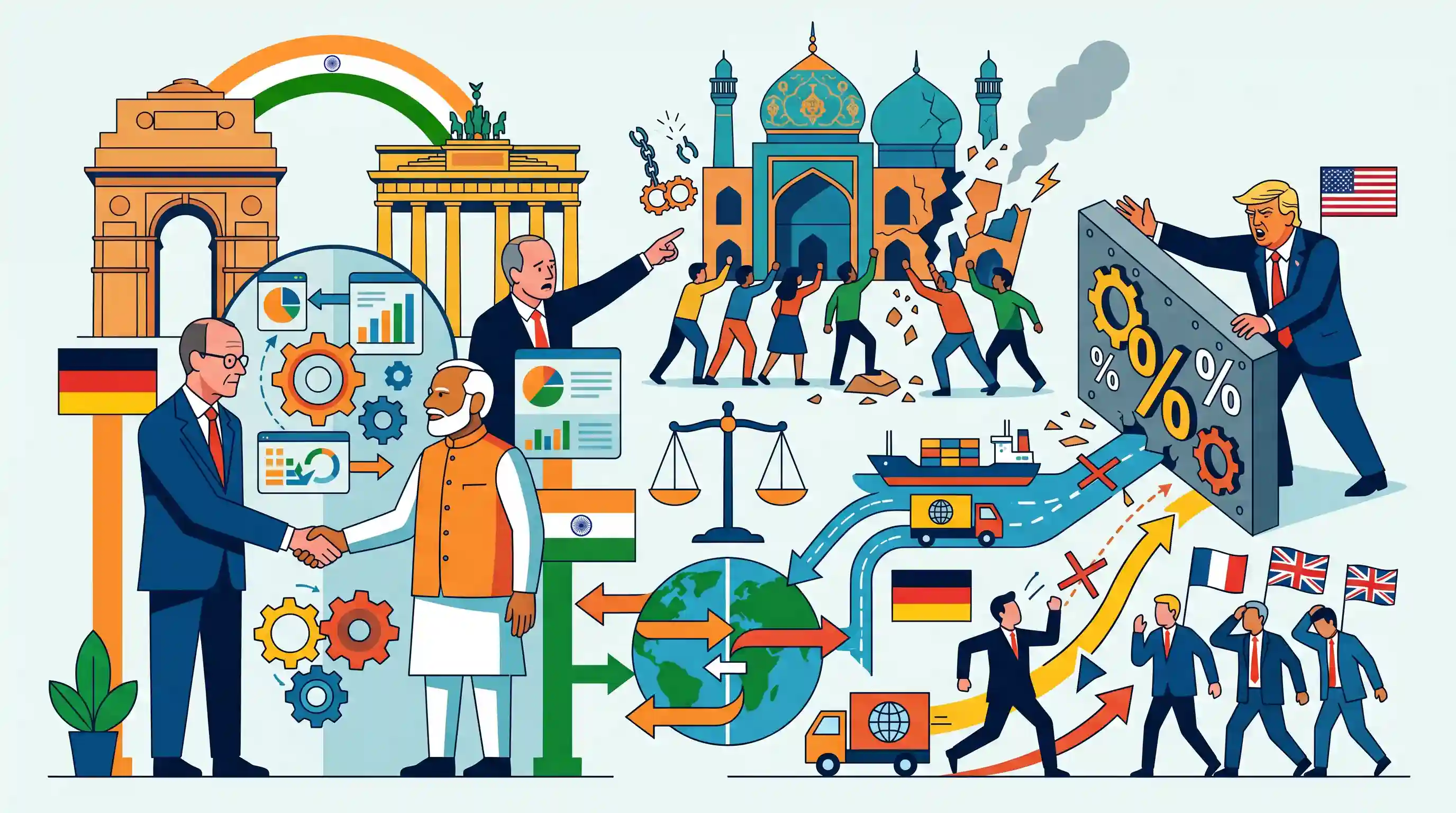
German Chancellor Friedrich Merz has stated that Iran's clerical regime is in its 'final days and weeks' as widespread anti-government protests challenge its legitimacy. Merz, speaking during a visit to India, condemned the regime's reliance on violence to maintain power. Simultaneously, US President Donald Trump has threatened to impose a 25% tariff on any nation trading with Iran, intensifying the geopolitical and economic squeeze on Tehran. This pressure directly affects European nations, notably Germany, which remains Iran's largest trading partner in the EU despite heavily restricted and declining trade volumes.
Key Points
- German Chancellor Friedrich Merz stated that the Iranian leadership is in its 'final days and weeks' due to ongoing anti-regime protests against the clerical establishment.
- Speaking during an India visit, Merz highlighted that the Iranian regime has lost legitimacy and is maintaining power solely through violence.
- US President Donald Trump warned of a 25% tariff on any country that conducts business with Iran, escalating economic pressure.
- Germany, despite declining trade volumes (down 25% in early 2025), remains Iran's most significant trading partner within the European Union.
Important Terms
Theocracy (Clerical Regime)

A system of government where religious leaders exercise political power and state laws are based on religious tenets, specifically the 'Velayat-e Faqih' system in Iran.
UPSC context
GS-II: International Relations/Comparative Politics. Essential for understanding West Asian geopolitics and the domestic legitimacy challenges facing Iran.
Secondary Sanctions
Sanctions that target third-party countries or entities to deter them from trading with a sanctioned nation, often through threats of restricted access to the sanctioning country's market.
UPSC context
GS-II: International Relations. Critically affects India’s energy security, oil imports from Iran, and strategic investments like Chabahar.
Strategic Autonomy
A state's ability to pursue its national interests and foreign policy independently, without being forced into binary alignments by external powers.
UPSC context
GS-II: International Relations. A cornerstone of Indian foreign policy, especially in balancing ties between the US, Russia, and Iran.
Chabahar Port
A strategic deep-sea port in Iran's Sistan-Baluchistan province, developed with Indian assistance to provide a transit route to Afghanistan and Central Asia bypassing Pakistan.
UPSC context
GS-II: IR and Connectivity. Key to India’s 'Connect Central Asia' policy and the International North-South Transport Corridor (INSTC).
European Union (EU)
A supranational political and economic union of 27 member states that maintains a single market and common trade policy, acting as a major global economic bloc.
UPSC context
GS-II: Global Groupings. Relevant for trade negotiations, India-EU Free Trade Agreement (FTA) talks, and collective responses to global sanctions.
Maximum Pressure Policy
A US diplomatic and economic strategy aimed at isolating Iran and compelling it to abandon its nuclear program and regional influence through crippling economic sanctions.
UPSC context
GS-II: International Relations. Explains the escalation of US-Iran tensions and the resultant global economic instability and oil price volatility.
Prelims Trap
Nations trading with Iran are subjected to mandatory UN-backed secondary sanctions.
The 25% tariff threat represents unilateral secondary sanctions by the US. India traditionally only recognizes UN-mandated sanctions, not extraterritorial measures.
Static Concepts Connected
What are secondary sanctions in international relations?
- Definition: Penalties imposed by a country on third-party nations or entities for conducting business with a primary sanctioned nation.
- Mechanism: Often enforced through tariffs, asset freezes, or denying access to the sanctioning country's financial system (e.g., US dollar clearing).
- India's policy: India officially complies only with multilateral UN Security Council sanctions, though practical geopolitics forces navigation of US unilateral sanctions.
What is India's strategic interest in the Chabahar Port?
- Strategic connectivity: Provides a direct sea-land route to Afghanistan and resource-rich Central Asia, bypassing overland transit through Pakistan.
- INSTC integration: Serves as a crucial node for the International North-South Transport Corridor (INSTC) connecting India to Eurasia.
- Regional balancing: Acts as a geopolitical counterbalance to China's Belt and Road Initiative (BRI) presence at the nearby Gwadar port.
Cross-Topic Patterns
US Sanctions & De-dollarisation
Extraterritorial US tariffs compel nations to explore alternative financial architectures, linking Iran sanctions directly to the push for Rupee-Rial trade mechanisms and broader dedollarisation efforts.
Regime Change & Diaspora Strategy
Internal instability in Iran tests India's non-interventionist foreign policy while threatening regional energy supply lines, the Chabahar project, and the safety of the Indian diaspora in West Asia.

Secondary sanctions, Chabahar's operational status, and Rupee-Rial trade mechanisms will likely form a complex Prelims question in 2026.
Linked PYQs · 2
Linked PYQs · 2
- 2018MainsGS2
In what ways would the ongoing US-Iran Nuclear Pact Controversy affect the national interest of India? How should India respond to this situation?
- 2012MainsGS2
How have the US sanctions against Iran affected India's bilateral relations with Iran?
